


Environmental effects of stratospheric ozone depletion, UV radiation, and interactions with climate change: UNEP Environmental Effects Assessment Panel, Update 2021
- PMID: 35191005
- PMCID: PMC8860140
- DOI: 10.1007/s43630-022-00176-5
Environmental effects of stratospheric ozone depletion, UV radiation, and interactions with climate change: UNEP Environmental Effects Assessment Panel, Update 2021
Abstract
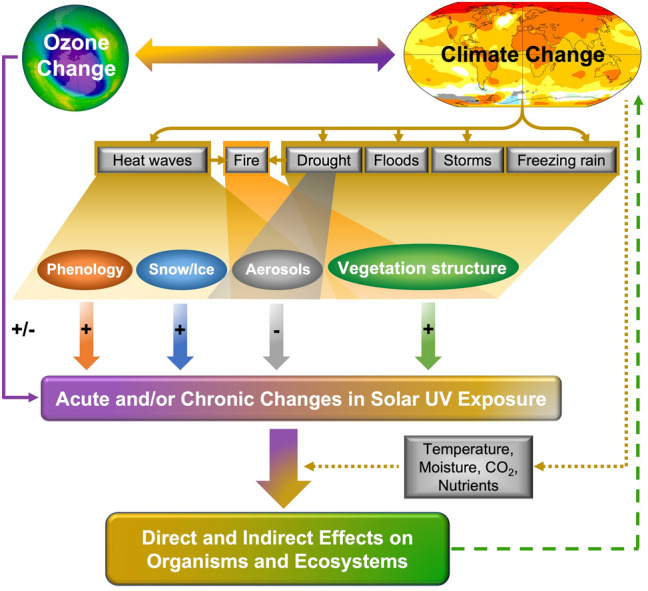
The Environmental Effects Assessment Panel of the Montreal Protocol under the United Nations Environment Programme evaluates effects on the environment and human health that arise from changes in the stratospheric ozone layer and concomitant variations in ultraviolet (UV) radiation at the Earth's surface. The current update is based on scientific advances that have accumulated since our last assessment (Photochem and Photobiol Sci 20(1):1-67, 2021). We also discuss how climate change affects stratospheric ozone depletion and ultraviolet radiation, and how stratospheric ozone depletion affects climate change. The resulting interlinking effects of stratospheric ozone depletion, UV radiation, and climate change are assessed in terms of air quality, carbon sinks, ecosystems, human health, and natural and synthetic materials. We further highlight potential impacts on the biosphere from extreme climate events that are occurring with increasing frequency as a consequence of climate change. These and other interactive effects are examined with respect to the benefits that the Montreal Protocol and its Amendments are providing to life on Earth by controlling the production of various substances that contribute to both stratospheric ozone depletion and climate change.
© 2022. The Author(s).
Conflict of interest statement
The authors have no conflicts of interest.
Figures
References
-
- Neale RE, Barnes PW, Robson TM, Neale PJ, Williamson CE, Zepp RG, Wilson SR, Madronich S, Andrady AL, Heikkilä AM, Bernhard GH, Bais AF, Aucamp PJ, Banaszak AT, Bornman JF, Bruckman LS, Byrne SN, Foereid B, Häder DP, Hollestein LM, Hou WC, Hylander S, Jansen MAK, Klekociuk AR, Liley JB, Longstreth J, Lucas RM, Martinez-Abaigar J, McNeill K, Olsen CM, Pandey KK, Rhodes LE, Robinson SA, Rose KC, Schikowski T, Solomon KR, Sulzberger B, Ukpebor JE, Wang QW, Wängberg SÅ, White CC, Yazar S, Young AR, Young PJ, Zhu L, Zhu M. Environmental effects of stratospheric ozone depletion, UV radiation, and interactions with climate change: UNEP Environmental Effects Assessment Panel, Update 2020. Photochemical and Photobiological Sciences. 2021;20(1):1–67. doi: 10.1007/s43630-020-00001-x. - DOI - PMC - PubMed
-
- Newman P, Nash ER, Kramarova N, Butler A. The 2019 southern stratospheric warming. “State of the Climate in 2019". Bulletin of the American Meteorological Society. 2020;101(8):S297–S298. doi: 10.1175/BAMS-D-20-0090.1. - DOI
-
- Davey SM, Sarre A. Editorial: The 2019/20 black summer bushfires. Australian Forestry. 2020;83(2):47–51. doi: 10.1080/00049158.2020.1769899. - DOI
-
- Lim E-P, Hendon HH, Butler AH, Thompson DWJ, Lawrence Z, Scaife AA, Shepherd TG, Polichtchouk I, Nakamura H, Kobayashi C, Comer R, Coy L, Dowdy A, Garreaud RD, Newman PA, Wang G. The 2019 Southern Hemisphere stratospheric polar vortex weakening and its impacts. Bulletin of the American Meteorological Society. 2021;102(6):E1150–E1171. doi: 10.1175/BAMS-D-20-0112.1. - DOI
-
- Jucker M, Goyal R. Ozone-forced southern annular mode during Antarctic stratospheric warming events. Geophysical Review Letters, In press, 2022 doi: 10.1029/2021GL095270. - DOI
MeSH terms
Substances
LinkOut - more resources
Full Text Sources
Medical
