Observational Study
. 2022 Apr;35(3):769-778.
doi: 10.1007/s40620-022-01257-5. Epub 2022 Feb 21.

Incidence of severe breakthrough SARS-CoV-2 infections in vaccinated kidney transplant and haemodialysis patients

Affiliations
Observational Study

Incidence of severe breakthrough SARS-CoV-2 infections in vaccinated kidney transplant and haemodialysis patients

Diana Rodríguez-Espinosa et al. J Nephrol. 2022 Apr.

Abstract

Introduction: Given the increased COVID-19 observed in kidney transplant recipients (KTRs) and haemodialysis patients, several studies have tried to establish the efficacy of mRNA vaccines in these populations by evaluating their humoral and cellular responses. However, there is currently no information on clinical protection (deaths and hospitalizations), a gap that this study aims to fill.

Methods: Observational prospective study involving 1,336 KTRs and haemodialysis patients from three dialysis units affiliated to Hospital Clínic of Barcelona, Spain, vaccinated with two doses of mRNA-1273 (Moderna) or BNT162b2 (Pfizer-BioNTech) SARS-CoV-2 mRNA vaccines. The outcomes measured were SARS-CoV-2 infection diagnosed by a positive RT-PCR fourteen days after the second vaccine dose, hospital admissions derived from infection, and a severe COVID-19 composite outcome, defined as either ICU admission, invasive and non-invasive mechanical ventilation, or death.

Results: Six per cent (18/302) of patients on haemodialysis were infected, of whom four required hospital admission (1.3%), only one (0.3%) had severe COVID-19, and none of them died. In contrast, 4.3% (44/1034) of KTRs were infected, and presented more hospital admissions (26 patients, 2.5%), severe COVID-19 (11 patients, 1.1%) or death (4 patients, 0.4%). KTRs had a significantly higher risk of hospital admission than HD patients, and this risk increased with age and male sex (HR 3.37 and 4.74, respectively).

Conclusions: The study highlights the need for booster doses in KTRs. In contrast, the haemodialysis population appears to have an adequate clinical response to vaccination, at least up to four months from its administration.

Keywords: COVID-19; Clinical efficacy; Haemodialysis; Kidney transplantation; mRNA SARS-CoV-2 vaccination.


Conflict of interest statement

The authors declare no conflicts of interest.

Figures
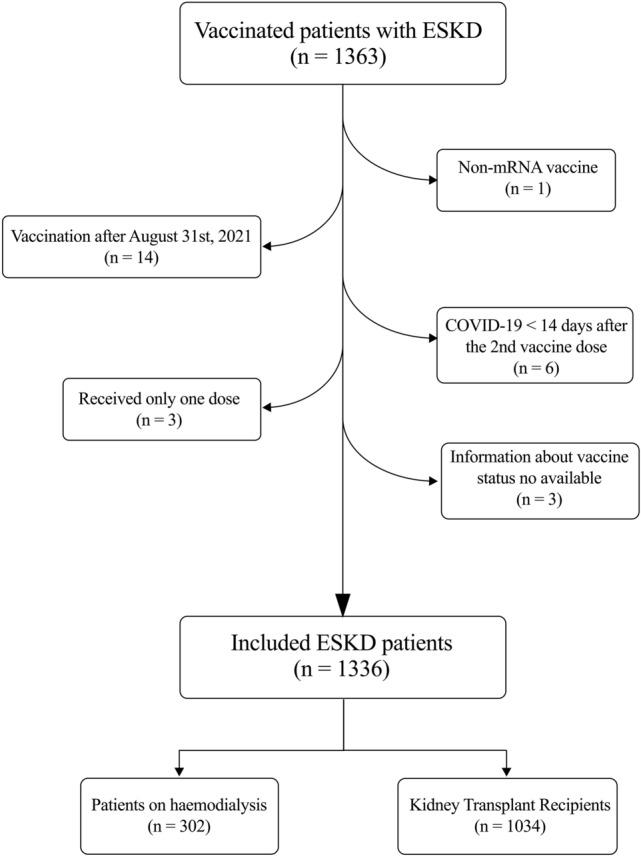
Fig. 1
Fig. 1
Flowchart of the included patients. ESKD, End-Stage Kidney Disease; COVID-19, Coronavirus Disease 2019
Fig. 2
Fig. 2
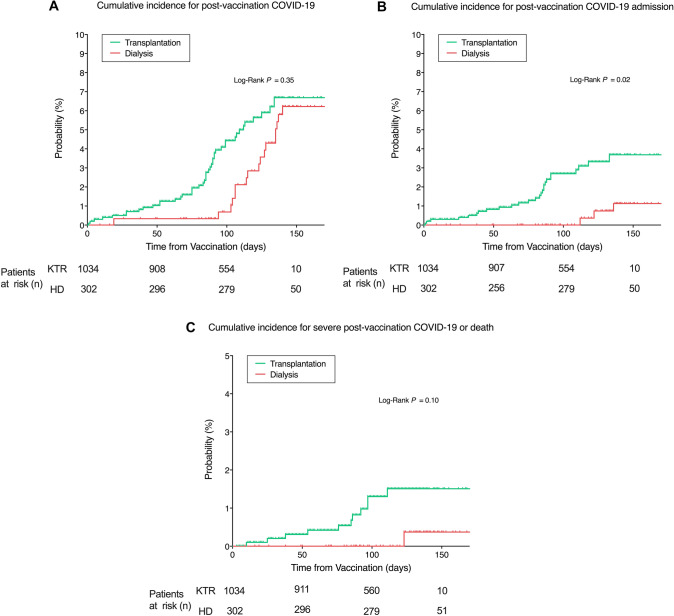
Cumulative incidence of COVID-19 after vaccination (total population). A Cumulative incidence of COVID-19 after vaccination for kidney transplant and dialysis patients. B, Cumulative incidence of hospital admissions for COVID-19 infection in kidney transplant and dialysis patients; C Cumulative incidence of severe COVID-19 or death in vaccinated kidney transplant and dialysis patients. Time is calculated since vaccine protection (+ 14 days after the second dose). KTR, Kidney Transplant Recipients. HD Haemodialysis
Fig. 3
Fig. 3
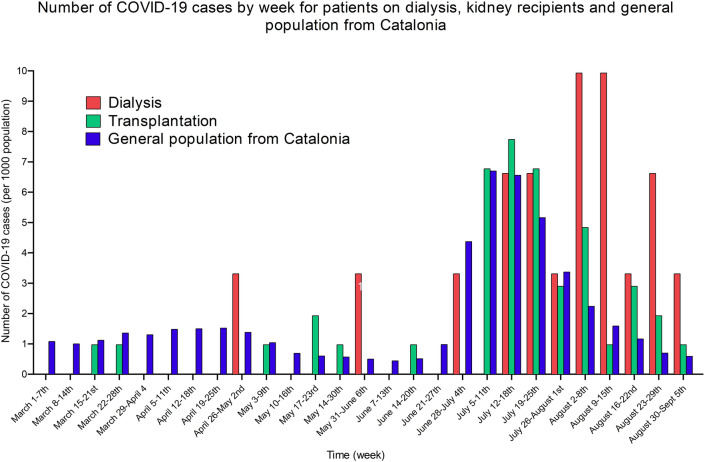
Number of COVID-19 cases by week for patients on dialysis, kidney transplant recipients and general population from Catalonia (per 1000 population)
Fig. 4
Fig. 4
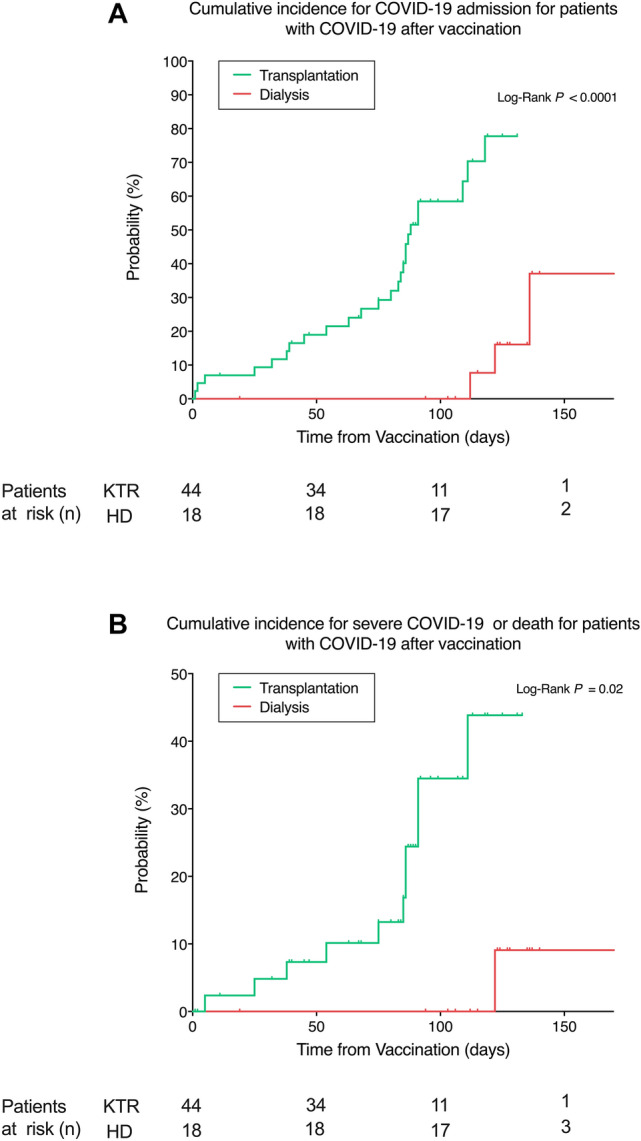
Cumulative incidence for hospital admission and severe COVID-19 (infected population). A Cumulative incidence for COVID-19 admission for kidney transplant and dialysis patients with COVID-19 after vaccination. B Cumulative incidence for severe COVID-19 or death for kidney transplant and dialysis patients after vaccination. Time is calculated since vaccine protection (+ 14 days after the second dose). KTR kidney transplant recipients, HD haemodialysis

References

    1. Gandolfini I, Delsante M, Fiaccadori E, et al. COVID-19 in kidney transplant recipients. Am J Transplant. 2020;20:1941–1943. doi: 10.1111/AJT.15891. - DOI - PMC - PubMed
    1. Broseta JJ, Rodríguez-Espinosa D, Cuadrado E, et al. SARS-CoV-2 infection in a spanish cohort of CKD-5D patients: Prevalence, clinical presentation, outcomes, and de-isolation results. Blood Purif. 2020 doi: 10.1159/000510557. - DOI - PubMed
    1. Montagud-Marrahi E, Cofan F, Torregrosa J-V, et al. Preliminary data on outcomes of SARS-CoV-2 infection in a Spanish single centre cohort of kidney recipients. Am J Transplant Off J Am Soc Transplant Am Soc Transplant Surg. 2020;26:3. doi: 10.1111/ajt.15970. - DOI - PMC - PubMed
    1. Kato S, Chmielewski M, Honda H, et al. Aspects of immune dysfunction in end-stage renal disease. Clin J Am Soc Nephrol. 2008;3:1526–1533. doi: 10.2215/CJN.00950208. - DOI - PMC - PubMed
    1. Eleftheriadis T, Antoniadi G, Liakopoulos V, et al. Disturbances of acquired immunity in haemodialysis patients. Semin Dial. 2007;20:440–451. doi: 10.1111/j.1525-139X.2007.00283.x. - DOI - PubMed

Publication types