. 2022 Feb 22;12(1):21.
doi: 10.1186/s13568-022-01360-7.

A new device-mediated miniprep method

Affiliations

A new device-mediated miniprep method

Baryshev Mikhail et al. AMB Express. .

Abstract

Small-scale plasmid DNA preparation or miniprep is a fundamental technique in estimation cloning experiments and is widely used for DNA methylation analysis in epigenetic research. Current plasmid DNA minipreps use the alkali-SDS-based method in a three-solution format and require spin column-based purification steps. This procedure requires the vortexing or pipetting of pelleted bacteria by centrifugation and manual mixing of the solutions. Here, we describe a centrifuge/mixer-based instrument with the ability to perform centrifugation, vibration, and rotor oscillation in order to perform all steps of plasmid DNA isolation by device only. We found that by applying rotor oscillation-driven mixing of solutions added in the lysis and neutralization steps, homogeneous mixing was achieved within 5 s at a rotor oscillation amplitude of 45° and oscillation frequency of 400 ± 30 rpm, yielding the maximal quantity and quality of plasmid DNA. No increase in host chromosome presence purified by this approach occurs for high-copy-number plasmids compared to manually performed miniprep, and indeed, there is a significant decrease in the presence of the chromosomal fraction in low-copy-number plasmids. The supercoiled form of plasmid DNA purified at a rotor oscillation amplitude of 45° does not turn into an open circular (OC) isoform when the plasmid is stored for 1 year at plus four degrees, in contrast to the plasmid purified with rotor oscillation amplitudes of 270°, 180° and 90°. The programmed time-work-efficient protocol of plasmid miniprep installed in the device gives the extreme simplicity of plasmid minipreps speeding up and facilitating the isolation of plasmid DNAs.

Keywords: Miniprep; Plasmid DNA; Plasmid DNA isolation; Supercoiled plasmid.


Conflict of interest statement

The authors declare that they have no known competing interests.

Figures
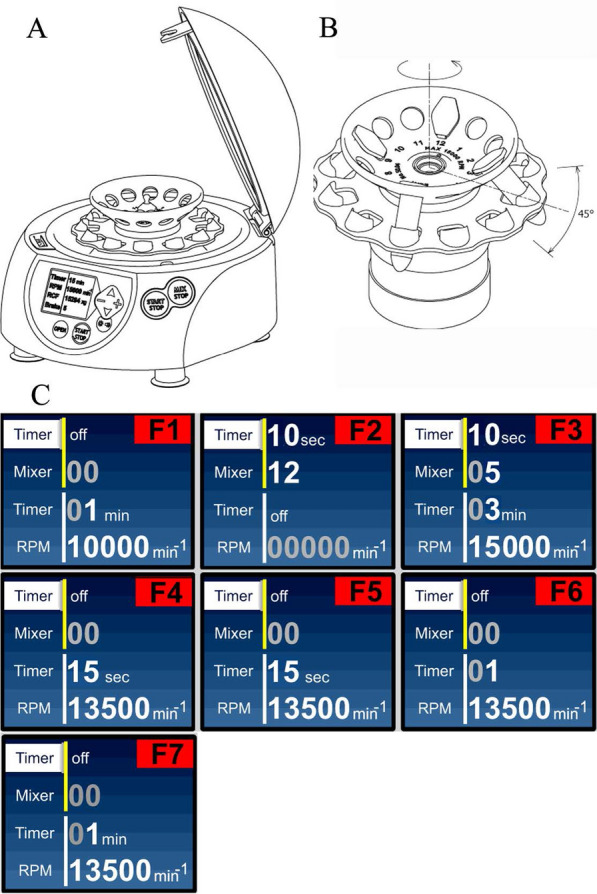
Fig. 1
Fig. 1
Schematic view of a miniprep assisting instrument assembly. A Centrifuge/mixer-based apparatus. B Two-part rotor. C F1-F7—steps of the DM miniprep protocol. Pre-set parameters for each step of device-mediated miniprep showing the different settings of parameters such as time and speed of centrifugation (F1, F3–F7), time and intensity of vibration for pellet resuspension (F2) and oscillation frequency of rotor motion at amplitude 45° for liquid mixing (F3). F3 is a step that combines the mixing of the solution by oscillation of the rotor with an oscillation frequency of 400 rpm (Mixer 5) and an amplitude of 45° for 10 s, after which the device automatically starts centrifugation. Amplitude of 45° for liquid mixing is a constant parameter in the DM miniprep
Fig. 2
Fig. 2
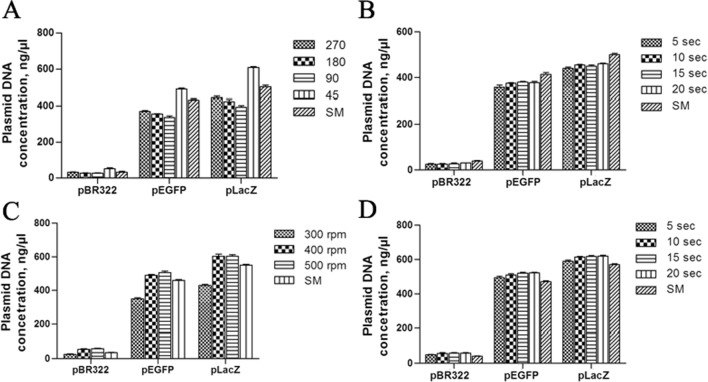
Admixing efficiency of solutions performed by rotor oscillation affects the plasmid DNA yields. A Effect of oscillation amplitude of 5 s of oscillation-driving mixing in DM minipreps at an oscillation frequency of 400 rpm on plasmid yields. B Effect of time oscillation driving mixing in DM minipreps at oscillation amplitude 270° and oscillation frequency 400 rpm on plasmid yields. C Effect of oscillation frequency of 5 s of oscillation driving mixing in DM minipreps at oscillation amplitude 45° on plasmid yields. D Effect of time oscillation driving mixing at oscillation amplitude 45° and oscillation frequency 400 rpm in DM minipreps on plasmid yields. Assays were performed in triplicate, and error bars represent the standard deviation
Fig. 3
Fig. 3
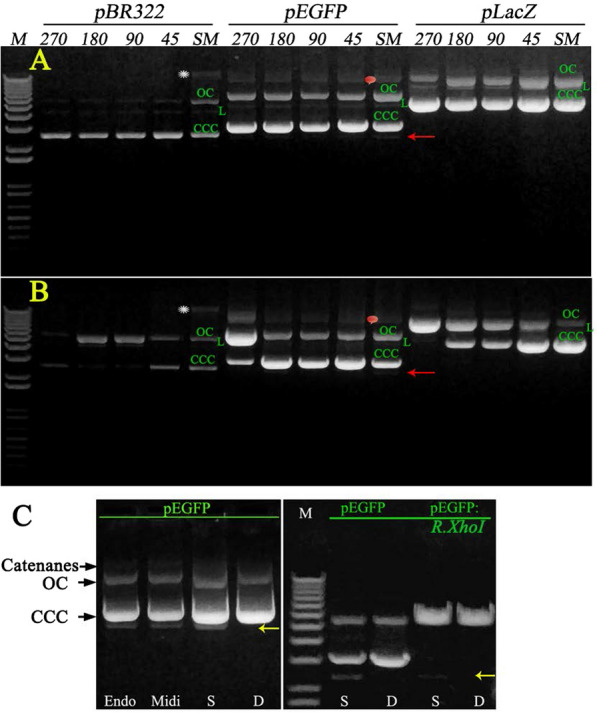
DM minipreps plasmids are purer compared to SM plasmids. A Comparison of DM and SM minipreps plasmid conformational states. DM, SM miniprep plasmids were eluted in 50 µl of elution buffer. 1 µl of the eluted high and 5 µl low copy number plasmid were loaded in the well in a 15 µl total volume. Plasmids were subjected to electrophoresis on 0.8% agarose gel. Migration of CCC, OC and linear (L) forms of plasmid DNA is indicated by the green abbreviation in the corresponding band. The red pictogram shows the migration of catenated forms of pEGFP. The presence of host genomic DNA in SM-isolated pBR322 is depicted by an asterisk. B Comparison of the DNA stability of DM and SM miniprep plasmids after one year of storage at + 4°. DNA sample loading and legend are the same as shown in A. C Comparison of pEGFP of DM (D) and SM (S) minipreps plasmid quality and capability of cleavage by restriction endonuclease in comparison to ZymoPURE-EndoZero Midiprep (Endo) and QIAGEN Midi Kits (Midi) isolated plasmid. 1 µl of pEGFP by SM and DM miniprtepped samples were digested with 1 µl of XhoI at 37 °C for 1 h in 15 µl of the recommended buffer. The plasmid digestion products were loaded into wells and separated by electrophoresis on a 0.8% agarose gel. The 1 kb plus DNA ladder was electrophoresed as a DNA size marker. dCCCDNA is indicated by the arrowhead and is resistant to restriction enzyme digestion
Fig. 4
Fig. 4
DM minipreps plasmids have a lower amount of host genomic DNA. A The amount of host genomic DNA in DM and SM plasmids; lanes 1–4—reference interval of quantities’ DNA for semiquantitative analysis; P, E, L—pBR322, pEGFP, LacZ plasmids purified by DM at oscillation amplitude 45° and 3, 4, 5—300, 400, 500 rpm oscillation frequency; SMP, SME, SML—pBR322, pEGFP, LacZ plasmids purified by SM method. B Densitometry analysis of amplified products is presented. C The amount of host genomic DNA in pEGFP plasmid DNA purified either by SM (S) or DM (D) minipreps and the ZymoPURE-EndoZero (Endo) Midiprep or QIAGEN Midi kit (Midi). D Densitometry analysis of amplified products is presented. Assays were performed in triplicate, and error bars represent the standard deviation
Fig. 5
Fig. 5
DM miniprep plasmids can efficiently be used in DNA quality-sensitive applications. A The transfection efficiency of PC3 prostate cancer cells with the DM (DM) minipreps plasmid was similar to that of the ZymoPURE-EndoZero Midiprep (Endo) and QIAGEN Midi (Midi) Kit-derived results. One of three independent experiments is reported. B pcDNA 3.1/His/LacZ plasmid purified with the DM minipreps method forms GFP-TAT-fusion protein complexes. pcDNA 3.1/His/LacZ plasmid was premixed with various amounts of the GFP-TAT fusion protein as described in methods. Samples were resolved by agarose gel electrophoresis. GFPmodTAT and GFP written on the right correspond to pure proteins.

References

    1. Altschuler M, Heddens DK, Diveley RR, Jr, Kresheck GC. Plasmid DNA isolation utilizing a novel nonionic detergent. Biotechniques. 1994;17:434–436. - PubMed
    1. Baryshev M, Inashkina I, Salmina K, Jackson TR, Erenpreisa J. DNA methylation of the Oct4A enhancers in embryonal carcinoma cells after etoposide treatment is associated with alternative splicing and altered pluripotency in reversibly senescent cells. Cell Cycle. 2018;17(3):362–366. doi: 10.1080/15384101.2018.1426412. - DOI - PMC - PubMed
    1. Baryshev M, Petrov N, Ryabov V, Popov B. Transient expression of inactive RB in mesenchymal stem cells impairs their adipogenic potential and is associated with hypermethylation of the PPARγ2 promoter. Genes Dis. 2022;9(1):165–175. doi: 10.1016/j.gendis.2020.11.001. - DOI - PMC - PubMed
    1. Birnboim HC, Doly J. A rapid alkaline extraction procedure for screening recombinant plasmid DNA. Nucleic Acids Res. 1979;7:1513–1523. doi: 10.1093/nar/7.6.1513. - DOI - PMC - PubMed
    1. Chamsart S, Patel H, Hanak JA, Hitchcock AG, Nienow AW. The impact of fluid-dynamic-generated stresses on chDNA and pDNA stability during alkaline cell lysis for gene therapy products. Biotechnol Bioeng. 2001;75(4):387–392. doi: 10.1002/bit.10046. - DOI - PubMed

LinkOut - more resources