


Does Excess Tissue Sodium Storage Regulate Blood Pressure?
- PMID: 35192140
- PMCID: PMC9142429
- DOI: 10.1007/s11906-022-01180-x
Does Excess Tissue Sodium Storage Regulate Blood Pressure?
Abstract
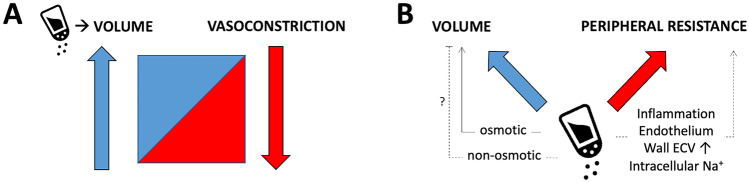
Purpose of review: The regulation of blood pressure is conventionally conceptualised into the product of "circulating blood volume" and "vasoconstriction components". Over the last few years, however, demonstration of tissue sodium storage challenged this dichotomous view.
Recent findings: We review the available evidence pertaining to this phenomenon and the early association made with blood pressure; we discuss open questions regarding its originally proposed hypertonic nature, recently challenged by the suggestion of a systemic, isotonic, water paralleled accumulation that mirrors absolute or relative extracellular volume expansion; we present the established and speculate on the putative implications of this extravascular sodium excess, in either volume-associated or -independent form, on blood pressure regulation; finally, we highlight the prevalence of high tissue sodium in cardiovascular, metabolic and inflammatory conditions other than hypertension. We conclude on approaches to reduce sodium excess and on the potential of emerging imaging technologies in hypertension and other conditions.
Keywords: Blood pressure; Blood vessels; Hypertension; Tissue sodium; Volume.
© 2022. The Author(s).
Conflict of interest statement
Giacomo Rossitto and Christian Delles declare that they have no conflict of interest.
Figures
References
-
- Mary S, Rossitto G, Delles C. Pathophysiology of hypertension. In GYH NSaL, editor. Hypertension (Dallas, Tex : 1979). 3rd ed. Oxford, UK: Oxford University Press. 2021.
-
- Herring NPDJ. Levick’s introduction to cardiovascular physiology. Sixth ed: CRC Press Book. 2018.
Publication types
MeSH terms
Substances
Grants and funding
LinkOut - more resources
Full Text Sources
Medical
Research Materials
