


Selumetinib Plus Adjuvant Radioactive Iodine in Patients With High-Risk Differentiated Thyroid Cancer: A Phase III, Randomized, Placebo-Controlled Trial (ASTRA)
- PMID: 35192411
- PMCID: PMC9851689
- DOI: 10.1200/JCO.21.00714
Selumetinib Plus Adjuvant Radioactive Iodine in Patients With High-Risk Differentiated Thyroid Cancer: A Phase III, Randomized, Placebo-Controlled Trial (ASTRA)
Abstract
Purpose: Selumetinib can increase radioactive iodine (RAI) avidity in RAI-refractory tumors. We investigated whether selumetinib plus adjuvant RAI improves complete remission (CR) rates in patients with differentiated thyroid cancer (DTC) at high risk of primary treatment failure versus RAI alone.
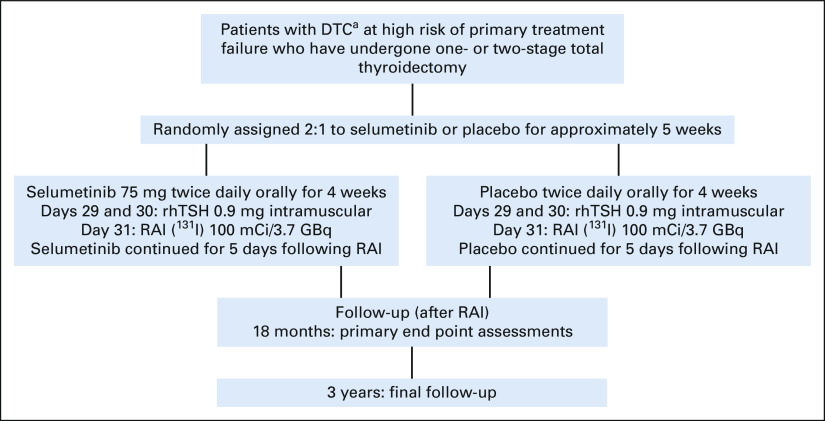
Methods: ASTRA (ClinicalTrials.gov identifier: NCT01843062) is an international, phase III, randomized, placebo-controlled, double-blind trial. Patients with DTC at high risk of primary treatment failure (primary tumor > 4 cm; gross extrathyroidal extension outside the thyroid gland [T4 disease]; or N1a/N1b disease with ≥ 1 metastatic lymph node(s) ≥ 1 cm or ≥ 5 lymph nodes [any size]) were randomly assigned 2:1 to selumetinib 75 mg orally twice daily or placebo for approximately 5 weeks (no stratification). On treatment days 29-31, recombinant human thyroid-stimulating hormone (0.9 mg)-stimulated RAI (131I; 100 mCi/3.7 GBq) was administered, followed by 5 days of selumetinib/placebo. The primary end point (CR rate 18 months after RAI) was assessed in the intention-to-treat population.
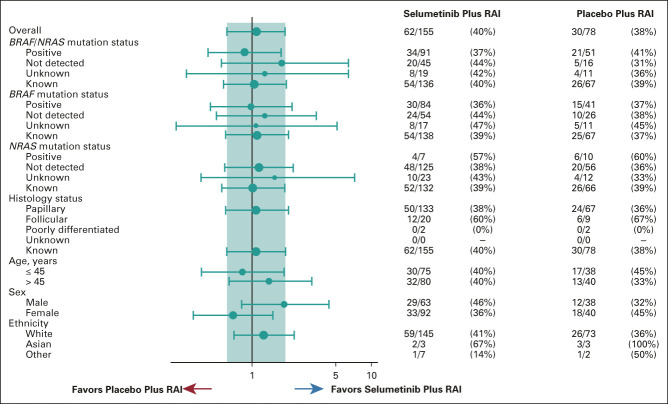
Results: Four hundred patients were enrolled (August 27, 2013-March 23, 2016) and 233 randomly assigned (selumetinib, n = 155 [67%]; placebo, n = 78 [33%]). No statistically significant difference in CR rate 18 months after RAI was observed (selumetinib n = 62 [40%]; placebo n = 30 [38%]; odds ratio 1.07 [95% CI, 0.61 to 1.87]; P = .8205). Treatment-related grade ≥ 3 adverse events were reported in 25/154 patients (16%) with selumetinib and none with placebo. The most common adverse event with selumetinib was dermatitis acneiform (n = 11 [7%]). No treatment-related deaths were reported.
Conclusion: Postoperative pathologic risk stratification identified patients with DTC at high risk of primary treatment failure, although the addition of selumetinib to adjuvant RAI failed to improve the CR rate for these patients. Future strategies should focus on tumor genotype-tailored drug selection and maintaining drug dosing to optimize RAI efficacy.
Conflict of interest statement
Figures
Comment in
-
Mitogen-Activated Protein Kinase Inhibitor Selumetinib Fails to Increase the Complete Response Rate of Radioactive Iodine Alone in High-Risk Differentiated Thyroid Cancer: Lessons From the Phase III ASTRA Study.J Clin Oncol. 2022 Jun 10;40(17):1847-1849. doi: 10.1200/JCO.22.00556. Epub 2022 Apr 29. J Clin Oncol. 2022. PMID: 35486879 Free PMC article. No abstract available.
References
-
- Haugen BR, Alexander EK, Bible KC, et al. : 2015 American Thyroid Association management guidelines for adult patients with thyroid nodules and differentiated thyroid cancer: The American Thyroid Association Guidelines Task Force on thyroid nodules and differentiated thyroid cancer. Thyroid 26:1-133, 2016 - PMC - PubMed
-
- Castagna MG, Maino F, Cipri C, et al. : Delayed risk stratification, to include the response to initial treatment (surgery and radioiodine ablation), has better outcome predictivity in differentiated thyroid cancer patients. Eur J Endocrinol 165:441-446, 2011 - PubMed
-
- Tuttle RM, Tala H, Shah J, et al. : Estimating risk of recurrence in differentiated thyroid cancer after total thyroidectomy and radioactive iodine remnant ablation: Using response to therapy variables to modify the initial risk estimates predicted by the new American Thyroid Association staging system. Thyroid 20:1341-1349, 2010 - PMC - PubMed
-
- Vaisman F, Momesso D, Bulzico DA, et al. : Spontaneous remission in thyroid cancer patients after biochemical incomplete response to initial therapy. Clin Endocrinol (Oxf) 77:132-138, 2012 - PubMed
-
- Cohen Y, Xing M, Mambo E, et al. : BRAF mutation in papillary thyroid carcinoma. J Natl Cancer Inst 95:625-627, 2003 - PubMed
Publication types
MeSH terms
Substances
Associated data
Grants and funding
LinkOut - more resources
Full Text Sources
Medical
