


TikTok and Attention-Deficit/Hyperactivity Disorder: A Cross-Sectional Study of Social Media Content Quality
- PMID: 35196157
- PMCID: PMC9659797
- DOI: 10.1177/07067437221082854
TikTok and Attention-Deficit/Hyperactivity Disorder: A Cross-Sectional Study of Social Media Content Quality
Abstract
Objectives: Social media platforms are increasingly being used to disseminate mental health information online. User-generated content about attention-deficit/hyperactivity disorder (ADHD) is one of the most popular health topics on the video-sharing social media platform TikTok. We sought to investigate the quality of TikTok videos about ADHD.
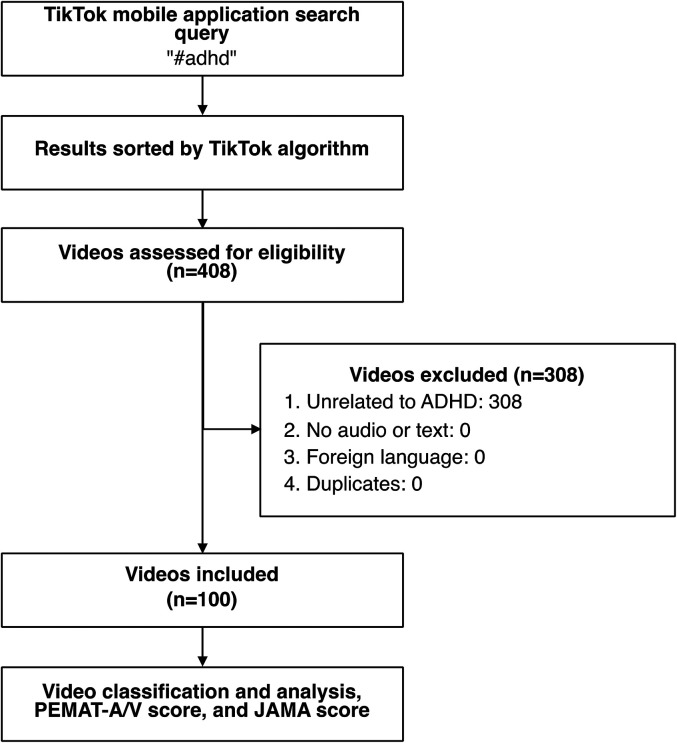
Method: The top 100 most popular videos about ADHD uploaded by TikTok video creators were classified as misleading, useful, or personal experience. Descriptive and quantitative characteristics of the videos were obtained. The Patient Education Materials Assessment Tool for Audiovisual Materials (PEMAT-A/V) and Journal of American Medical Association (JAMA) benchmark criteria were used to assess the overall quality, understandability, and actionability of the videos.
Results: Of the 100 videos meeting inclusion criteria, 52% (n = 52) were classified as misleading, 27% (n = 27) as personal experience, and 21% (n = 21) as useful. Classification agreement between clinician ratings was 86% (kappa statistic of 0.7766). Videos on the platform were highly understandable by viewers but had low actionability. Non-healthcare providers uploaded the majority of misleading videos. Healthcare providers uploaded higher quality and more useful videos, compared to non-healthcare providers.
Conclusions: Approximately half of the analyzed TikTok videos about ADHD were misleading. Clinicians should be aware of the widespread dissemination of health misinformation on social media platforms and its potential impact on clinical care.
Objectifs: Les plateformes des médias sociaux servent de plus en plus à diffuser de l’information sur la santé mentale en ligne. Le contenu créé par les utilisateurs au sujet du trouble de déficit de l’attention avec hyperactivité (TDAH) est un des thèmes de santé les plus populaires sur la plateforme de partage vidéo du média social TikTok. Nous avons cherché à investiguer la qualité des vidéos TikTok en matière de TDAH.
Méthode: Les 100 vidéos les plus populaires sur le TDAH téléchargées par les créateurs de vidéo de TikTok ont été classées comme étant une expérience trompeuse, utile ou personnelle. Les caractéristiques descriptives et quantitatives des vidéos ont été obtenues. L’outil d’évaluation du matériel d’éducation des patients (PEMAT) pour le matériel audio-visuel (AV) et les critères de référence du Journal of American Medical Association (JAMA) ont servi à évaluer la qualité, la compréhensibilité et l’applicabilité générales des vidéos.
Résultats: Sur les 100 vidéos qui satisfaisaient aux critères d’inclusion, 52 % (n = 52) étaient classées trompeuses, 27 % (n = 27) comme une expérience personnelle, et 21 % (n = 21) utiles. La concordance du classement entre les cotes des cliniciens était de 86 % (statistique kappa-de 0.7766). Les vidéos de la plateforme étaient très compréhensibles pour les spectateurs mais avaient une faible applicabilité. Les prestataires autres que de la santé ont téléchargé la majorité des vidéos trompeuses. Les prestataires de soins de santé ont téléchargé des vidéos de plus grande qualité et plus utiles, comparativement aux prestataires autres que de la santé.
Conclusions: Presque la moitié des vidéos TikTok analysées sur le TDAH était trompeuse. Les cliniciens devraient être au courant de la diffusion et de la désinformation répandue en matière de santé sur les plateformes des médias sociaux et de son effet potentiel sur les soins cliniques. l.
Keywords: TikTok; adhd; attention-deficit/hyperactivity disorder; diagnosis; e-mental health; misinformation; public health; social media.
Conflict of interest statement
The author(s) declared the following potential conflicts of interest with respect to the research, authorship, and/or publication of this article: AY is a paid consultant for Winterlight Labs. EN has received funding from the University of Toronto Postgraduate Medical Education Research Award and a Labatt Family Discovery Program research grant. EAJ has received funding from the University of Toronto, Department of Psychiatry Excellence Funds, Centre for Addiction and Mental Health (CAMH) AFP Innovation Funds, and a research operating grant from RIAT (Restoring Invisible and Abandoned Trials).
Figures
References
-
- BBC News. TikTok named as the most downloaded app of 2020. BBC, August 10, 2021. [accessed 2021 Oct 15]. https://www.bbc.com/news/business-58155103.
-
- Clark N. How A.D.H.D. Creators on TikTok Are Spreading Awareness. The New York Times, May 24, 2021. [accessed 2021 June 9]. https://www.nytimes.com/2021/05/24/style/adhd-online-creators-diagnosis.....
-
- Boseley M. TikTok accidentally detected my ADHD. For 23 years everyone missed the warning signs. The Guardian, June 3, 2021. [accessed 2021 Oct 10]. http://www.theguardian.com/commentisfree/2021/jun/04/tiktok-accidentally....
-
- Muse K, McManus F, Leung C, et al. Cyberchondriasis: fact or fiction? A preliminary examination of the relationship between health anxiety and searching for health information on the Internet. J Anxiety Disord. 2012;26(1):189-196. - PubMed
Publication types
MeSH terms
LinkOut - more resources
Full Text Sources
Medical
