


Sexual harassment in secondary school: Prevalence and ambiguities. A mixed methods study in Scottish schools
- PMID: 35196313
- PMCID: PMC8865636
- DOI: 10.1371/journal.pone.0262248
Sexual harassment in secondary school: Prevalence and ambiguities. A mixed methods study in Scottish schools
Abstract
Background: Adolescence is characterized by identity formation, exploration and initiation of intimate relationships. Much of this occurs at school, making schools key sites of sexual harassment. Schools often lack awareness and understanding of the issue, and UK research on the topic is scarce. We explored prevalence and perceptions of sexual harassment in a school-based mixed-methods study of 13-17 year-old Scottish adolescents.
Methods: A student survey (N = 638) assessed past 3-months school-based victimization and perpetration prevalence via 17 behavioral items based on the most commonly used school-based sexual harassment measure ('Hostile Hallways'). Eighteen focus groups (N = 119 students) explored which of 10 behaviors were perceived as harassing/unacceptable and why.
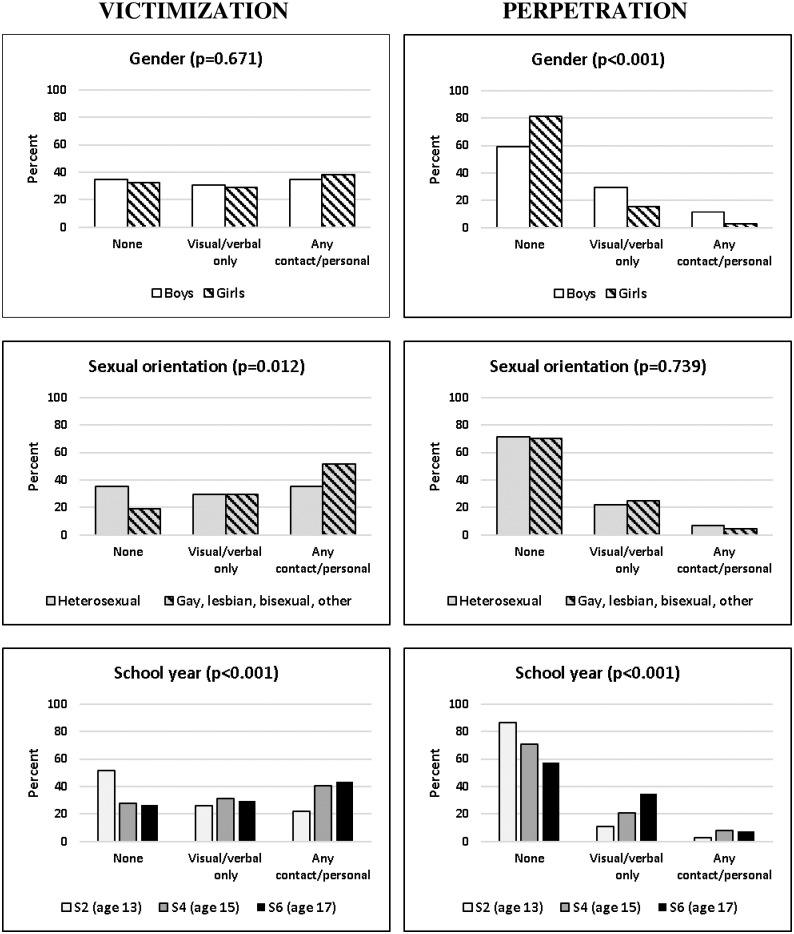
Results: Two-thirds reported any victimization: 64.7% 'visual/verbal' (e.g. sexual jokes) and 34.3% 'contact/personally-invasive' behaviors (e.g. sexual touching; most of whom also reported experiencing visual/verbal types) in the past 3-months. Data suggested a gateway effect, such that contact/personally-invasive behaviors are more likely to be reported by those also reporting more common visual/verbal behaviors. Some survey participants reported being unsure about whether they had experienced certain behaviors; and in focus groups, participants expressed uncertainty regarding the acceptability of most behaviors. Ambiguities centered on behavioral context and enactment including: degree of pressure, persistence and physicality; degree of familiarity between the instigator-recipient; and perception of the instigator's intent. In attempting to resolve ambiguities, students applied normative schemas underpinned by rights (to dignity, respect and equality) and 'knowingness', usually engendered by friendship.
Conclusions: Our study confirms school-based sexual harassment is common but also finds significant nuance in the ways in which students distinguish between acceptable and harassing. School-based strategies to tackle sexual harassment must engage with this complexity.
Conflict of interest statement
The authors have declared that no competing interests exist.
Figures
References
-
- Office for Standards in Education Children’s Services and Skills (Ofsted). Ofsted review into sexual abuse in schools: terms of reference: https://www.gov.uk/government/publications/ofsted-review-of-sexual-abuse (Accessed May 2021); 2021.
-
- Office for Standards in Education Children’s Services and Skills (Ofsted). Review of sexual abuse in schools and colleges: https://www.gov.uk/government/publications/review-of-sexual-abuse-in-sch... (Accessed June 2021); 2021.
-
- House of Commons Women and Equalities Committee. Sexual harassment and sexual violence in schools. London: House of Commons; 2016.
-
- Furman W, Shaffer L. The role of romantic relationships in adolescent development. In: Florsheim P, editor. Adolescent romantic relations and sexual behavior: Theory, research, and practical implications: Lawrence Erlbaum Associates; 2003. p. 3–22.
-
- Keller J, Mendes K, Ringrose J. Speaking ‘unspeakable things’: documenting digital feminist responses to rape culture. Journal of Gender Studies. 2018;27:22–36.
Publication types
MeSH terms
Grants and funding
LinkOut - more resources
Full Text Sources
Miscellaneous
