


Influence of the COVID-19 pandemic on abortions and births in Sweden: a mixed-methods study
- PMID: 35197343
- PMCID: PMC8882666
- DOI: 10.1136/bmjopen-2021-054076
Influence of the COVID-19 pandemic on abortions and births in Sweden: a mixed-methods study
Abstract
Introduction: Although considered an essential service by the WHO, there are indications that access to induced abortion care has been restricted during the COVID-19 pandemic.
Objectives: To investigate if the number of induced abortions and ongoing pregnancies changed during the first pandemic wave of COVID-19 in 2020 compared with recent years prior to the pandemic and explore possible reasons for the findings.
Design: Convergent parallel mixed-methods design. Collection of quantitative data from the Swedish National Board of Health and Welfare and the Swedish Pregnancy Register, and qualitative data from interviews.
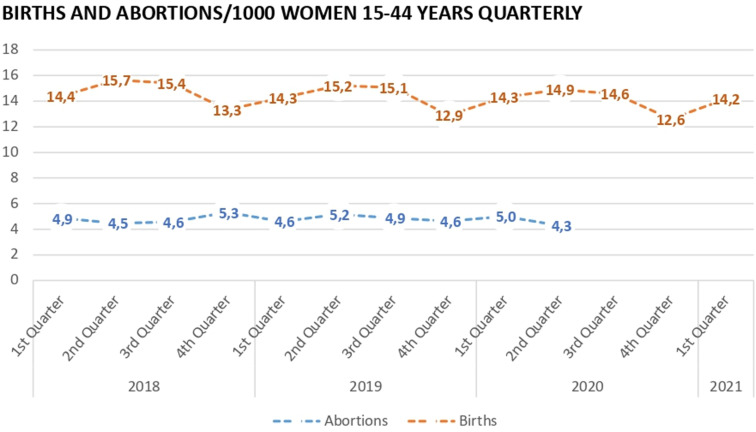
Setting and time period: National data on abortions (January 2018-June 2020) and births (January 2018-March 2021). Interviews performed at the main abortion clinic, Gothenburg, Sweden, in June 2020.
Participants: All women aged 15-44 years living in Sweden 2018-2020, approximately 1.9 million. 15 women who sought abortion were interviewed.
Primary and secondary outcome measures: Number of abortions and births/1000 women aged 15-44 years. Themes and subthemes identified from interviews.
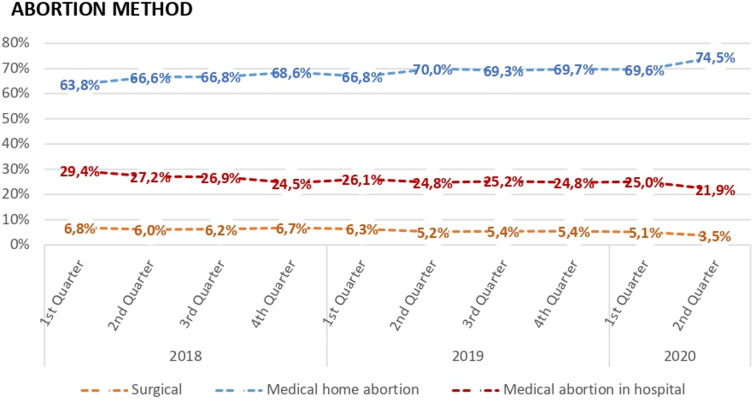
Results: The number of abortions and ongoing pregnancies did not change significantly during the study period compared with before the pandemic started. Interview themes identified were the following: meeting with abortion care during the COVID-19 pandemic (availability, and fear of being infected and infecting others); and the impact of the COVID-19 pandemic on the abortion decision (to catch COVID-19 during pregnancy, feelings of loneliness and isolation, and social aspects).
Conclusions: This study shows that the number of abortions and ongoing pregnancies remained unchanged during the first wave of the COVID-19 pandemic in 2020 in Sweden compared with before the start of the pandemic. Abortion-seeking women did not hesitate to proceed with the abortion. The women expressed a number of fears concerning both availability of care and their health, which could have been properly addressed by the authorities.
Keywords: COVID-19; reproductive medicine; sexual medicine.
© Author(s) (or their employer(s)) 2022. Re-use permitted under CC BY-NC. No commercial re-use. See rights and permissions. Published by BMJ.
Conflict of interest statement
Competing interests: All authors have completed the Unified Competing Interest form at http://icmje.org/disclosure-of-interest/ (available on request from the corresponding author) and declare that HH has received compensation from Gedeon Richter for lectures, JR, TJ-A, IM, ME and VN have no competing interests. For all authors, their spouses, partners or children have no financial interests that may be relevant to the submitted work.
Figures
References
-
- WHO . Health topic - Abortion, 2021. Available: https://www.who.int/health-topics/abortion#tab=tab_1 [Accessed May 2021].
-
- WHO . Regional office for Europe. Health topic - Coronavirus disease (COVID-19) outbreak, 2021. Available: euro.who.int/en/health-topics/health-emergencies/coronavirus-covid-19/no... [Accessed May 2021].
-
- WHO . Maintaining essential health serviced: operational guidance for the COVID-19 context, interim guidance, 2020. Available: WHO/2019-nCoV/essential_health_services/2020.2 [Accessed May 2021].
Publication types
MeSH terms
LinkOut - more resources
Full Text Sources
Medical
