. 2022 Feb 23;5(1):158.
doi: 10.1038/s42003-021-02996-0.

Integration of questionnaire-based risk factors improves polygenic risk scores for human coronary heart disease and type 2 diabetes

Collaborators, Affiliations

Integration of questionnaire-based risk factors improves polygenic risk scores for human coronary heart disease and type 2 diabetes

Max Tamlander et al. Commun Biol. .

Abstract

Large-scale biobank initiatives and commercial repositories store genomic data collected from millions of individuals, and tools to leverage the rapidly growing pool of health and genomic data in disease prevention are needed. Here, we describe the derivation and validation of genomics-enhanced risk tools for two common cardiometabolic diseases, coronary heart disease and type 2 diabetes. Data used for our analyses include the FinnGen study (N = 309,154) and the UK Biobank project (N = 343,672). The risk tools integrate contemporary genome-wide polygenic risk scores with simple questionnaire-based risk factors, including demographic, lifestyle, medication, and comorbidity data, enabling risk calculation across resources where genome data is available. Compared to routinely used clinical risk scores for coronary heart disease and type 2 diabetes prevention, the risk tools show at least equivalent risk discrimination, improved risk reclassification (overall net reclassification improvements ranging from 3.7 [95% CI 2.8-4.6] up to 6.2 [4.6-7.8]), and capacity to be improved even further with standard lipid and blood pressure measurements. Without the need for blood tests or evaluation by a health professional, the risk tools provide a powerful yet simple method for preliminary cardiometabolic risk assessment for individuals with genome data available.


Conflict of interest statement

The authors declare no competing interests.

Figures
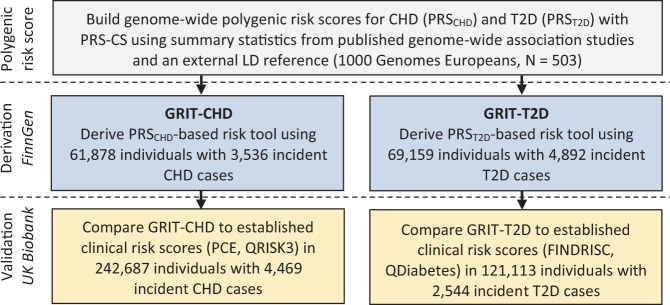
Fig. 1
Fig. 1. Derivation and validation of Genomics-enhanced RIsk Tools (GRIT) for CHD and T2D.
Genome-wide PRSs for CHD and T2D were derived using the algorithm PRS-CS by obtaining weights from GWAS summary statistics from two large GWASs that do not overlap with UK Biobank. We derived two risk tools to estimate 10-year risk of incident disease, GRIT-CHD and GRIT-T2D, which integrate PRSs and simple, easily surveyable risk factors. We then assessed discrimination, reclassification, calibration, and risk stratification of the risk tools in the UK Biobank and compared their performance to established clinical risk scores (Pooled Cohort Equations and QRISK3 for CHD, FINDRISC and QDiabetes for T2D). The derivation and validation of the baseline, GRIT-CHD+, and GRIT-T2D+ scores were analogous.
Fig. 2
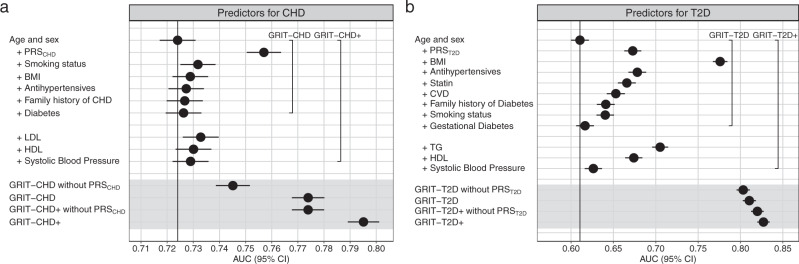
Fig. 2. AUC for combinations of age, sex, and individual risk factors and the GRIT scores in UK Biobank.
Panel a shows results for CHD (N = 242,687 participants) and panel b for T2D (N = 121,113). The AUC was first calculated for age and sex and additionally for each individual risk factor integrated with age and sex. Lastly, the AUC was calculated for the GRIT scores and the GRIT scores without PRSs. Points indicate AUC estimates and error bars represent the 95% CIs for each factor with incident disease as endpoint. BMI body mass index, LDL low-density lipoprotein, HDL high-density lipoprotein, TG triglycerides, CVD cardiovascular disease.
Fig. 3
Fig. 3. AUC for combinations of age, sex, and individual risk factors and the GRIT scores in UK Biobank stratified by sex and age.
Panel a shows results for CHD and panel b for T2D. The AUC was first calculated for age and sex and additionally for each individual risk factor integrated with age and sex. Lastly, the AUC was calculated for the GRIT scores and the GRIT scores without PRSs. Points indicate AUC estimates and error bars represent the 95% CIs for each factor with incident disease as endpoint. The CHD analysis sample sizes were 105,439 (men), 137,248 (women), 101,508 (age < 55), and 141,179 (age ≥ 55). The T2D analysis sample sizes were 55,898 (men), 65,215 (women), 46,238 (age < 55), and 74,875 (age ≥ 55). BMI body mass index, LDL low-density lipoprotein, HDL high-density lipoprotein, TG triglycerides, CVD cardiovascular disease.
Fig. 4
Fig. 4. AUC for the GRIT scores compared with the clinical risk scores in UK Biobank.
Panel a shows results for CHD (N = 242,687 participants) and panel b for T2D (N = 121,113). The sex-specific baseline models include age and PRS, and additionally BMI for the T2D model. Our sex-specific Genomics-enhanced RIsk Tools (GRIT-CHD and GRIT-T2D) were compared to established clinical risk scores (Pooled Cohort Equations and QRISK3 for CHD, FINDRISC and QDiabetes for T2D). Points indicate AUC estimates and error bars represent the 95% CIs for each factor with incident disease as endpoint. All tests were two-sided. PCE Pooled Cohort Equations.

References

    1. Denny JC, Collins FS. Precision medicine in 2030—seven ways to transform healthcare. Cell. 2021;184:1415–1419. doi: 10.1016/j.cell.2021.01.015. - DOI - PMC - PubMed
    1. Lewis CM, Vassos E. Polygenic risk scores: from research tools to clinical instruments. Genome Med. 2020;12:44. doi: 10.1186/s13073-020-00742-5. - DOI - PMC - PubMed
    1. Torkamani A, Wineinger NE, Topol EJ. The personal and clinical utility of polygenic risk scores. Nat. Rev. Genet. 2018;19:581–590. doi: 10.1038/s41576-018-0018-x. - DOI - PubMed
    1. Mars N, et al. Polygenic and clinical risk scores and their impact on age at onset and prediction of cardiometabolic diseases and common cancers. Nat. Med. 2020;26:549–557. doi: 10.1038/s41591-020-0800-0. - DOI - PubMed
    1. Khera AV, et al. Genome-wide polygenic scores for common diseases identify individuals with risk equivalent to monogenic mutations. Nat. Genet. 2018;50:1219–1224. doi: 10.1038/s41588-018-0183-z. - DOI - PMC - PubMed

Publication types

MeSH terms