


Brain and Spinal Cord Adaptations Associated With Patellofemoral Pain: A Systematic Review and Meta-Analysis
- PMID: 35197832
- PMCID: PMC8859985
- DOI: 10.3389/fnint.2022.791719
Brain and Spinal Cord Adaptations Associated With Patellofemoral Pain: A Systematic Review and Meta-Analysis
Abstract
Objective: To evaluate the evidence for altered cortical and spinal cord functions in individuals with patellofemoral pain (PFP).
Methods: We conducted a comprehensive search of databases to appraise and analyze the studies published prior to December 10, 2021 that examined spinal reflex excitability measured using Hoffmann reflex (H-reflex) amplitudes, corticospinal excitability measured using transcranial magnetic stimulation (TMS)-elicited motor evoked potential (MEP) amplitudes, motor threshold (MT), or stimulus-response (SR) curves, cortical reorganization assessed using TMS cortical mapping or structural magnetic resonance imaging (MRI), or functional changes of the brain assessed using functional MRI (fMRI) in individuals with PFP.
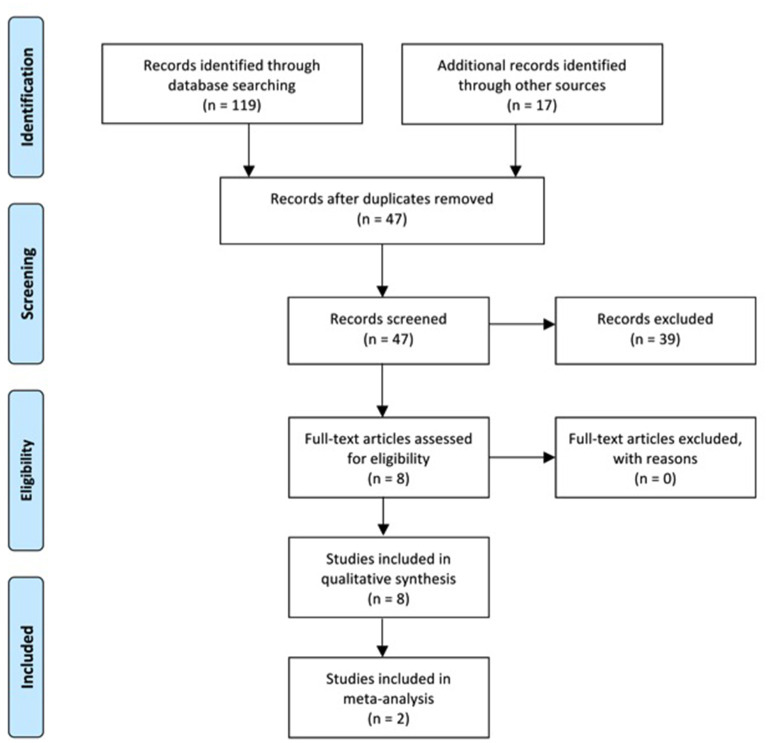
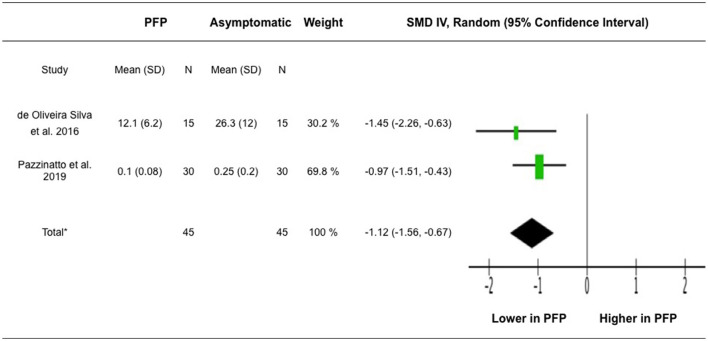
Results: Eight studies were eligible for analyses. While an earlier study showed that pain had no effect on the H-reflex amplitude of the quadriceps muscle, more recent evidence reported a decrease in vastus medialis (VM) H-reflex amplitude in participants with PFP. VM H-reflex amplitude was correlated with pain, chronicity, physical function, and isometric knee extensor torque production in participants with PFP. Altered corticospinal excitability was reported in participants with PFP, observed as increased MT in the VM and vastus lateralis (VL) muscles. In addition, cortical reorganization has been observed, where decreased number of cortical peaks, shifts and reduced volumes, and increased overlap of motor cortex representations for the VM, VL, and rectus femoris (RF) muscles were reported in participants with PFP.
Conclusion: There is emerging evidence on altered cortical and spinal cord functions in individuals with PFP, however, solid conclusions cannot be drawn due to limited literature available. Further research is needed to better understand the adaptations of the brain and spinal cord in this population.
Systematic review registration: https://www.crd.york.ac.uk/prospero/, identifier: CRD42020212128.
Keywords: H-reflex; brain; cortical reorganization; corticospinal excitability; neurophysiological adaptation; patellofemoral pain; spinal cord.
Copyright © 2022 Ho, Liang, Budge, Madriaga, Meske and Nguyenton.
Conflict of interest statement
The authors declare that the research was conducted in the absence of any commercial or financial relationships that could be construed as a potential conflict of interest.
Figures
References
-
- Collins N. J., Barton C. J., Van Middelkoop M., Callaghan M. J., Rathleff M. S., Vicenzino B. T., et al. . (2018). 2018 Consensus statement on exercise therapy and physical interventions (orthoses, taping and manual therapy) to treat patellofemoral pain: recommendations from the 5th International Patellofemoral Pain Research Retreat, Gold Coast, Australia, 2017. Br. J. Sports Med. 52, 1170–1178. 10.1136/bjsports-2018-099397 - DOI - PubMed
-
- Crossley K. M., Stefanik J. J., Selfe J., Collins N. J., Davis I. S., Powers C. M., et al. . (2016). 2016 Patellofemoral pain consensus statement from the 4th International Patellofemoral Pain Research Retreat, Manchester. Part 1: Terminology, definitions, clinical examination, natural history, patellofemoral osteoarthritis and patient-reported outcome measures. Br. J. Sports Med. 50, 839–843. 10.1136/bjsports-2016-096384 - DOI - PMC - PubMed
Publication types
LinkOut - more resources
Full Text Sources
Research Materials
