


Global, regional, and national burdens of common micronutrient deficiencies from 1990 to 2019: A secondary trend analysis based on the Global Burden of Disease 2019 study
- PMID: 35198923
- PMCID: PMC8850322
- DOI: 10.1016/j.eclinm.2022.101299
Global, regional, and national burdens of common micronutrient deficiencies from 1990 to 2019: A secondary trend analysis based on the Global Burden of Disease 2019 study
Abstract
Background: Understanding micronutrient deficiency burdens and trends can help guide effective intervention strategies. This study aims to elucidate trends in common micronutrient deficiencies, in particular, dietary iron, iodine and vitamin A deficiencies, from 1990 to 2019 using Global Burden of Disease (GBD) 2019 study data.
Methods: We analyzed data from the GBD 2019 study to calculate the prevalence, incidence, and disability-adjusted life year (DALY) rates of micronutrient deficiencies in geographic populations worldwide from 1990 to 2019. The estimated annual percentage changes (EAPCs) and age-standardized rates were calculated to evaluate the temporal trends.
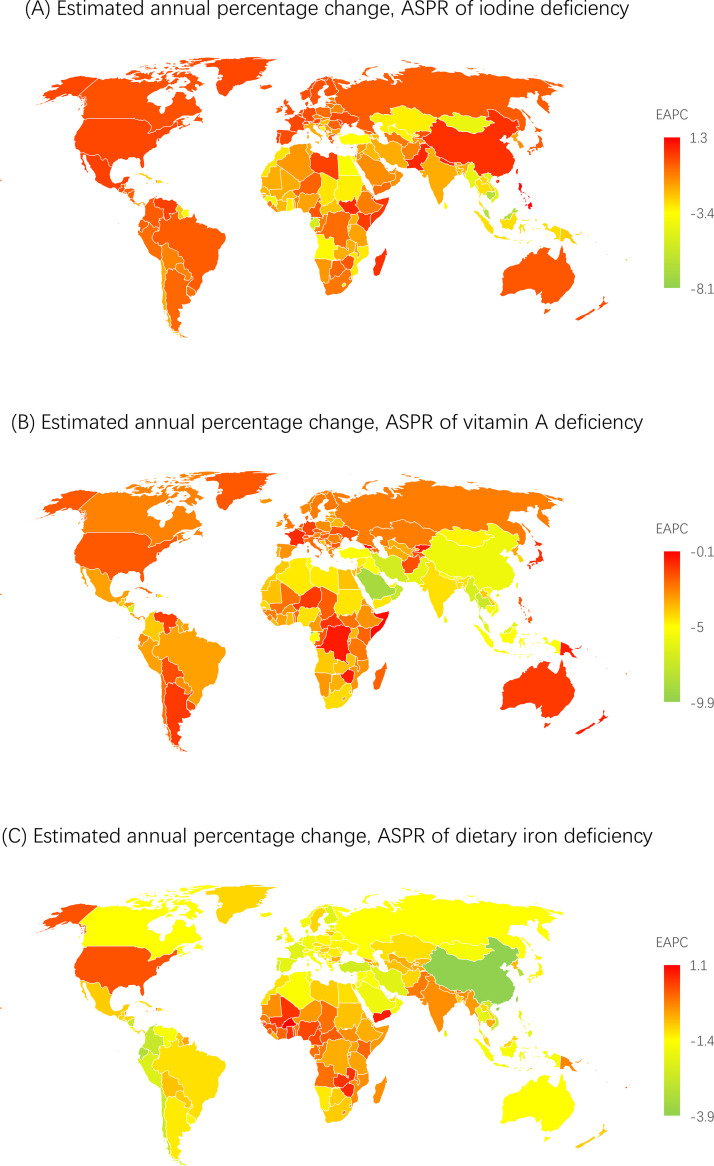
Findings: Globally, the age-standardized prevalence rates of iodine deficiency, vitamin A deficiency, and dietary iron deficiency decreased, with EAPCs of -0.690 (95% CI, -0.842 to -0.538), -3.15 (95% CI, -3.20 to -3.02), and -0.546 (95% CI, -0.585 to -0.507) between 1999 and 2019, respectively. Regarding the sociodemographic index (SDI), the highest age-standardized prevalence, incidence, and DALY rates of micronutrient deficiency were found in low-SDI countries in 2019. There were linear associations between the SDI and the healthcare access and quality (HAQ) index and age-standardized prevalence, incidence, and DALY rates.
Interpretation: Global micronutrient deficiency burdens have decreased since 1990. The potential burden of iodine deficiency in some developed countries is worthy of attention. The results of this study could guide policy makers in implementing cost-effective interventions to reduce micronutrient deficiency burdens, particularly in low-SDI and low-HAQ index countries.
Funding: This work was supported by the National Natural Science Foundation of China (Grant No. 82000753) and the China Postdoctoral Science Foundation (Grant No. 2021MD703910).
© 2022 The Author(s).
Conflict of interest statement
No potential conflicts of interest relevant to this article were reported.
Figures



References
-
- HLPE Nutrition and food systems. A report by the High Level Panel of Experts on Food Security and Nutrition of the Committee on World Food Security; Rome; 2017.
-
- Development Initiatives; Bristol, UK: 2020. Global Nutrition Report: Action on equity to end malnutrition.
-
- McLean E, Cogswell M, Egli I, Wojdyla D, de Benoist B. Worldwide prevalence of anaemia, WHO Vitamin and Mineral Nutrition Information System, 1993-2005. Public Health Nutr. 2009;12:444–454. - PubMed
-
- Dallman PR. Iron deficiency and the immune response. Am J Clin Nutr. 1987;46:329–334. - PubMed
LinkOut - more resources
Full Text Sources
