


Impact of poverty and family adversity on adolescent health: a multi-trajectory analysis using the UK Millennium Cohort Study
- PMID: 35199082
- PMCID: PMC8841277
- DOI: 10.1016/j.lanepe.2021.100279
Impact of poverty and family adversity on adolescent health: a multi-trajectory analysis using the UK Millennium Cohort Study
Abstract
Background: Children exposed to poverty and family adversities including domestic violence, parental mental ill health and parental alcohol misuse may experience poor outcomes across the life course. However, the complex interrelationships between these exposures in childhood are unclear. We therefore assessed the clustering of trajectories of household poverty and family adversities and their impacts on adolescent health outcomes.
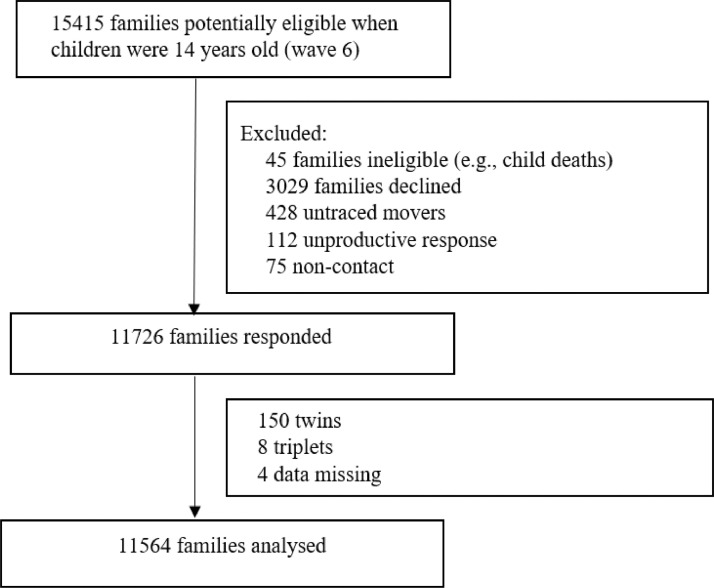
Methods: We used longitudinal data from the UK Millennium Cohort study on 11564 children followed to age 14 years. Family adversities included parent reported domestic violence and abuse, poor mental health and frequent alcohol use. We used a group-based multi-trajectory cluster model to identify trajectories of poverty and family adversity for children. We assessed associations of these trajectories with child physical, mental and behavioural outcomes at age 14 years using multivariable logistic regression, adjusting for confounders.
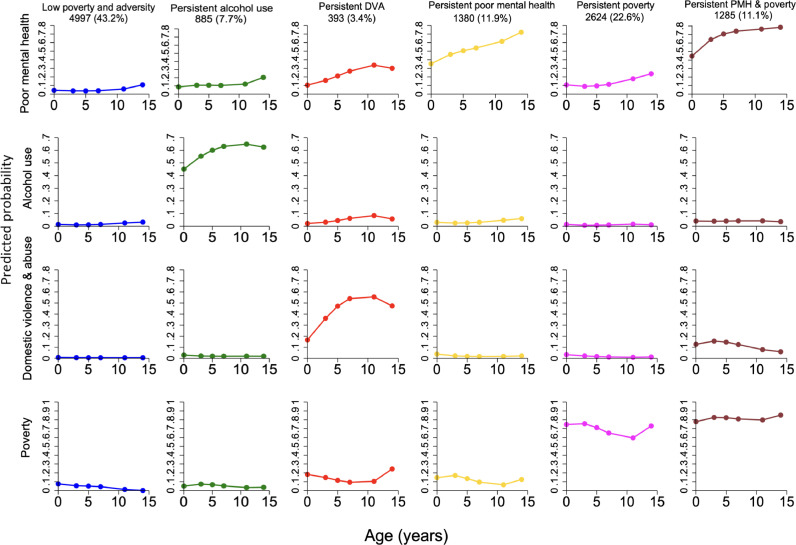
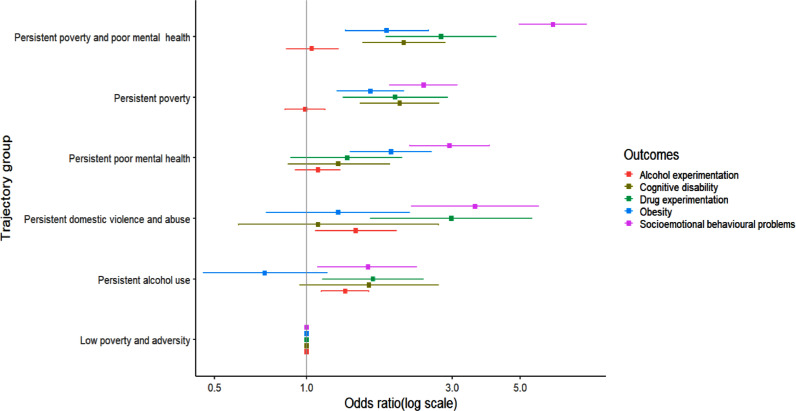
Findings: Six trajectories were identified: low poverty and family adversity (43·2%), persistent parental alcohol use (7·7%), persistent domestic violence and abuse (3·4%), persistent poor parental mental health (11·9%), persistent poverty (22·6%) and persistent poverty and poor parental mental health (11·1%). Compared with children exposed to low poverty and adversity, children in the persistent adversity trajectory groups experienced worse outcomes; those exposed to persistent poor parental mental health and poverty were particularly at increased risk of socioemotional behavioural problems (adjusted odds ratio 6·4; 95% CI 5·0 - 8·3), cognitive disability (aOR 2·1; CI 1·5 - 2·8), drug experimentation (aOR 2·8; CI 1·8 - 4·2) and obesity (aOR 1·8; CI 1·3 - 2·5).
Interpretation: In a contemporary UK cohort, persistent poverty and/or persistent poor parental mental health affects over four in ten children. The combination of both affects one in ten children and is strongly associated with adverse child outcomes, particularly poor child mental health.
Funding: The National Institute for Health Research (NIHR) Policy Research Programme, NIHR Applied Research Collaboration South London (ARC South London) at King's College Hospital NHS Foundation Trust and the Medical Research Council (MRC).
Keywords: child health; child poverty; cohort; family adversity; multi-trajectory analysis.
© 2021 The Author(s).
Conflict of interest statement
This work was funded by the National Institute for Health Research (NIHR) Policy Research Programme (ORACLE: OveRcoming Adverse ChiLdhood Experiences, Grant reference number NIHR200717); and the National Institute for Health Research (NIHR) Applied Research Collaboration South London (NIHR ARC South London) at King's College Hospital NHS Foundation Trust. DTR is supported by the NIHR School for Public Health Research, the NIHR Public Health Policy Research and by the Medical Research Council (MRC) on a Clinician Scientist Fellowship (MR/P008577/1). VSS is supported by the Swedish Research Council for Health, Working Life and Welfare (FORTE) [2016-07148; 2020-00274]. DKS is supported by the FORTE [2020-00274] and the NIHR Public Health Policy Research Unit. Professors Kaner and Howard are supported by NIHR Senior Investigator awards and Prof Kaner is Director of the NIHR Applied Research Collaboration for the North East and North Cumbria. The views expressed in this publication are those of the authors and not necessarily those of the NIHR, MRC or FORTE. All authors declare no competing interests.
Figures
References
-
- Children's Commissioner. Estimating the prevalence of the ‘toxic trio’. 2019. https://www.childrenscommissioner.gov.uk/wp-content/uploads/2018/07/Vuln... (accessed January 1, 2021 ).
-
- Department for EducationThe Stationery Office; London: 2018. Working together to safeguard children: A guide to inter-agency working to safeguard and promote the welfare of children.
-
- U.S. Department of Health & Human Services, Administration for Children and Families, Administration on Children, Youth and Families, Children's Bureau. Child Maltreatment 2018.https://www.acf.hhs.gov/sites/default/files/documents/cb/cm2018.pdf (accessed April 1, 2021).
-
- Cleaver H, Unell I, Aldgate J. Children's needs–parenting capacity. Child abuse: Parental mental illness, learning disability, substance misuse and domestic violence London:TSO2011.
Grants and funding
LinkOut - more resources
Full Text Sources
