Review
. 2022 Feb 5;9(2):64.
doi: 10.3390/bioengineering9020064.

N-Acetylglucosamine Sensing and Metabolic Engineering for Attenuating Human and Plant Pathogens

Affiliations
Review

N-Acetylglucosamine Sensing and Metabolic Engineering for Attenuating Human and Plant Pathogens

Sekhu Ansari et al. Bioengineering (Basel). .

Abstract

During evolution, both human and plant pathogens have evolved to utilize a diverse range of carbon sources. N-acetylglucosamine (GlcNAc), an amino sugar, is one of the major carbon sources utilized by several human and phytopathogens. GlcNAc regulates the expression of many virulence genes of pathogens. In fact, GlcNAc catabolism is also involved in the regulation of virulence and pathogenesis of various human pathogens, including Candida albicans, Vibrio cholerae, Leishmania donovani, Mycobacterium, and phytopathogens such as Magnaporthe oryzae. Moreover, GlcNAc is also a well-known structural component of many bacterial and fungal pathogen cell walls, suggesting its possible role in cell signaling. Over the last few decades, many studies have been performed to study GlcNAc sensing, signaling, and metabolism to better understand the GlcNAc roles in pathogenesis in order to identify new drug targets. In this review, we provide recent insights into GlcNAc-mediated cell signaling and pathogenesis. Further, we describe how the GlcNAc metabolic pathway can be targeted to reduce the pathogens' virulence in order to control the disease prevalence and crop productivity.

Keywords: DAC1; HXK1; N-Acetylglucosamine; NAG1; NGT1; chitin; colonization; pathogens; plant immunity; virulence.


Conflict of interest statement

The authors declare that they have no known competing financial interests or personal relationships that could influence the work reported in this paper.

Figures
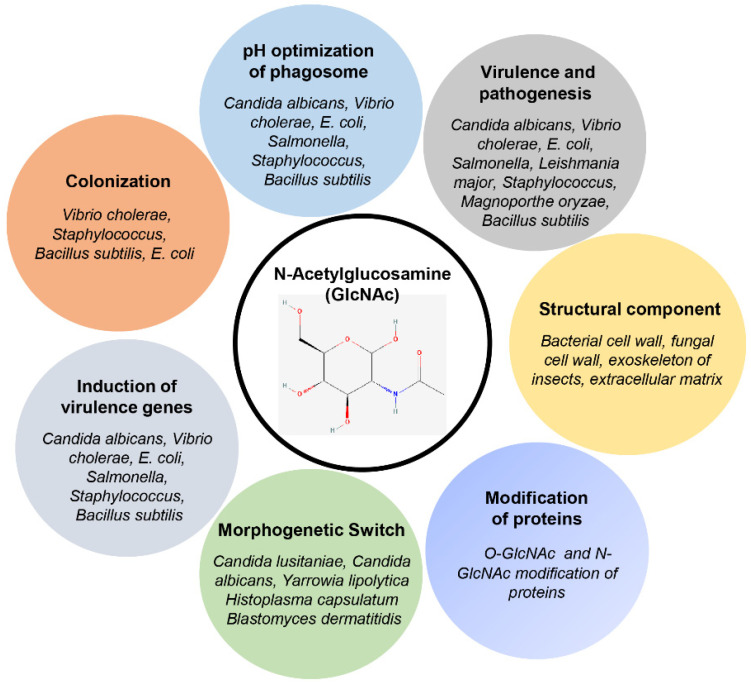
Figure 1
Figure 1
Diverse roles of GlcNAc. The GlcNAc plays a key role in pathogenesis and provides a survival advantage to the pathogens in the host. The chemical structure of GlcNAc (PubChem CID 439174) retrieved on 19 January 2022 from https://pubchem.ncbi.nlm.nih.gov/compound/N-Acetyl-D-Glucosamine.
Figure 2
Figure 2
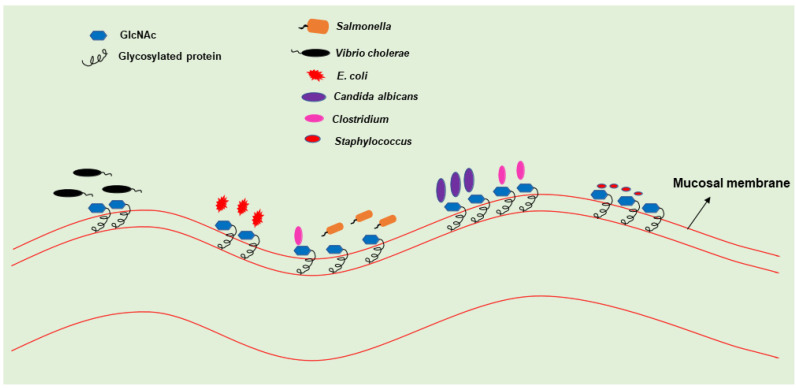
Pathogen infection at mucosal membrane: Mucous membrane is rich in glycosylated proteins. Several pathogens such as Candida albicans, E. coli, Salmonella spp., Vibrio cholerae, etc., exploit GlcNAc released from glycoproteins at the mucosal membrane.
Figure 3
Figure 3
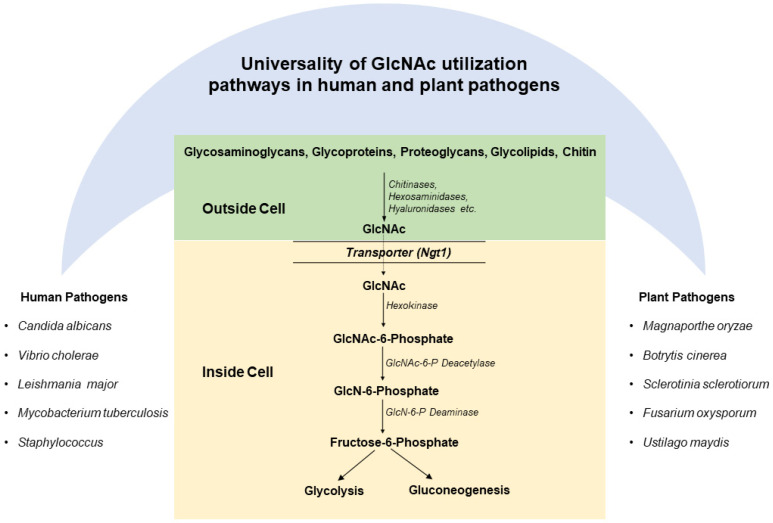
GlcNAc catabolic pathway: glycosaminoglycans, glycoproteins, proteoglycans, glycolipids, and chitin are the major sources of GlcNAc. Enzymes such as chitinases, hexosaminidases, hyaluronidases, etc., release free-GlcNAc from these macromolecules, which are taken up by the pathogens. The GlcNAc catabolic pathway involves three enzymes: hexokinase, GlcNAc-6-P deacetylase, and GlcNAc-6-P deaminase, which act sequentially to convert GlcNAc into fructose-6-phosphate.
Figure 4
Figure 4
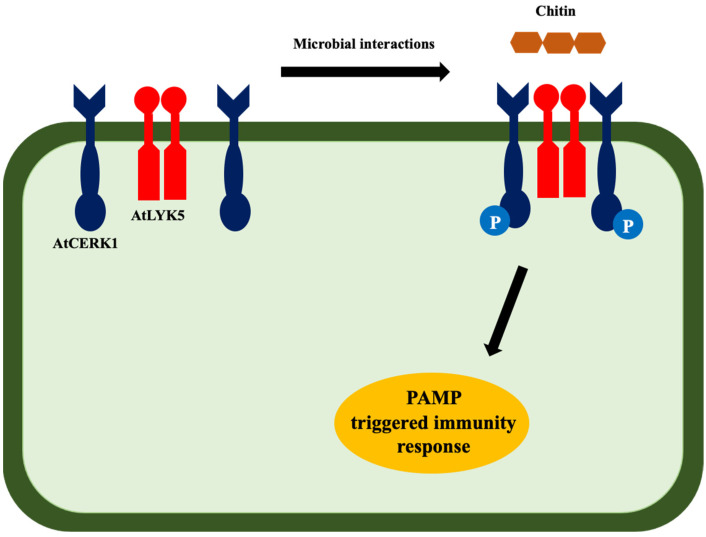
Chitin-triggered immunity in plants. Microbe-derived chitin activates the formation of tetramer [AtCERK1(AtLYK5)2 AtCERK1] that phosphorylates the AtCERK1 at the same time. This phosphorylation activates the PAMP-triggered immunity in plants [78].

Similar articles

Cited by

References

    1. Ansari S., Bhatt D.N., Sood C., Datta A. Functional Characterization of the LdNAGD Gene in Leishmania Donovani. Microbiol. Res. 2021;251:126830. doi: 10.1016/j.micres.2021.126830. - DOI - PubMed
    1. Naderer T., Heng J., McConville M.J. Evidence That Intracellular Stages of Leishmania Major Utilize Amino Sugars as a Major Carbon Source. PLoS Pathog. 2010;6:e1001245. doi: 10.1371/journal.ppat.1001245. - DOI - PMC - PubMed
    1. Horta M.F., Mendes B.P., Roma E.H., Noronha F.S.M., Macêdo J.P., Oliveira L.S., Duarte M.M., Vieira L.Q. Reactive Oxygen Species and Nitric Oxide in Cutaneous Leishmaniasis. J. Parasitol. Res. 2012;2012:1–11. doi: 10.1155/2012/203818. - DOI - PMC - PubMed
    1. Ghosh S., Rao K.H., Sengupta M., Bhattacharya S.K., Datta A. Two Gene Clusters Co-Ordinate for a Functional N-Acetylglucosamine Catabolic Pathway in Vibrio Cholerae: New Insights into GlcNAc Catabolism of Vibrio Cholerae. Mol. Microbiol. 2011;80:1549–1560. doi: 10.1111/j.1365-2958.2011.07664.x. - DOI - PubMed
    1. Swiatek M.A., Tenconi E., Rigali S., van Wezel G.P. Functional Analysis of the N-Acetylglucosamine Metabolic Genes of Streptomyces Coelicolor and Role in Control of Development and Antibiotic Production. J. Bacteriol. 2012;194:1136–1144. doi: 10.1128/JB.06370-11. - DOI - PMC - PubMed

LinkOut - more resources