


Feasibility, Acceptability, and Clinical Significance of a Dyadic, Web-Based, Psychosocial and Physical Activity Self-Management Program (TEMPO) Tailored to the Needs of Men with Prostate Cancer and Their Caregivers: A Multi-Center Randomized Pilot Trial
- PMID: 35200566
- PMCID: PMC8871005
- DOI: 10.3390/curroncol29020067
Feasibility, Acceptability, and Clinical Significance of a Dyadic, Web-Based, Psychosocial and Physical Activity Self-Management Program (TEMPO) Tailored to the Needs of Men with Prostate Cancer and Their Caregivers: A Multi-Center Randomized Pilot Trial
Abstract
Background: Prostate cancer is the most common cancer diagnosis among men. Family caregivers (often female spouses) play a key role in ensuring patients' needs are met, frequently assuming their role with no formal training, which can contribute to a high burden. The purpose of this study was to pilot TEMPO-the first dyadic, Tailored, wEb-based, psychosocial and physical activity self-Management PrOgram for men with prostate cancer and their caregivers.
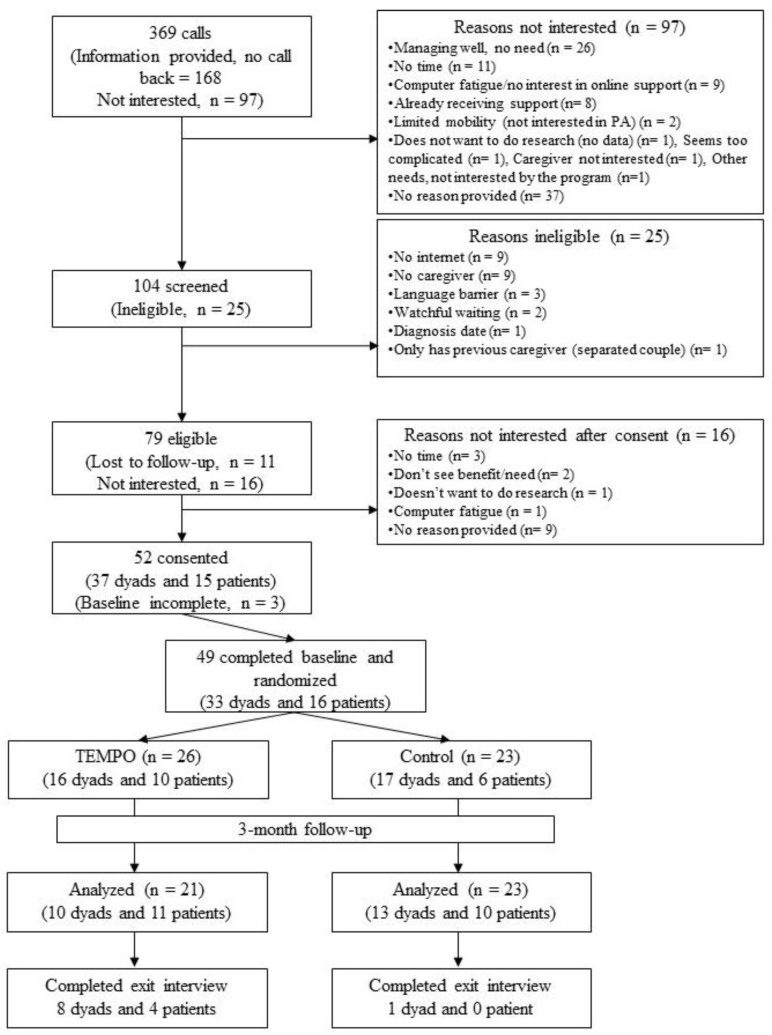
Methods: 49 men with prostate cancer and their caregivers were randomized to TEMPO or usual care. Baseline and follow-up questionnaires were completed to assess feasibility, acceptability, and clinical significance. A priori benchmarks for these outcomes were set. Thirteen exit interviews were conducted to further explore acceptability.
Results: Feasibility benchmarks were met with the exception for recruitment with on average 6.1 dyads recruited/month (benchmark: 8 dyads/month). Benchmarks of acceptability focused on attrition (<25%) and system usability, which were met. Using the strict criteria for adherence of 100% of the module viewed and participants spending at least 15 min on the module, 45% of participants were adherent. The clinical significance on anxiety and quality of life was supported for caregivers, and mostly supported for the men with prostate cancer.
Conclusion: This pilot trial was successful, with minor modifications needed prior to a large trial.
Keywords: behavior change; caregivers; dyadic interventions; dyads; e-Health interventions; physical activity; pilot study; prostate cancer; psychosocial needs; self-management.
Conflict of interest statement
The authors declare no conflict of interest. The funders had no role in the design, execution, interpretation, or writing of the study.
Figures
References
-
- Canadian Cancer Society’s Advisory Committee on Cancer Statistics . Canadian Cancer Statistics 2016. Canadian Cancer Society; Toronto, ON, Canada: 2016.
-
- Msaouel P., Gralla R.J., Jones R.A., Hollen P.J. Key issues affecting quality of life and patient-reported outcomes in prostate cancer: An analysis conducted in 2128 patients with initial psychometric assessment of the prostate cancer symptom scale (PCSS) BMJ Support. Palliat. Care. 2017;7:308–315. doi: 10.1136/bmjspcare-2016-001146. - DOI - PMC - PubMed
-
- Regan T.W., Lambert S.D., Kelly B., McElduff P., Girgis A., Kayser K., Turner J. Cross-sectional relationships between dyadic coping and anxiety, depression, and relationship satisfaction for patients with prostate cancer and their spouses. Patient Educ. Couns. 2014;96:120–127. doi: 10.1016/j.pec.2014.04.010. - DOI - PubMed
Publication types
MeSH terms
Substances
Grants and funding
LinkOut - more resources
Full Text Sources
Medical
Miscellaneous
