


Effect of Quality of Caregiver-Adolescent Relationship on Sexual Debut, Transactional Sex, and on Age-Disparate Relationships Among Young Women in Rural South Africa Enrolled in HPTN 068
- PMID: 35202045
- PMCID: PMC8887792
- DOI: 10.1097/QAI.0000000000002890
Effect of Quality of Caregiver-Adolescent Relationship on Sexual Debut, Transactional Sex, and on Age-Disparate Relationships Among Young Women in Rural South Africa Enrolled in HPTN 068
Abstract
Background: Adolescent girls and young women (AGYW) remain burdened by the HIV epidemic. Positive caregiver-child relationships are associated with safe sexual behaviors in young people; yet, this literature often highlights the role of parent-child communication and parental monitoring, neglecting the importance of emotional relationships between a caregiver and adolescent.
Setting: We used longitudinal data from HIV Prevention Trial Network 068-conducted among 2533 AGYW (13-20 years) over a period of 5 years in Agincourt, South Africa.
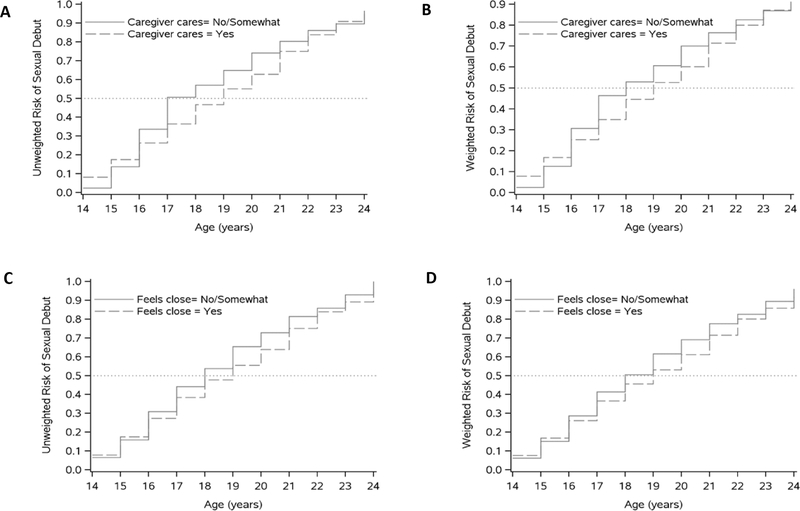
Method: Kaplan-Meier and Cox models were used to estimate the effect of quality of caregiver-adolescent relationships (caring and closeness) on sexual debut, and log-binomial models with generalized estimating equations were used to examine the relationship between our exposures and transactional sex and age-disparate relationships.
Results: Sexual debut was delayed among those who reported high levels of caregiver caring [hazard ratio: 0.80, 95% confidence interval (CI): 0.69 to 0.93] and caregiver closeness (hazard ratio: 0.80, 95% CI: 0.68 to 0.95). AGYW who reported high quality caregiver-adolescent relationships had a lower risk of transactional sex [caring: risk ratio (RR): 0.67, 95% CI: 0.58 to 0.78; closeness: RR: 0.58; 95% CI: 0.50 to 0.67]. Similarly, those with high-quality caregiver-adolescent relationships were less likely to be in an age-disparate relationship (caring: RR: 0.68, 95% CI: 0.58 to 0.79; closeness: RR: 0.77, 95% CI: 0.66 to 0.90).
Conclusions: Findings indicate high-quality caregiver-adolescent relationships are associated with delayed sexual debut, a lower risk of transactional sex, and having an older partner. Family-centered interventions are needed to improve relationships between AGYW and caregivers.
Copyright © 2021 Wolters Kluwer Health, Inc. All rights reserved.
Conflict of interest statement
The authors have no conflicts of interest to disclose.
Figures
References
-
- Biglan A et al. Social and behavioral factors associated with high-risk sexual behavior among adolescents. J. Behav. Med 13, 245–261 (1990). - PubMed
-
- Bouris A et al. A Systematic Review of Parental Influences on the Health and Well-Being of Lesbian, Gay, and Bisexual Youth: Time for a New Public Health Research and Practice Agenda. J. Prim. Prev 31, 273–309 (2010). - PubMed
-
- Li X, Stanton B & Feigelman S Impact of perceived parental monitoring on adolescent risk behavior over 4 years. J. Adolesc. Health 27, 49–56 (2000). - PubMed
Publication types
MeSH terms
Grants and funding
LinkOut - more resources
Full Text Sources
Medical
