Review
. 2022 Jan 18;8(1):10.
doi: 10.3390/ncrna8010010.

A Structural View of miRNA Biogenesis and Function

Affiliations
Review

A Structural View of miRNA Biogenesis and Function

Ana Lúcia Leitão et al. Noncoding RNA. .

Abstract

Micro-RNAs (miRNAs) are a class of non-coding RNAs (ncRNAs) that act as post-transcriptional regulators of gene expression. Since their discovery in 1993, they have been the subject of deep study due to their involvement in many important biological processes. Compared with other ncRNAs, miRNAs are generated from devoted transcriptional units which are processed by a specific set of endonucleases. The contribution of structural biology methods for understanding miRNA biogenesis and function has been essential for the dissection of their roles in cell biology and human disease. In this review, we summarize the application of structural biology for the characterization of the molecular players involved in miRNA biogenesis (processors and effectors), starting from the X-ray crystallography methods to the more recent cryo-electron microscopy protocols.

Keywords: Argonaute; DGCR8; Dicer; Drosha; Exportin-5; RISC; X-ray crystallography; biogenesis; cryo-electron microscopy; microRNA; nuclease; structural biology.


Conflict of interest statement

The authors declare no conflict of interest.

Figures
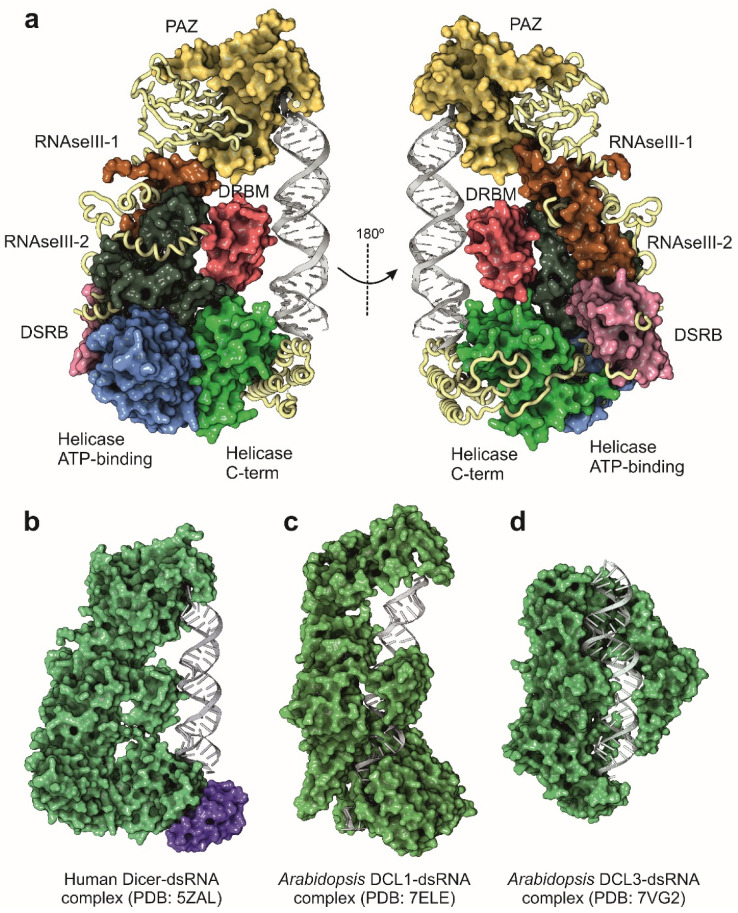
Figure 3
Figure 3
Structure of Dicer and Dicer-like proteins determined by cryo-EM. (a) Functional domains of human Dicer protein. (b) Structure of human Dicer in complex with the TRBP protein, a component of the RISC complex (magenta surface) and the pre-let-7 [51]. (c) Structure of the Dicer-like protein 1 (DCL1) from A. thaliana in complex with the pre-miR-166f [71]. (d) Structure of the Dicer-like protein 3 (DCL3) from A. thaliana in complex with a synthetic 40 mer dsRNA [72]. All the structures were rendered and represented with Protein Imager software [39].
Figure 4
Figure 4
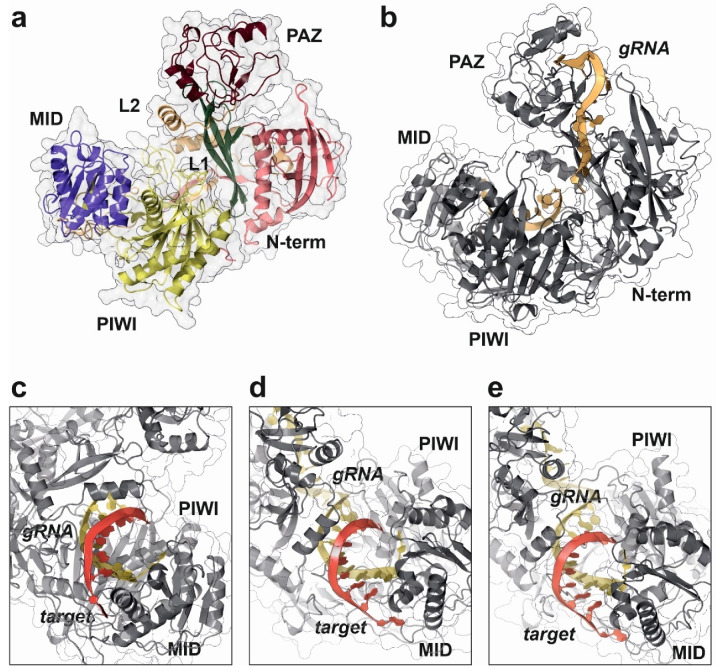
Structural details of human AGO2 protein complex with a synthetic guide RNA (gRNA) and cognate targets with different pairing specificities, as determined by X-ray crystallography experiments. This work proposed the “walking model” for target recognition and engagement by AGO2 driven by the dynamic base pairing of the miRNA seed sequence [109]. (a) Domain distribution in human AGO2 structure (PDB code: 7KI3). (b) Surface representation of human AGO2 in complex to a synthetic gRNA (yellow ribbon), showing the characteristic open pocket that accommodates the dsRNA hybrid during target recognition (PDB code: 4W5N). (c) Detailed view of the RNA-binding pocket in human AGO2, showing the target-guide dsRNA hybrid with a 2–7 seed pairing (PDB code: 4W5T). (d) Human AGO2 targeting dsRNA complex with a 2–8 seed pairing (PDB code: 4W5Q). (e) Human AGO2 structure complex with an RNA guide and a 2–9 seed pairing target (PDB code: 4W5O). All the figure panels were prepared with the Protein Imager software [39].
Figure 1
Figure 1
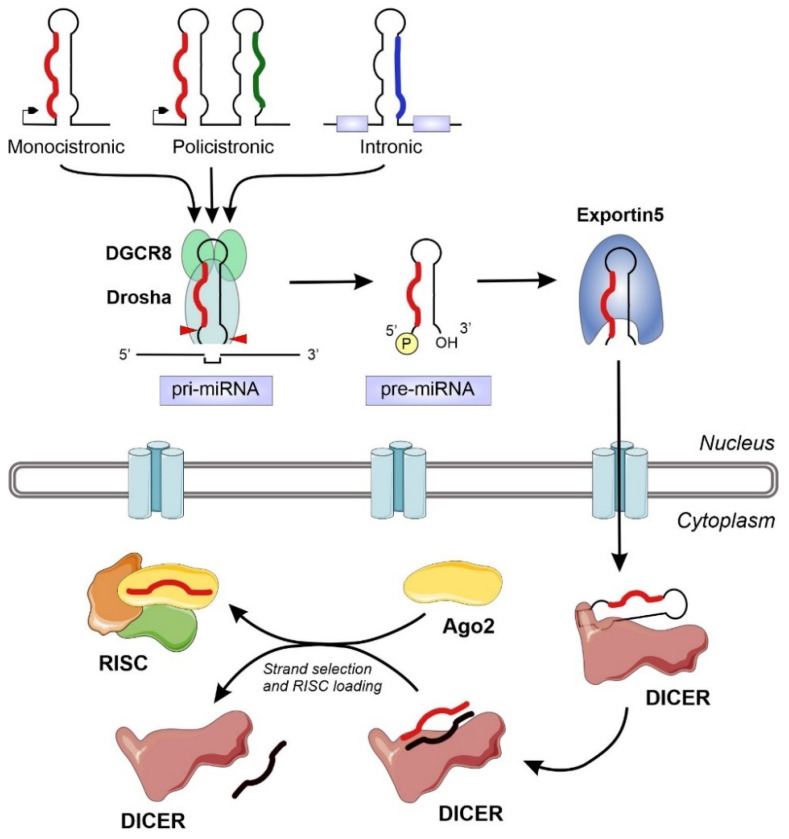
Schematic representation of the miRNA biogenesis pathway, including all the relevant enzymes and cellular compartments involved. The eukaryotic genomes contain transcriptional units that will generate miRNAs. These information units, that appear isolated or clustered, can be located in several genomic territories, including intergenic regions, coding and non-coding genes. After transcription, the typical hairpin-loop secondary structure present in primary miRNAs (pri-miRNAs) is recognized and excised by the microprocessor complex (composed by DGCR8 and Drosha). The generated precursor miRNAs (pre-miRNAs) will be exported to the cytoplasm and further processed by the Dicer nuclease to generate a dsRNA. The mature miRNA chain will be selected by Ago2 and engaged together into the RNA-induced silencing complex (RISC) to exert its regulatory action.
Figure 2
Figure 2
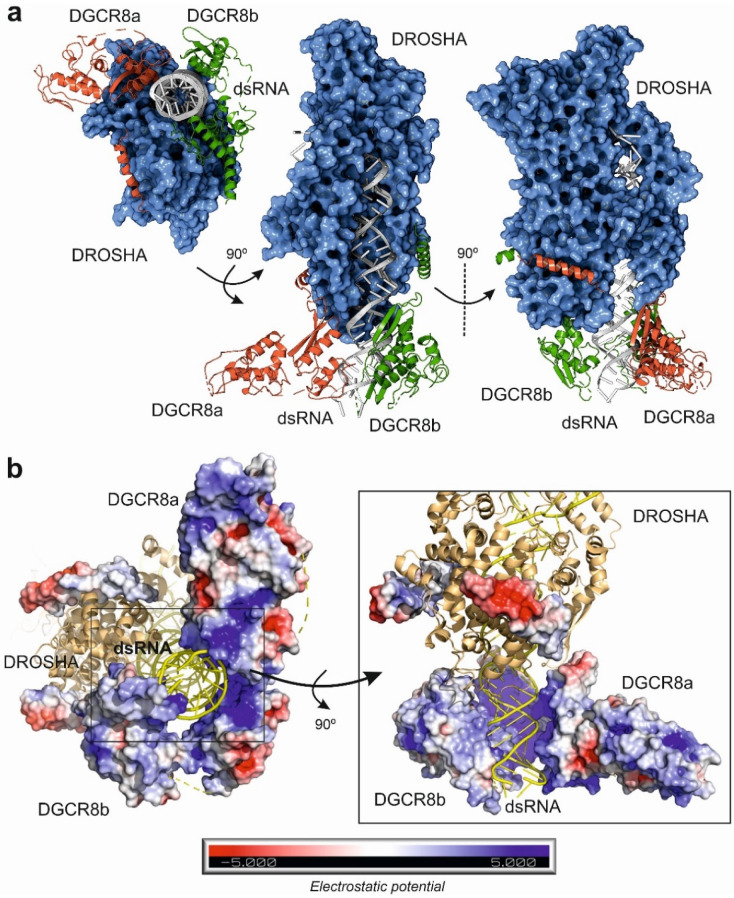
Different views of the human microprocessor complex structure composed by the Drosha endonuclease, two monomers of DGCR8 protein (a and b) and a synthetic pri-miRNA as determined by cryo-electron microscopy (PDB code: 6V5B) [37]. (a) Overview of the microprocessor complex structure, showing how the dimerized DGCR8 protein can recognize and bind to the basal segment of the pri-miRNA, acting as an anchor for the further binding of the catalytic RNAse Drosha. (b) Detailed view of the interaction between the pri-miRNA and the microprocessor complex, showing the electrostatic potential distribution over the surface of the DGCR8 dimer and the positively charged pocket that accommodates the base of the pri-miRNA substrate. Figure was prepared with 3D Protein Imager [39] and PyMOL [40].
Figure 5
Figure 5
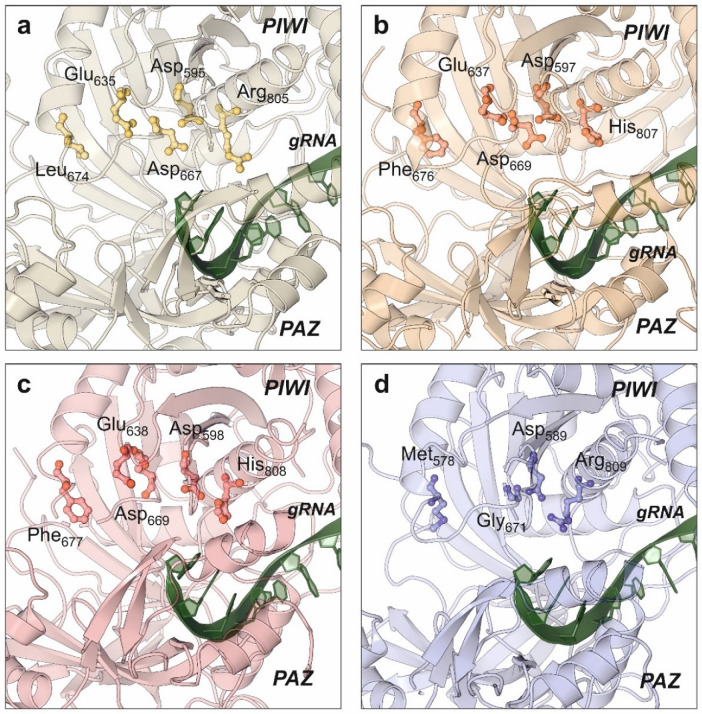
Conservation of the catalytic residues in the PIWI domain of all human Argonaute proteins as determined by X-ray crystallography. The catalytic amino acids are in the side surface of the PIWI domain, close to the RNA-binding groove. Among all the human Argonaute paralogs, only AGO2 and AGO3 retain the catalytic amino acid tetrad D-E-D-H. (a) AGO1 (PDB code: 4KRE), (b) AGO2 (PDB code: 4W5N), (c) AGO3 (PDB code: 5VM9), (d) AGO4 (PDB code: 6OON). All the figure panels were prepared with the Protein Imager software [39].

References

    1. Lee R.C., Feinbaum R.L., Ambros V. The C. elegans heterochronic gene lin-4 encodes small RNAs with antisense complementarity to lin-14. Cell. 1993;75:843–854. doi: 10.1016/0092-8674(93)90529-Y. - DOI - PubMed
    1. Wightman B., Ha I., Ruvkun G. Posttranscriptional regulation of the heterochronic gene lin-14 by lin-4 mediates temporal pattern formation in C. elegans. Cell. 1993;75:855–862. doi: 10.1016/0092-8674(93)90530-4. - DOI - PubMed
    1. Lagos-Quintana M., Rauhut R., Lendeckel W., Tuschl T. Identification of novel genes coding for small expressed RNAs. Science. 2001;294:853–858. doi: 10.1126/science.1064921. - DOI - PubMed
    1. Lee R.C., Ambros V. An extensive class of small RNAs in Caenorhabditis elegans. Science. 2001;294:862–864. doi: 10.1126/science.1065329. - DOI - PubMed
    1. Lau N.C., Lim L.P., Weinstein E.G., Bartel D.P. An abundant class of tiny RNAs with probable regulatory roles in Caenorhabditis elegans. Science. 2001;294:858–862. doi: 10.1126/science.1065062. - DOI - PubMed

LinkOut - more resources