. 2022 Feb 24;16(2):e0009524.
doi: 10.1371/journal.pntd.0009524. eCollection 2022 Feb.

Opportunity or catastrophe? effect of sea salt on host-parasite survival and reproduction

Affiliations

Opportunity or catastrophe? effect of sea salt on host-parasite survival and reproduction

Ao Yu et al. PLoS Negl Trop Dis. .

Erratum in

Abstract

Seawater intrusion associated with decreasing groundwater levels and rising seawater levels may affect freshwater species and their parasites. While brackish water certainly impacts freshwater systems globally, its impact on disease transmission is largely unknown. This study examined the effect of artificial seawater on host-parasite interactions using a freshwater snail host, Biomphalaria alexandrina, and the human trematode parasite Schistosoma mansoni. To evaluate the impact of increasing salinity on disease transmission four variables were analyzed: snail survival, snail reproduction, infection prevalence, and the survival of the parasite infective stage (cercariae). We found a decrease in snail survival, snail egg mass production, and snail infection prevalence as salinity increases. However, cercarial survival peaked at an intermediate salinity value. Our results suggest that seawater intrusion into freshwaters has the potential to decrease schistosome transmission to humans.


Conflict of interest statement

The authors have declared that no competing interests exist.

Figures
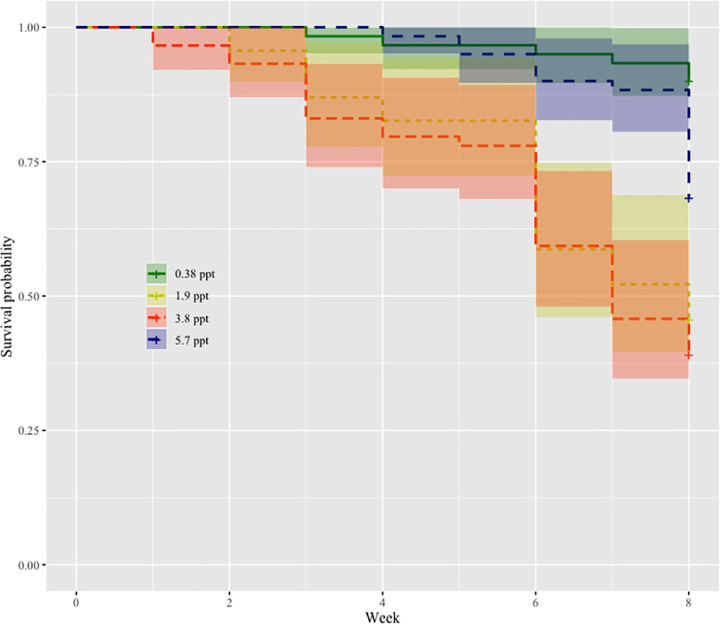
Fig 1
Fig 1. Probability of survival for snails in treatment groups of 0.38 ppt, 1.9 ppt, 3.8 ppt, 5.7 ppt salinity treatments.
Snail survival in 0.38 ppt is significantly higher than 1.9 ppt (p < 0.05), 3.8 ppt (p < 0.0001), and 5.7 ppt (p < 0.0001). The survival probability of 1.9 ppt is significantly higher than 3.8 ppt and 5.7 ppt salinity treatments (p < 0.05). For coefficients and pairwise comparisons see supplement Table B in S1 Text.
Fig 2
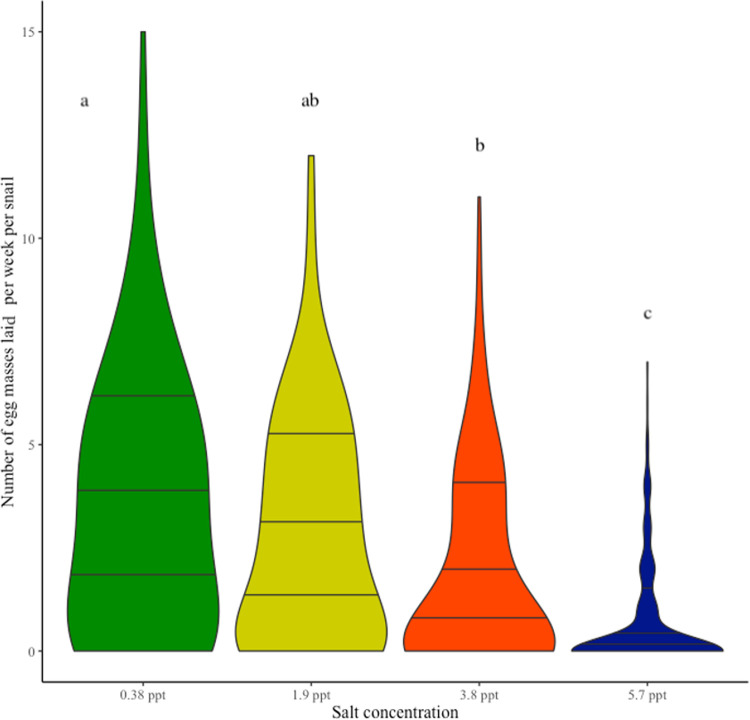
Fig 2. Egg mass output for uninfected snails in treatment groups 0.38 ppt, 1.9 ppt, 3.8 ppt, and 5.7 ppt.
The sample size for uninfected snails are 18 snails in 0.38 ppt with 144 total observations, 47 snails in 1.9 ppt with 376 total observations, 33 snails in 3.8 ppt with 264 total observations, and 39 snails in 5.7 ppt with 312 total observations. Snails in the 0.38 ppt salinity treatment had significantly higher egg mass output than 3.8 ppt (p < 0.05) or 5.7 ppt (p < 0.0001). Snails in the 1.9 ppt and 3.8 ppt treatments also had a higher output compared to the 5.7 ppt treatment (p < 0.0001 and p < 0.05, respectively). The horizontal lines on the violin plot represent data quantiles of 25%, 50%, and 75%. Letters above bars indicate significant differences in egg mass production, with different letters representing significant differences. For pairwise comparisons see supplement Table C in S1 Text.
Fig 3
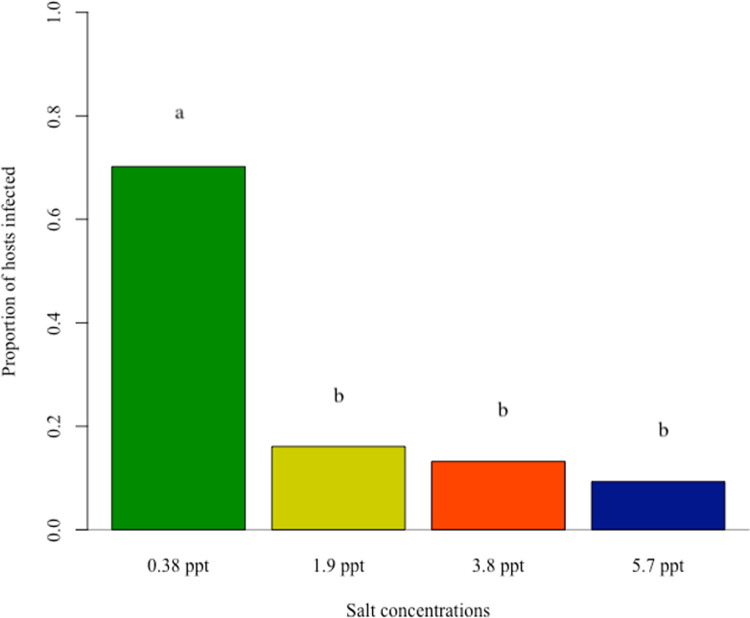
Fig 3. Snail infection prevalence in 0.38 ppt, 1.9 ppt, 3.8 ppt, and 5.7 ppt salinity treatments after exposure to Schistosoma mansoni miracidia.
Different letters above bars indicate significant differences in infection prevalence among the treatments. For pairwise comparisons see supplement Table E in S1 Text.
Fig 4
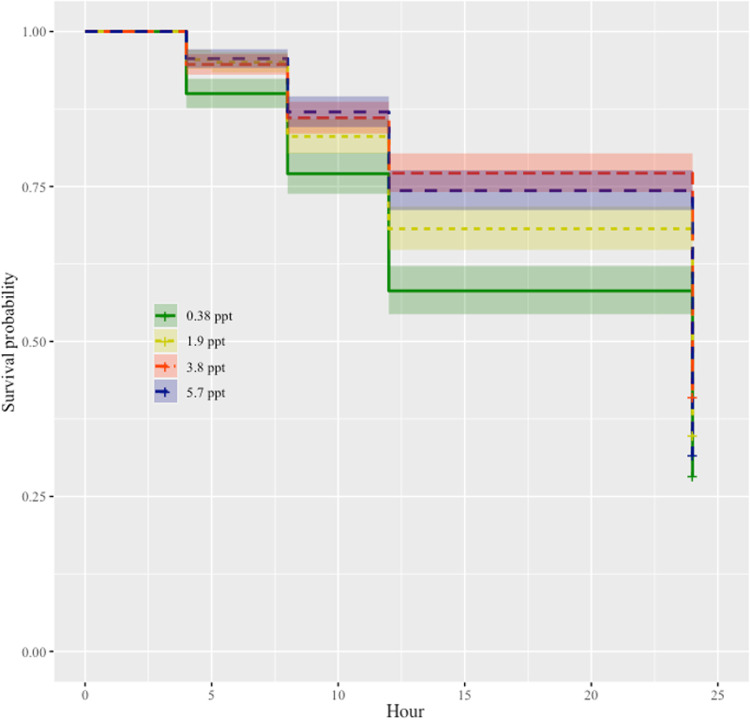
Fig 4. Survival probability of cercariae in 0.38 ppt, 1.9 ppt, 3.8 ppt, and 5.7 ppt salinity treatments over a 24-hour period.
All four treatment groups are significantly different from one another except for 1.9 ppt and 5.7 ppt (p > 0.05) For pairwise comparisons see supplement Table G in S1 Text.

References

    1. Zickfeld K, Solomon S, Gilford DM. Centuries of thermal sea-level rise due to anthropogenic emissions of short-lived greenhouse gases. Proc Natl Acad Sci U S A. 2017;114: 657–662. doi: 10.1073/pnas.1612066114 - DOI - PMC - PubMed
    1. Kaushal SS, Groffman PM, Likens GE, Belt KT, Stack WP, Kelly VR, et al. Increased salinization of fresh water in the Northeastern United States. Proc Natl Acad Sci U S A. 2005;102: 13517–13520. doi: 10.1073/pnas.0506414102 - DOI - PMC - PubMed
    1. Lei F, Poulin R. Effects of salinity on multiplication and transmission of an intertidal trematode parasite. Mar Biol. 2011;158: 995–1003. doi: 10.1007/s00227-011-1625-7 - DOI
    1. Preston D, Johnson P. Ecological consequences of parasitism. In: Nature Education Knowledge. 2010.
    1. Laidemitt MR, Anderson LC, Wearing HJ, Mutuku MW, Mkoji GM, Loker ES. Antagonism between parasites within snail hosts impacts the transmission of human schistosomiasis. Elife. 2019;8. doi: 10.7554/eLife.50095 - DOI - PMC - PubMed