. 2022 Apr:194:106775.
doi: 10.1016/j.rmed.2022.106775. Epub 2022 Feb 18.

Chronotropic index during 6-minute walk and acute respiratory events in COPDGene

Affiliations

Chronotropic index during 6-minute walk and acute respiratory events in COPDGene

David M Macdonald et al. Respir Med. 2022 Apr.

Abstract

Background: Lower heart rate (HR) increases during exercise and slower HR recovery (HRR) after exercise are markers of worse autonomic function that may be associated with risk of acute respiratory events (ARE).

Methods: Data from 6-min walk testing (6MWT) in COPDGene were used to calculate the chronotropic index (CI) [(HR immediately post 6MWT - resting HR)/((220 - age) - resting HR)] and HRR at 1 min after 6MWT completion. We used zero-inflated negative binomial regression to test associations of CI and HRR with rates of any ARE (requiring steroids and/or antibiotics) and severe ARE (requiring emergency department visit or hospitalization), among all participants and in spirometry subgroups (normal, chronic obstructive pulmonary disease [COPD], and preserved ratio with impaired spirometry).

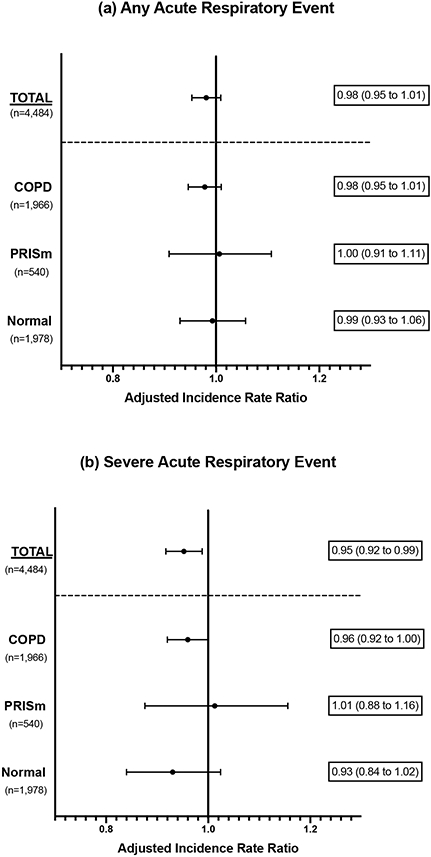
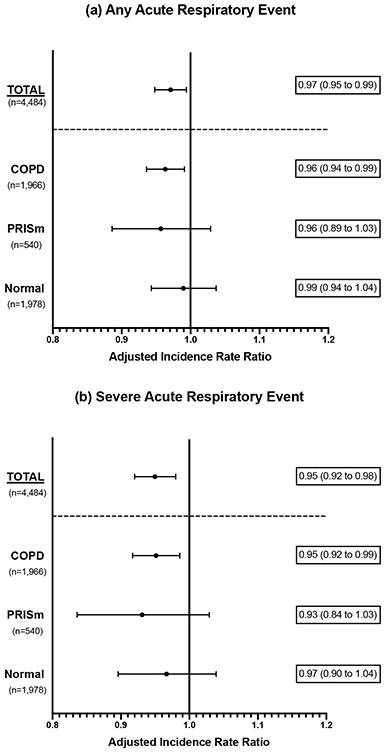
Results: Among 4,484 participants, mean follow-up time was 4.1 years, and 1,966 had COPD. Among all participants, CI-6MWT was not associated with rate of any ARE [adjusted incidence rate ratio (aIRR) 0.98 (0.95-1.01)], but higher CI-6MWT was associated with lower rate of severe ARE [0.95 (0.92-0.99)]. Higher HRR was associated with a lower rate of both any ARE [0.97 (0.95-0.99)] and severe ARE [0.95 (0.92-0.98)]. Results were similar in the COPD spirometry subgroup.

Conclusion: Heart rate measures derived from 6MWT tests may have utility in predicting risk of acute respiratory events and COPD exacerbations.

Keywords: Cardiac chronotropy; Chronic obstructive; Cohort study; Disease exacerbation; Pulmonary disease.


Figures

Figure 1:
Figure 1:
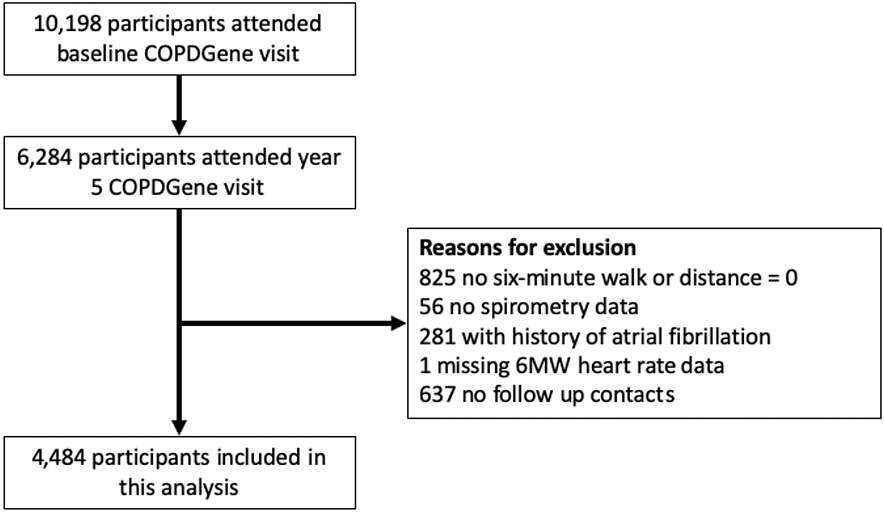
Study participant flow diagram.
Figure 2:
Figure 2:
Adjusted incidence rate ratios (aIRR) for the association between chronotropic index obtained from 6-minute walk test (CI-6MWT) and rate of (a) any acute respiratory events and (b) severe acute respiratory events (requiring emergency department visit or hospitalization). Results are presented for all participants (Total), and by spirometry subgroup. Incidence ratio ratios are adjusted for age, sex, race, body mass index (BMI), FEV1 percent predicted, current vs former smoking status, and 6-minute walk test distance. aIRRs represent the change in rate for each 0.1 unit change in CI-6MWT. COPD, chronic obstructive pulmonary disease; PRISm, preserved ratio, impaired spirometry.
Figure 3:
Figure 3:
Adjusted incidence rate ratios (aIRR) for the association between heart rate recovery (HRR) and rate of (a) any acute respiratory events and (b) severe acute respiratory events (requiring emergency department visit or hospitalization). Results are presented for all participants (Total), and by spirometry subgroup. Incidence ratio ratios are adjusted for age, sex, race, body mass index (BMI), FEV1 percent predicted, current vs former smoking status, and 6-minute walk test distance. aIRRs represent the change in rate for each 5 beat/minute change in HRR. COPD, chronic obstructive pulmonary disease; PRISm, preserved ratio, impaired spirometry.

References

    1. Vestbo J, Edwards LD, Scanlon PD, et al. Changes in Forced Expiratory Volume in 1 Second over Time in COPD. N Engl J Med. 2011;365(13):1184–1192. doi:10.1056/NEJMoa1105482 - DOI - PubMed
    1. Hurst JR, Vestbo J, Anzueto A, et al. Susceptibility to Exacerbation in Chronic Obstructive Pulmonary Disease. N Engl J Med. 2010;363(12):1128–1138. doi:10.1056/NEJMoa0909883 - DOI - PubMed
    1. Dransfield MT, Kunisaki KM, Strand MJ, et al. Acute Exacerbations and Lung Function Loss in Smokers with and without Chronic Obstructive Pulmonary Disease. Am J Respir Crit Care Med. 2017;195(3):324–330. doi:10.1164/rccm.201605-1014OC - DOI - PMC - PubMed
    1. the COPDGene Investigators, Busch R, Han MK, et al. Risk factors for COPD exacerbations in inhaled medication users: the COPDGene study biannual longitudinal follow-up prospective cohort. BMC Pulm Med. 2016;16(1):28. doi:10.1186/s12890-016-0191-7 - DOI - PMC - PubMed
    1. Gupta M, Bansal V, Chhabra SK. Abnormal heart rate recovery and chronotropic incompetence on exercise in chronic obstructive pulmonary disease. Chron Respir Dis. 2013;10(3):117–126. doi:10.1177/1479972313493097 - DOI - PubMed

Publication types