Review
. 2022 Feb 13;11(4):650.
doi: 10.3390/cells11040650.

Recent Advances in Ovarian Cancer: Therapeutic Strategies, Potential Biomarkers, and Technological Improvements

Affiliations
Review

Recent Advances in Ovarian Cancer: Therapeutic Strategies, Potential Biomarkers, and Technological Improvements

Salima Akter et al. Cells. .

Abstract

Aggressive and recurrent gynecological cancers are associated with worse prognosis and a lack of effective therapeutic response. Ovarian cancer (OC) patients are often diagnosed in advanced stages, when drug resistance, angiogenesis, relapse, and metastasis impact survival outcomes. Currently, surgical debulking, radiotherapy, and/or chemotherapy remain the mainstream treatment modalities; however, patients suffer unwanted side effects and drug resistance in the absence of targeted therapies. Hence, it is urgent to decipher the complex disease biology and identify potential biomarkers, which could greatly contribute to making an early diagnosis or predicting the response to specific therapies. This review aims to critically discuss the current therapeutic strategies for OC, novel drug-delivery systems, and potential biomarkers in the context of genetics and molecular research. It emphasizes how the understanding of disease biology is related to the advancement of technology, enabling the exploration of novel biomarkers that may be able to provide more accurate diagnosis and prognosis, which would effectively translate into targeted therapies, ultimately improving patients' overall survival and quality of life.

Keywords: angiogenesis; molecular insight; ovarian cancer; technology advances; therapeutic strategies and targets.


Conflict of interest statement

The authors declare no conflict of interest.

Figures
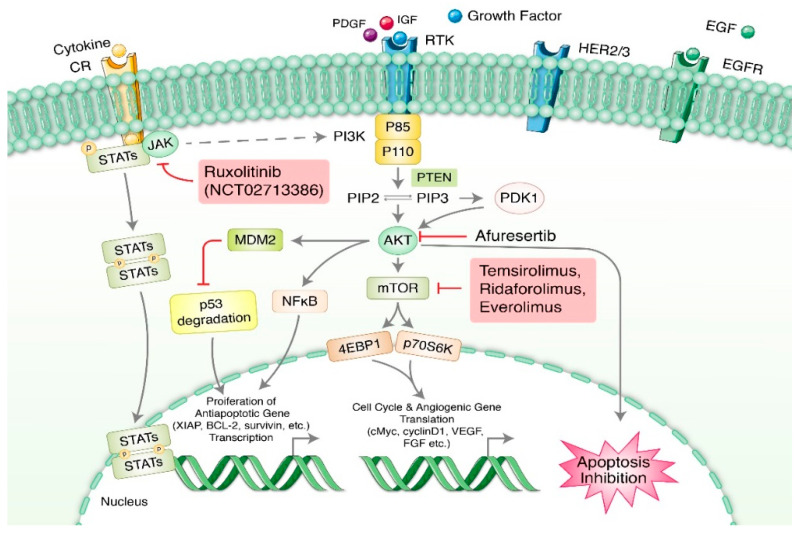
Figure 1
Figure 1
PI3K/Akt/mTOR signaling pathway. This pathway is upregulated in ovarian cancer by either (i) receptors of upstream growth factors and ligand stimulation, (ii) indirect activation via cross-talk with JAK/STAT signaling, or (iii) intrinsically via activation of amplified/mutated PI3K or amplification of Akt isoform, or deletion/inactivation in tumor-suppressor protein PTEN. Afuresertib, an Akt inhibitor, is safely used in platinum-resistant ovarian cancer. Most frequently studied mTOR inhibitors in completed OC phase II clinical trials are temsirolimus, ridaforolimus, and everolimus. Ruxolitinib, a JAK inhibitor, is already FDA approved for treatment of polycythemia vera.
Figure 2
Figure 2
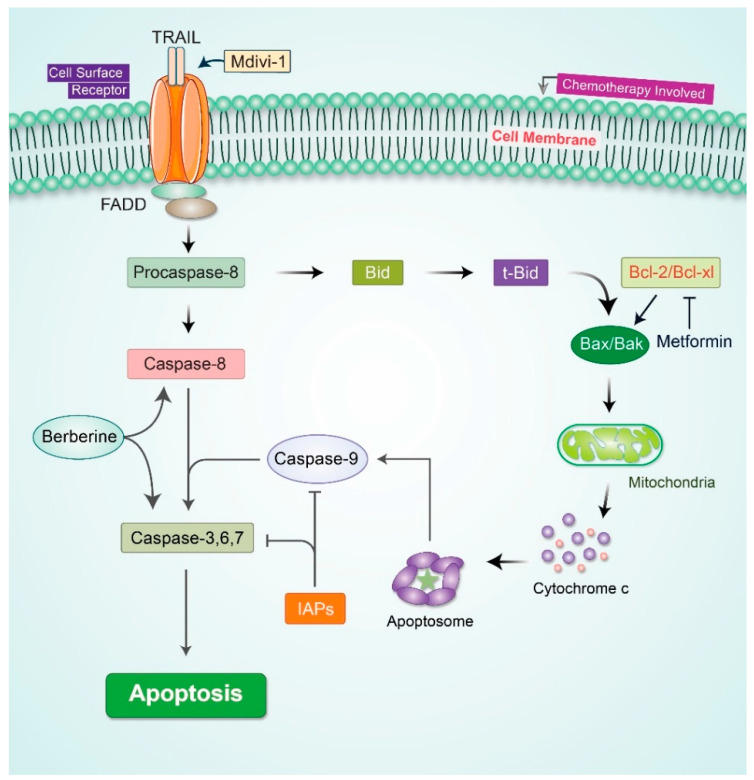
Apoptosis signaling in cancer cells. Metformin-induced apoptotic pathway in ovarian cancer cell lines stimulates AMP-activated protein kinase (AMPK)-independent apoptotic pathway. Berberine activates caspase-8 and caspase-3-mediated apoptotic pathway. Mdivi-1 stimulates TRAIL-induced extrinsic pathway.
Figure 3
Figure 3
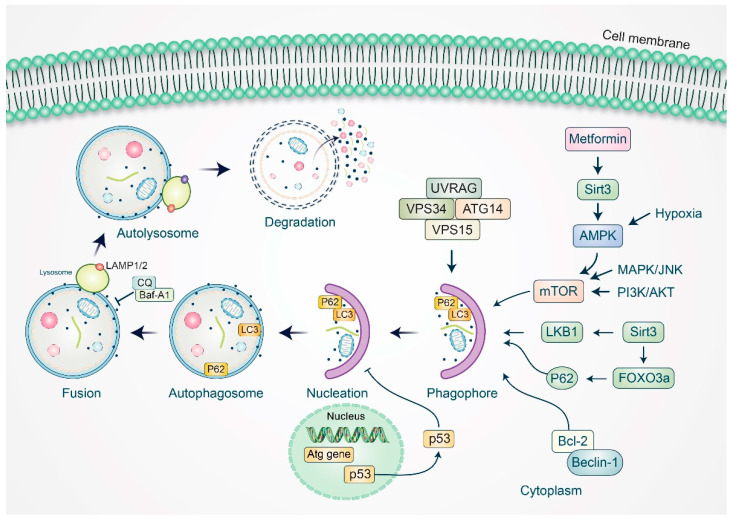
Modulation of autophagy signaling in relation to Sirt3 and autophagy in ovarian cancer. Metformin-mediated Sirt3 overexpression triggers AMPK, which increases activation of LC3. Sirt3 is also involved in autophagy regulation through MAPK/JNK/mTOR autophagy pathway. Several autophagy-related genes, such as beclin-1, p62, LKB1, and VPS34 complex, stimulate autophagy initiation. Sirt3 also activates FOXO3a, which subsequently activates p62 and autophagy. Transcription factor p53 activates and promotes synthesis of autophagy proteins, and high cytoplasmic levels of p53 may result in inhibition of autophagosome formation.

References

    1. Ahmed N., Kadife E., Raza A., Short M., Jubinsky P.T., Kannourakis G. Ovarian Cancer, Cancer Stem Cells and Current Treatment Strategies: A Potential Role of Magmas in the Current Treatment Methods. Cells. 2020;9:719. doi: 10.3390/cells9030719. - DOI - PMC - PubMed
    1. Lengyel E. Ovarian Cancer Development and Metastasis. Am. J. Pathol. 2010;177:1053–1064. doi: 10.2353/ajpath.2010.100105. - DOI - PMC - PubMed
    1. Yang M.Q., Elnitski L. A Systems Biology Comparison of Ovarian Cancers Implicates Putative Somatic Driver Mutations through Protein-Protein Interaction Models. PLoS ONE. 2016;11:e0163353. doi: 10.1371/journal.pone.0163353. - DOI - PMC - PubMed
    1. Bast R.C., Jr., Hennessy B., Mills G.B. The biology of ovarian cancer: New opportunities for translation. Nat. Rev. Cancer. 2009;9:415–428. doi: 10.1038/nrc2644. - DOI - PMC - PubMed
    1. Marcus C.S., Maxwell G.L., Darcy K.M., Hamilton C.A., McGuire W.P. Current Approaches and Challenges in Managing and Monitoring Treatment Response in Ovarian Cancer. J. Cancer. 2014;5:25–30. doi: 10.7150/jca.7810. - DOI - PMC - PubMed

Publication types