Review
. 2022 Feb 15;11(4):675.
doi: 10.3390/cells11040675.

Circulating Mitochondrial DNA and Inter-Organelle Contact Sites in Aging and Associated Conditions

Affiliations
Review

Circulating Mitochondrial DNA and Inter-Organelle Contact Sites in Aging and Associated Conditions

Anna Picca et al. Cells. .

Abstract

Mitochondria are primarily involved in cell bioenergetics, regulation of redox homeostasis, and cell death/survival signaling. An immunostimulatory property of mitochondria has also been recognized which is deployed through the extracellular release of entire or portioned organelle and/or mitochondrial DNA (mtDNA) unloading. Dynamic homo- and heterotypic interactions involving mitochondria have been described. Each type of connection has functional implications that eventually optimize mitochondrial activity according to the bioenergetic demands of a specific cell/tissue. Inter-organelle communications may also serve as molecular platforms for the extracellular release of mitochondrial components and subsequent ignition of systemic inflammation. Age-related chronic inflammation (inflamm-aging) has been associated with mitochondrial dysfunction and increased extracellular release of mitochondrial components-in particular, cell-free mtDNA. The close relationship between mitochondrial dysfunction and cellular senescence further supports the central role of mitochondria in the aging process and its related conditions. Here, we provide an overview of (1) the mitochondrial genetic system and the potential routes for generating and releasing mtDNA intermediates; (2) the pro-inflammatory pathways elicited by circulating mtDNA; (3) the participation of inter-organelle contacts to mtDNA homeostasis; and (4) the link of these processes with senescence and age-associated conditions.

Keywords: exosomes; extracellular vesicles; inflamm-aging; mitochondrial damage; mitochondrial dynamics; mitochondrial-derived vesicles; mitochondrial-lysosomal axis; mitophagy; oxidative stress; senescence.


Conflict of interest statement

The authors declare no conflict of interest.

Figures
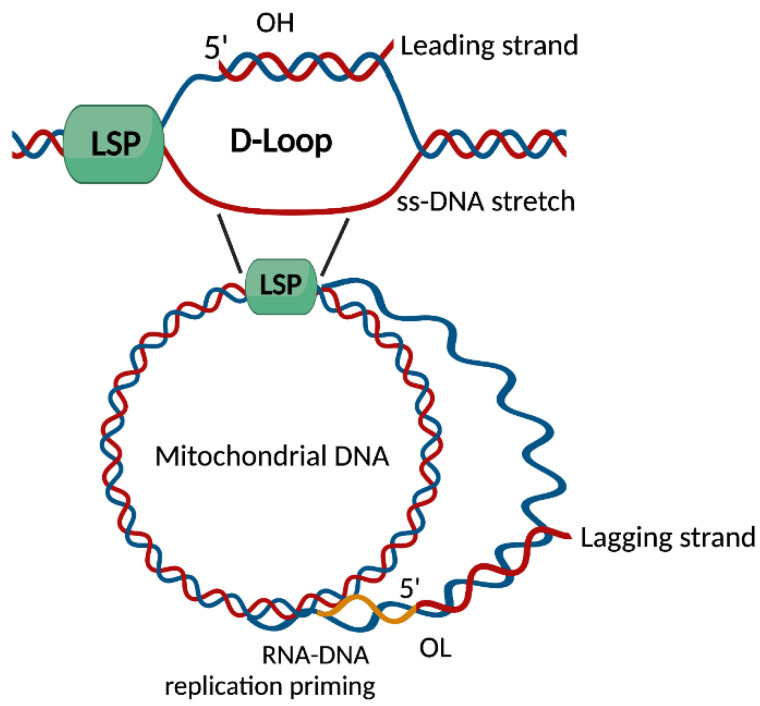
Figure 1
Figure 1
Molecular events of mtDNA expression and replication. D-loop, displacement-loop; LSP, light-strand promoter; OH, origin of heavy-strand replication; OL, origin of light-strand replication; ss-DNA, single-stranded DNA. Created with BioRender.com, accessed on 21 October 2021.
Figure 2
Figure 2
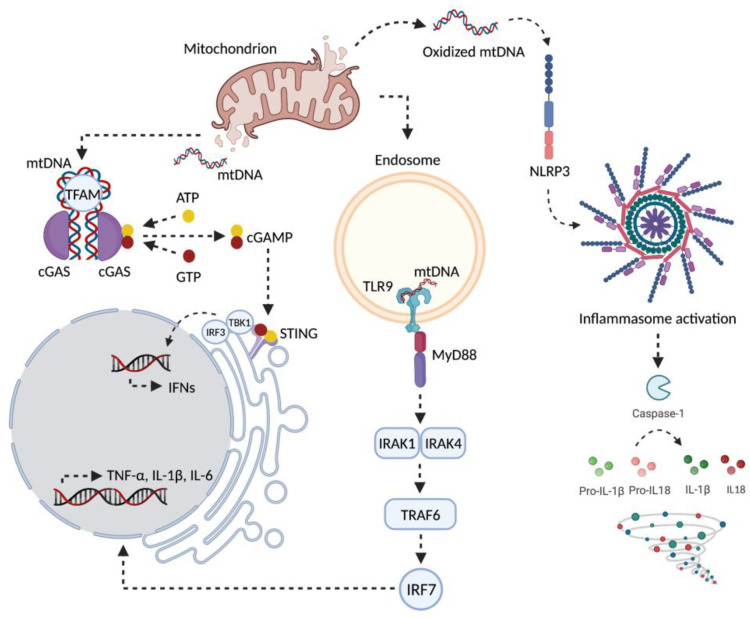
Schematic representation of major signaling pathways through which the displacement of mitochondrial components can trigger inflammation. A decline in the efficiency mitochondrial quality control processes may lead to the intracellular accrual of oxidized components, including mtDNA, that further engulf the mitophagy machinery. These debris can be cleared by the cell along alternative non-degradative routes that release mitochondrial-derived components into the cytoplasm or the extracellular compartment. Displaced mitochondrial-derived components can be recognized as damage-associated molecular patters and trigger inflammation by activating three distinct signaling pathways via the interaction with (1) cytosolic cyclic GMP-AMP synthase (cGAS)-stimulator of interferon genes (STING) DNA-sensing system; (2) toll-like receptors (TLRs); (3) nucleotide-binding oligomerization domain (NOD)-like receptor family pyrin domain containing 3 (NLRP3) inflammasome. ATP, Adenosine triphosphate; cGAMP, Cyclic guanosine monophosphate–adenosine monophosphate; GTP, guanosine triphosphate; IFNs, interferons; IL, interleukin; IRAK, interleukin 1 receptor associated kinase; IRF, interferon regulatory factor; mtDNA, mitochondrial DNA; MyD88, Myeloid differentiation primary response 88; TBK1, TANK-binding kinase 1; TFAM, mitochondrial transcription factor A; TNF-α, tumor necrosis factor-α; TRAF, TNF Receptor Associated Factor 6. Created with BioRender.com, accessed on 18 January 2022.
Figure 3
Figure 3
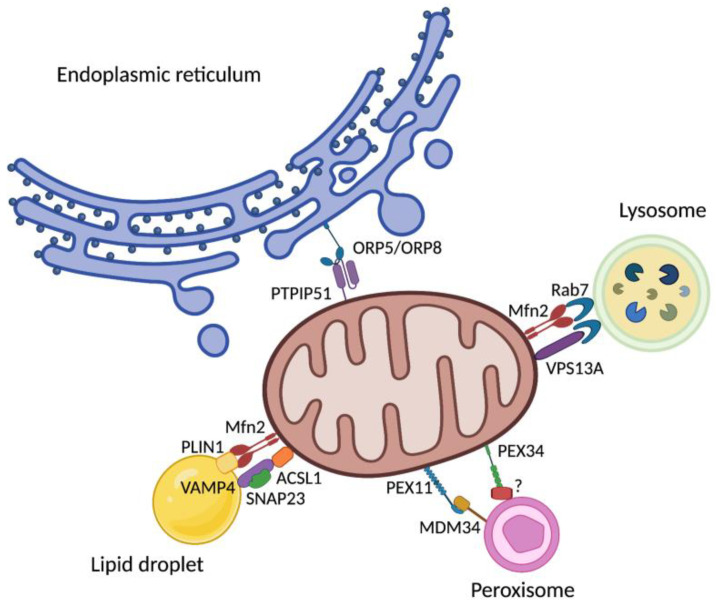
Schematic representation of mitochondrial contact sites. To coordinate all the activities and achieve homeostasis, mitochondria use molecular platforms through which establish contacts with the endoplasmic reticulum, lysosome, peroxisome, and lipid droplet. ACSL1, acyl-CoA synthase long chain family member 1; Mfn2, mitofusin 2; MDM34, Mitochondrial distribution and morphology protein 34; ORP, oxysterol-binding protein-related proteins; PEX, peroxisomal integral membrane protein; PLIN1, peripilin 1; PTPIP51, protein tyrosine phosphatase interacting protein 51; RAB7, Ras-related in brain 7; SNAP23, synaptosomal-associated protein 23; VAMP4, vesicle-associated membrane protein 4; VPS13A, Vacuolar Protein Sorting 13 Homolog A; Created with BioRender.com, accessed on 21 January 2022.

References

    1. Margulis L., Bermudes D. Symbiosis as a mechanism of evolution: Status of cell symbiosis theory. Symbiosis. 1985;1:101–124. - PubMed
    1. Lane N., Martin W. The energetics of genome complexity. Nature. 2010;467:929–934. doi: 10.1038/nature09486. - DOI - PubMed
    1. Klecker T., Böckler S., Westermann B. Making connections: Interorganelle contacts orchestrate mitochondrial behavior. Trends Cell Biol. 2014;24:537–545. doi: 10.1016/j.tcb.2014.04.004. - DOI - PubMed
    1. Valm A.M., Cohen S., Legant W.R., Melunis J., Hershberg U., Wait E., Cohen A.R., Davidson M.W., Betzig E., Lippincott-Schwartz J. Applying systems-level spectral imaging and analysis to reveal the organelle interactome. Nature. 2017;546:162–167. doi: 10.1038/nature22369. - DOI - PMC - PubMed
    1. Wallace D.C. Colloquium paper: Bioenergetics, the origins of complexity, and the ascent of man. Proc. Natl. Acad. Sci. USA. 2010;107:8947–8953. doi: 10.1073/pnas.0914635107. - DOI - PMC - PubMed

Publication types

MeSH terms

Substances

LinkOut - more resources