Review
. 2022 Feb 16;11(4):688.
doi: 10.3390/cells11040688.

Shaping of Hepatic Ischemia/Reperfusion Events: The Crucial Role of Mitochondria

Affiliations
Review

Shaping of Hepatic Ischemia/Reperfusion Events: The Crucial Role of Mitochondria

João S Teodoro et al. Cells. .

Abstract

Hepatic ischemia reperfusion injury (HIRI) is a major hurdle in many clinical scenarios, including liver resection and transplantation. Various studies and countless surgical events have led to the observation of a strong correlation between HIRI induced by liver transplantation and early allograft-dysfunction development. The detrimental impact of HIRI has driven the pursuit of new ways to alleviate its adverse effects. At the core of HIRI lies mitochondrial dysfunction. Various studies, from both animal models and in clinical settings, have clearly shown that mitochondrial function is severely hampered by HIRI and that its preservation or restoration is a key indicator of successful organ recovery. Several strategies have been thus implemented throughout the years, targeting mitochondrial function. This work briefly discusses some the most utilized approaches, ranging from surgical practices to pharmacological interventions and highlights how novel strategies can be investigated and implemented by intricately discussing the way mitochondrial function is affected by HIRI.

Keywords: conditioning; ischemia/reperfusion; liver; liver surgery; mitochondria.


Conflict of interest statement

The authors declare no conflict of interest with the publication of this work.

Figures
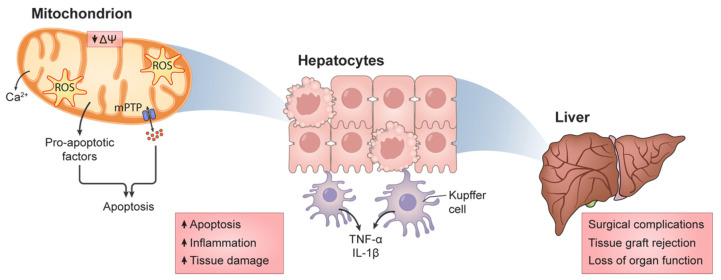
Figure 1
Figure 1
The upscaling of damage in HIRI. Severe compromise to mitochondrial function results in the exacerbated generation of reactive oxygen species (ROS), resulting in the activation of pro-apoptotic protocols such as the opening of the mitochondrial permeability transition pore (mPTP) and release of pro-apoptotic factors, such as ionic calcium (Ca2+). While mitochondrial Ca2+ release is markedly lower when compared with other Ca2+ sources that could lead to elevated levels (for example, the endoplasmic reticulum or from extracellular sources), the damage to mitochondrial function and integrity will undoubtedly lead to the release of Ca2+ and other pro-apoptotic factors. Furthermore, these sources could initiate mitochondrial dysfunction, rather than mitochondrial injury per se. Regardless, given enough replication of these phenomena, cellular survival is at risk, which in turn is a marker for further damage, due to the activation of sterile inflammatory procedures. All these processes, if left unchecked, might result in tissue loss and, eventually, organ failure.
Figure 2
Figure 2
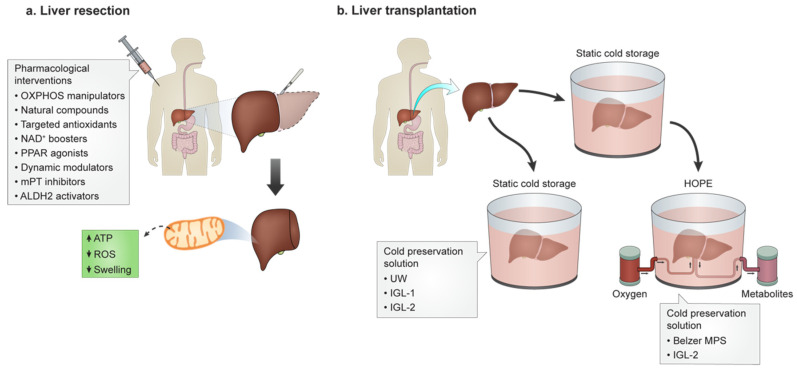
Interventions towards improved hepatic survival in liver surgery upon HIRI. (a) in liver surgeries where warm ischemia is required (for instance, in liver resection surgeries), preconditioning with mechanical (i.e., blood flow occlusion and restoration) or with pharmacological agents have been tested both in the bench and the bedside, with promising results. Of note is that, by directly or indirectly targeting mitochondria for function preservation, these strategies can make up for the difference in between failure or preservation and restoration of hepatic function, size and proficiency. (b) On the other hand, where cold ischemia is required (i.e., transplantation), new developments in preservation solutions have both increased the time window for which the organ is still in usable form, and also expanded the pool of organs that can be used, by virtue of the massively improved preservation protocols.

References

    1. Kalra A., Tuma F. Physiology, Liver. StatPearls Publishing; Treasure Island, FL, USA: 2018. - PubMed
    1. Rui L. Energy Metabolism in the Liver. Compr. Physiol. 2014;4:177–197. doi: 10.1002/cphy.c130024. - DOI - PMC - PubMed
    1. Bodzin A.S., Baker T.B. Liver Transplantation Today: Where We Are Now and Where We Are Going. Liver Transplant. 2018;24:1470–1475. doi: 10.1002/lt.25320. - DOI - PubMed
    1. Ghinolfi D., Melandro F., Torri F., Martinelli C., Cappello V., Babboni S., Silvestrini B., de Simone P., Basta G., del Turco S. Extended Criteria Grafts and Emerging Therapeutics Strategy in Liver Transplantation. The Unstable Balance between Damage and Repair. Transplant. Rev. 2021;35:100639–100649. doi: 10.1016/j.trre.2021.100639. - DOI - PubMed
    1. Lee S.H., Culberson C., Korneszczuk K., Clemens M.G. Differential Mechanisms of Hepatic Vascular Dysregulation with Mild vs. Moderate Ischemia-Reperfusion. Am. J. Physiol. Gastrointest. Liver Physiol. 2008;294:G1219–G1226. doi: 10.1152/ajpgi.00527.2007. - DOI - PubMed

Publication types