. 2022 Feb 18;11(4):720.
doi: 10.3390/cells11040720.

Selective PPARα Modulator Pemafibrate and Sodium-Glucose Cotransporter 2 Inhibitor Tofogliflozin Combination Treatment Improved Histopathology in Experimental Mice Model of Non-Alcoholic Steatohepatitis

Affiliations

Selective PPARα Modulator Pemafibrate and Sodium-Glucose Cotransporter 2 Inhibitor Tofogliflozin Combination Treatment Improved Histopathology in Experimental Mice Model of Non-Alcoholic Steatohepatitis

Kentaro Murakami et al. Cells. .

Abstract

Ballooning degeneration of hepatocytes is a major distinguishing histological feature of non-alcoholic steatosis (NASH) progression that can lead to cirrhosis and hepatocellular carcinoma (HCC). In this study, we evaluated the effect of the selective PPARα modulator (SPPARMα) pemafibrate (Pema) and sodium-glucose cotransporter 2 (SGLT2) inhibitor tofogliflozin (Tofo) combination treatment on pathological progression in the liver of a mouse model of NASH (STAM) at two time points (onset of NASH progression and HCC survival). At both time points, the Pema and Tofo combination treatment significantly alleviated hyperglycemia and hypertriglyceridemia. The combination treatment significantly reduced ballooning degeneration of hepatocytes. RNA-seq analysis suggested that Pema and Tofo combination treatment resulted in an increase in glyceroneogenesis, triglyceride (TG) uptake, lipolysis and liberated fatty acids re-esterification into TG, lipid droplet (LD) formation, and Cidea/Cidec ratio along with an increased number and reduced size and area of LDs. In addition, combination treatment reduced expression levels of endoplasmic reticulum stress-related genes (Ire1a, Grp78, Xbp1, and Phlda3). Pema and Tofo treatment significantly improved survival rates and reduced the number of tumors in the liver compared to the NASH control group. These results suggest that SPPARMα and SGLT2 inhibitor combination therapy has therapeutic potential to prevent NASH-HCC progression.

Keywords: ER stress; SGLT2; SPPARMα; ballooning.


Conflict of interest statement

T.K. is an advisory board member and a recipient of support from a collaborative research fund from Kowa Company, Ltd. J.-C.F., and J.F.-N. are consultants of Kowa Company, Ltd. Kowa Co. had no role in the design of the study; in the collection, analyses, or interpretation of data; in the writing of the manuscript, or in the decision to publish the results. K.M., Y.S., M.A. (Masato Asahiyama), W.Y. and T.T. (Toshiaki Takizawa) are employees of Kowa Company, Ltd. Rest of the authors declare no conflict of interest.

Figures
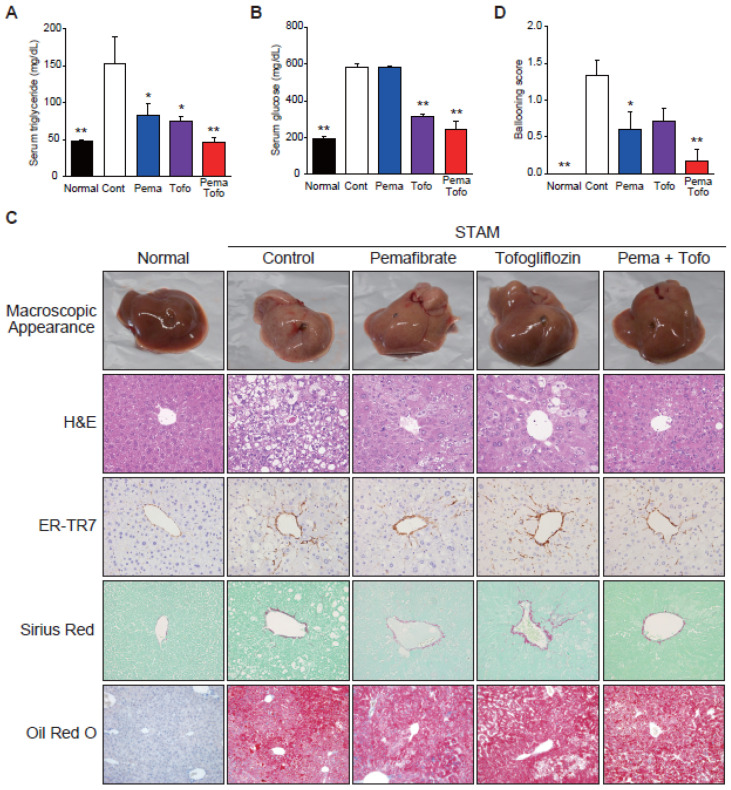
Figure 1
Figure 1
Pemafibrate and Tofogliflozin combination improves hypertriglyceridemia, hyperglycemia, macrovesicular steatosis, and ballooning score in STAM mice liver. (A) Serum triglyceride, (B) Serum glucose, (C) Representative gross morphology of liver, H&E stained, ER-TR7 stained, Sirius-red stained, and Oil red O stained liver section, and (D) Ballooning score of normal, control, pemafibrate, tofogliflozin, and pemafibrate and tofogliflozin combination-treated STAM mice. Error bars show s.e.m. * p < 0.05; ** p < 0.01: Significantly difference from STAM control group by Dunnett’s multiple comparison test.
Figure 2
Figure 2
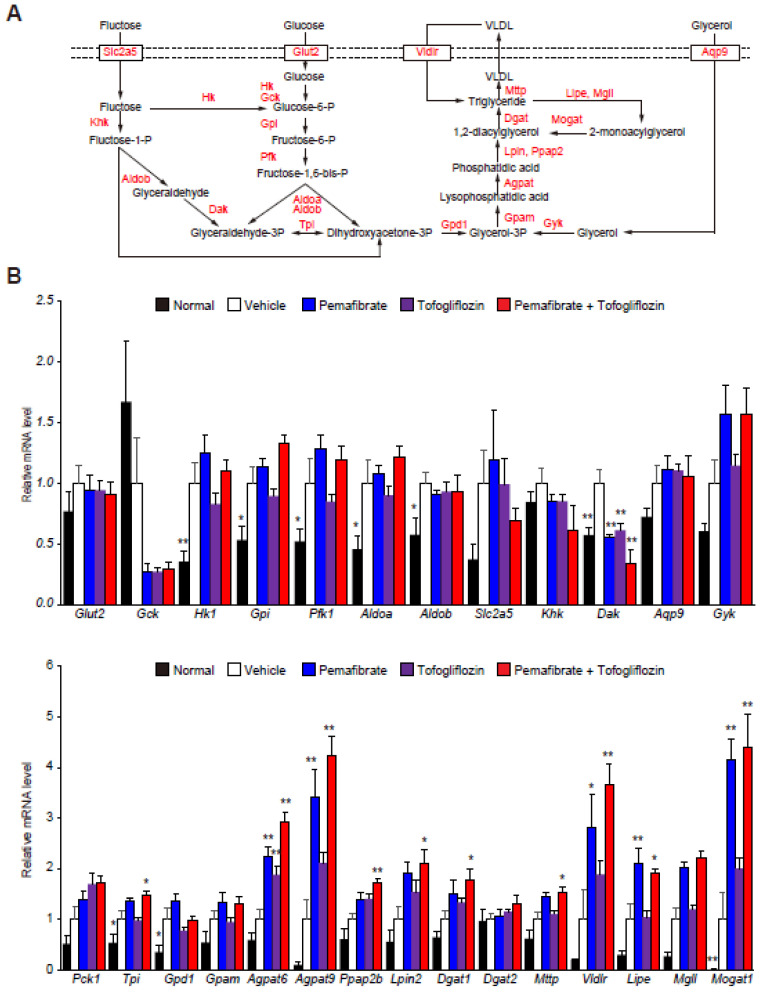
Pemafibrate and Tofogliflozin combination induces lipolysis and fatty acid re-esterification genes expression in STAM mice liver. (A) Schematic representation of the glycolytic and TG synthesis pathways in the liver. (B) qPCR validation of glycolytic and TG metabolism-related genes expression of normal, control, pemafibrate, tofogliflozin, and pemafibrate and tofogliflozin combination-treated STAM mice liver. Error bars show s.e.m. * p < 0.05; ** p < 0.01: Significantly difference from STAM control group by Dunnett’s multiple comparison test.
Figure 3
Figure 3
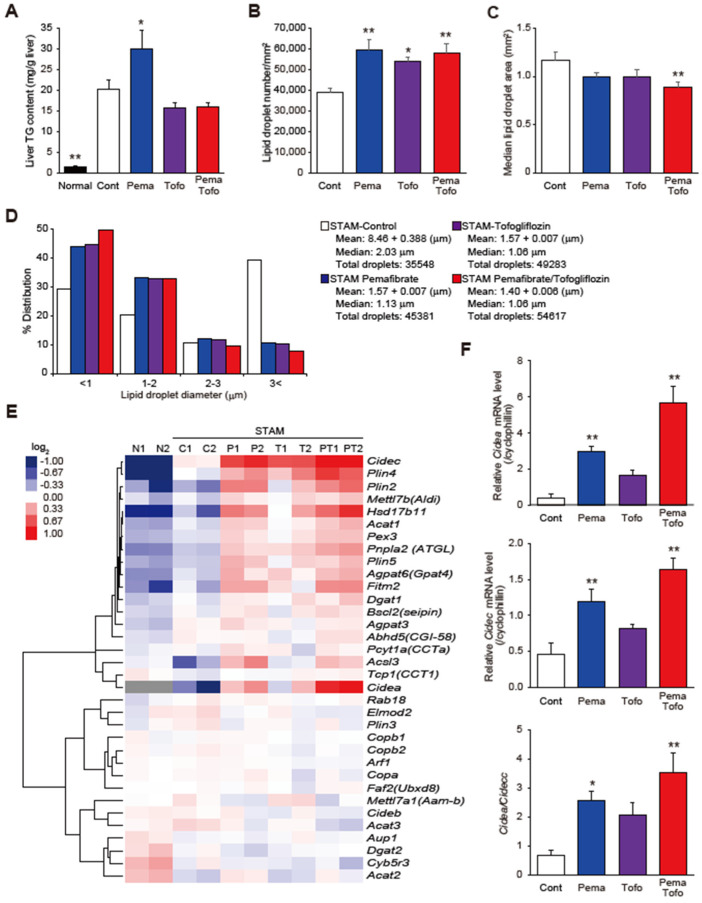
Pemafibrate and Tofogliflozin combination induces lipid droplets formation. (A) Liver TG content, (B) Lipid droplet number, (C) Median lipid droplet, (D) Lipid droplet sizes distribution, (E) Heatmap of hierarchical clustering of LDAPs and formation-related genes, and (F) Cidea, Cidec, and Cidea/Cidec ratio of control, pemafibrate, tofogliflozin, and pemafibrate and tofogliflozin combination-treated STAM mice. * p < 0.05; ** p < 0.01: Significantly difference from STAM control group by Dunnett’s multiple comparison test.
Figure 4
Figure 4
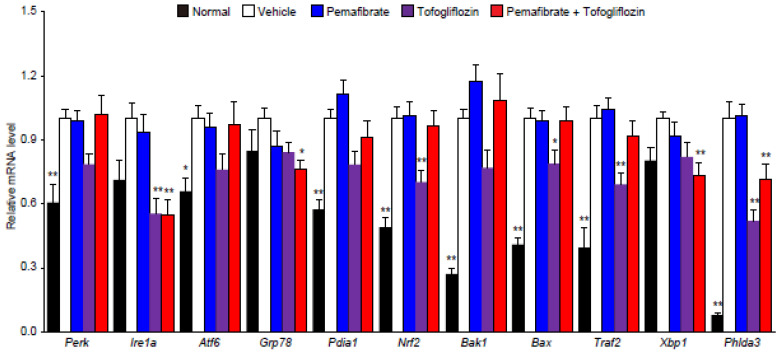
Pemafibrate and Tofogliflozin combination improves ER stress genes expression in STAM mice liver. qPCR validation of ER stress-related genes expression of normal, control, pemafibrate, tofogliflozin, and pemafibrate and tofogliflozin combination-treated STAM mice liver. * p < 0.05; ** p < 0.01: Significantly difference from STAM control group by Dunnett’s multiple comparison test.
Figure 5
Figure 5
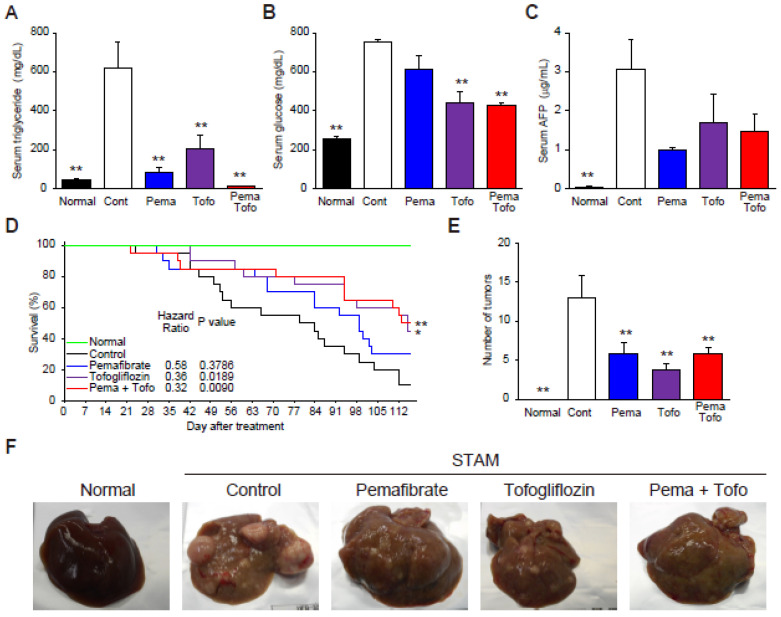
Pemafibrate and Tofogliflozin combination improves survival rate in STAM mice liver. (A) Serum triglyceride, (B) Serum glucose, (C) Serum AFP, (D) Kaplan-Meier survival curves, (E) Number of tumors, and (F) Representative gross morphology of liver from normal, control, pemafibrate, tofogliflozin, and pemafibrate and tofogliflozin combination-treated STAM mice. Log-rank p-value and hazard ratio were shown in the survival curve figure. Error bars show s.e.m. * p < 0.05; ** p < 0.01: Significantly difference from STAM control group by Dunnett’s multiple comparison test.

References

    1. Sheka A.C., Adeyi O., Thompson J., Hameed B., Crawford P.A., Ikramuddin S. Nonalcoholic Steatohepatitis: A Review. JAMA. 2020;323:1175–1183. doi: 10.1001/jama.2020.2298. - DOI - PubMed
    1. Tilg H., Moschen A.R., Roden M. NAFLD and diabetes mellitus. Nat. Rev. Gastroenterol. Hepatol. 2017;14:32–42. doi: 10.1038/nrgastro.2016.147. - DOI - PubMed
    1. Suzuki A., Diehl A.M. Nonalcoholic Steatohepatitis. Annu. Rev. Med. 2017;68:85–98. doi: 10.1146/annurev-med-051215-031109. - DOI - PubMed
    1. Haas J.T., Francque S., Staels B. Pathophysiology and Mechanisms of Nonalcoholic Fatty Liver Disease. Annu. Rev. Physiol. 2016;78:181–205. doi: 10.1146/annurev-physiol-021115-105331. - DOI - PubMed
    1. Taylor R.S., Taylor R.J., Bayliss S., Hagström H., Nasr P., Schattenberg J.M., Ishigami M., Toyoda H., Wai-Sun Wong V., Peleg N., et al. Association Between Fibrosis Stage and Outcomes of Patients With Nonalcoholic Fatty Liver Disease: A Systematic Review and Meta-Analysis. Gastroenterology. 2020;158:1611–1625. doi: 10.1053/j.gastro.2020.01.043. - DOI - PubMed

Publication types

MeSH terms

Substances