. 2022 Jan 29;10(2):320.
doi: 10.3390/biomedicines10020320.

Phytochemically Derived Zingerone Nanoparticles Inhibit Cell Proliferation, Invasion and Metastasis in Human Oral Squamous Cell Carcinoma

Affiliations

Phytochemically Derived Zingerone Nanoparticles Inhibit Cell Proliferation, Invasion and Metastasis in Human Oral Squamous Cell Carcinoma

Cheng-Mei Yang et al. Biomedicines. .

Abstract

Due to its aggressiveness and high mortality rate, oral cancer still represents a tough challenge for current cancer therapeutics. Similar to other carcinomas, cancerous invasion and metastasis are the most important prognostic factors and the main obstacles to therapy for human oral squamous cell carcinoma (OSCC). Fortunately, with the rise of the nanotechnical era and innovative nanomaterial fabrication, nanomaterials are widely used in biomedicine, cancer therapeutics, and chemoprevention. Recently, phytochemical substances have attracted increasing interest as adjuvants to conventional cancer therapy. The ginger phenolic compound zingerone, a multitarget pharmacological and bioactive phytochemical, possesses potent anti-inflammatory, antioxidant, and anticancer activities. In our previous study, we generated phytochemically derived zingerone nanoparticles (NPs), and documented their superior antitumorigenic effect on human hepatoma cells. In the present study, we further investigated the effects of zingerone NPs on inhibiting the invasiveness and metastasis of human OSCC cell lines. Zingerone NPs elicited significant cytotoxicity in three OSCC cell lines compared to zingerone. Moreover, the lower dose of zingerone NPs (25 µM) markedly inhibited colony formation and colony survival by at least five-fold compared to zingerone treatment. Additionally, zingerone NPs significantly attenuated cell motility and invasiveness. In terms of the signaling mechanism, we determined that the zingerone NP-mediated downregulation of Akt signaling played an important role in the inhibition of cell viability and cell motility. Zingerone NPs inhibited matrix metalloproteinase (MMP) activity, which was highly correlated with the attenuation of cell migration and cell invasion. By further detecting the roles of zingerone NPs in epithelial-mesenchymal transition (EMT), we observed that zingerone NPs substantially altered the levels of EMT-related markers by decreasing the levels of the mesenchymal markers, N-cadherin and vimentin, rather than the epithelial proteins, ZO-1 and E-cadherin, compared with zingerone. In conclusion, as novel and efficient phytochemically derived nanoparticles, zingerone NPs may serve as a potent adjuvant to protect against cell invasion and metastasis, which will provide a beneficial strategy for future applications in chemoprevention and conventional therapeutics in OSCC treatment.

Keywords: chemoprevention; epithelial–mesenchymal transition; human oral squamous cell carcinoma; metastasis; phytochemical; zingerone nanoparticle.


Conflict of interest statement

The authors have declared that no competing interest exists.

Figures
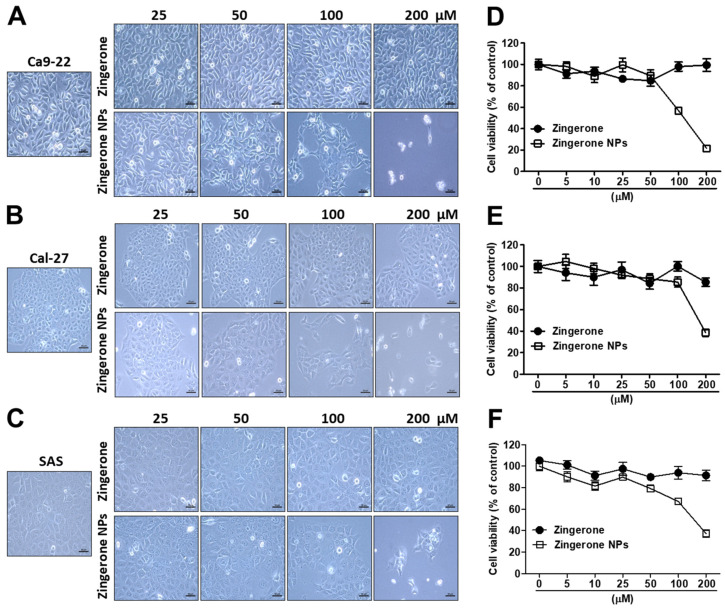
Figure 1
Figure 1
Zingerone NPs induced a significant cytotoxicity in three human OSCC Ca9-22, Cal-27 and SAS cell lines. Cells were treated with zingerone and/or zingerone NPs for 24 h. The effects of zingerone and/or zingerone NPs on cellular morphology and cell viability were observed in Ca9-22 cells (A), Ca1-27 cells (B), and SAS cells (C), respectively, using inverted microscopy. Bar: 50 µm. Further cellular viability was analyzed and recorded using an MTT assay in Ca9-22 cells (D), Ca1-27 cells (E), and SAS cells (F), respectively. Data are expressed as mean ± SEM of three experiments.
Figure 2
Figure 2
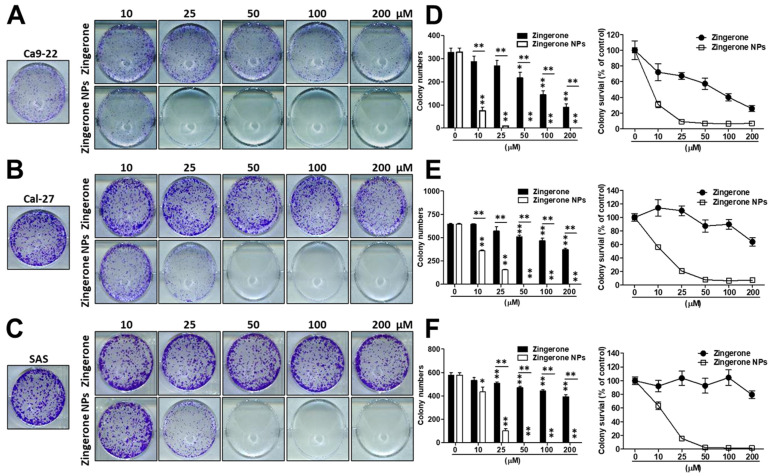
Zingerone NPs elicited a superior anti-tumorigenicity in three human OSCC Ca9-22, Cal-27, and SAS cell lines in vitro. Cells were treated with various doses of zingerone and/or zingerone NPs for 7–10 days. The colony formation was further stained and detected using crystal violet staining. The zingerone NP-mediated anti-tumorgenicity on Ca9-22 cells (A), Ca1-27 cells (B), and SAS cells (C) was observed and recorded using inverted microscopy. Quantitative analysis of colony formation was performed, and either colony numbers or colony survival rate for (D) Ca9-22 cells, (E) Ca1-27 cells, and (F) SAS cells, respectively, were further counted and determined using absorbance detection at 595 nm. All data are expressed as the mean ± SEM of three experiments. * p < 0.05, ** p < 0.01.
Figure 3
Figure 3
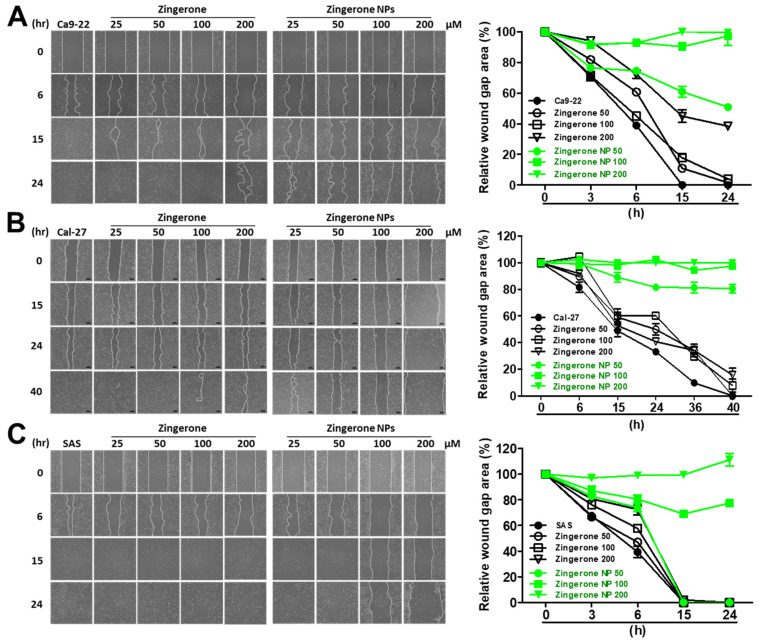
Effect of nanosized zingerone on cell motility of human OSCC cell lines. Dose and time effects of zingerone NPs on (A) Ca9-22 cells, (B) Ca1-27 cells, and (C) SAS cells were validated and imaged using wound scratch assays. The percentages of gap healing were further analyzed and quantified at the indicated time intervals (right panels). Data are mean ± SEM of at least three independent experiments.
Figure 4
Figure 4
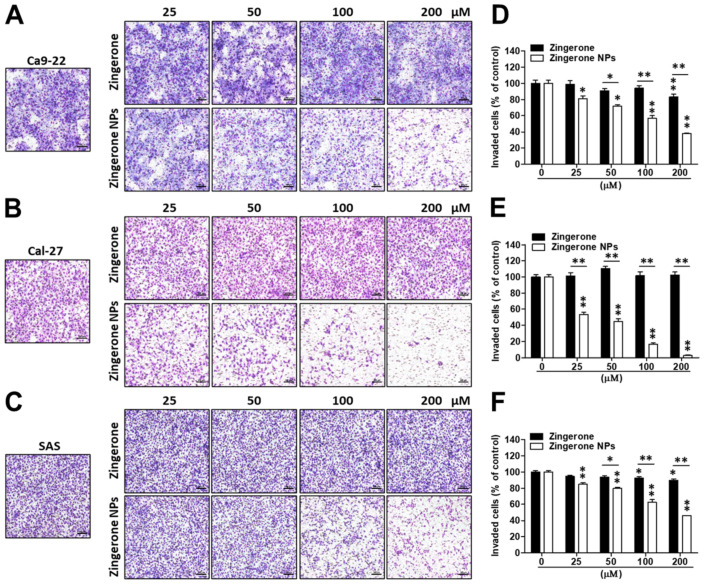
Effect of nanosized zingerone on cell invasion of three human OSCC cell lines. Cells were treated with various doses of zingerone and/or zingerone NPs and then subjected to Boyden chamber assays. Following incubation for an adequate time, the cell invasion of three human OSCC cell lines, (A) Ca9-22 cells, (B) Ca1-27 cells, and (C) SAS cells, was imaged and recorded using inverted microscopy. Bar: 100 µm. The invasive cells of (D) Ca9-22 cells, (E) Ca1-27 cells, and (F) SAS cells were further counted and quantified. Bars represented as mean ± SEM for n = 5 membranes in three separate experiments (* p < 0.05; ** p < 0.01).
Figure 5
Figure 5
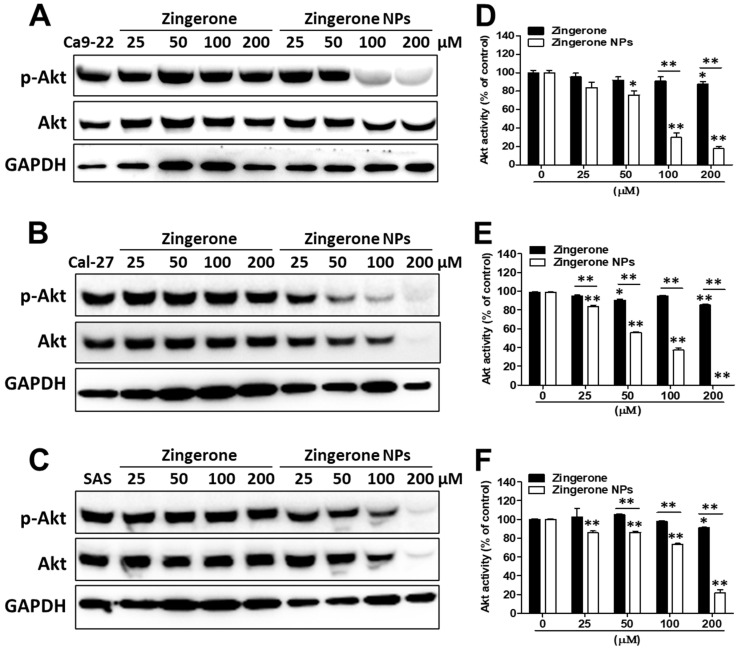
Effect of zingerone NPs on Akt activity of human OSCC cell lines. Cells were treated with zingerone and/or zingerone NPs for 24 h. The Akt activity was detected on (A) Ca9-22 cells, (B) Ca1-27 cells, and (C) SAS cells, respectively using Western blotting. The Akt activity was further analyzed and quantitated for (D) Ca9-22 cells, (E) Ca1-27 cells, and (F) SAS cells. Data are expressed as mean ± SEM of three experiments. * p < 0.05, ** p < 0.01.
Figure 6
Figure 6
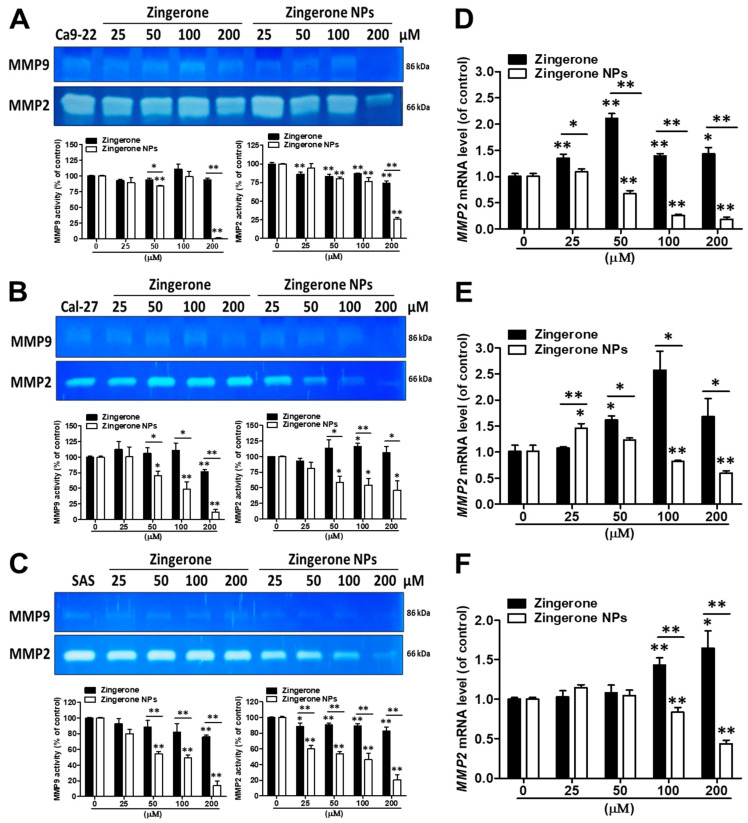
Effects of zingerone NPs on MMPs activity of human OSCC cell lines. Cells were incubated in serum-free DMEM and contained with various doses of zingerone and/or zingerone NPs for 24 h. The conditioned media of (A) Ca9-22 cells, (B) Ca1-27 cells, and (C) SAS cells were collected to analyze MMP activity, including MMP2 and MMP9, using a gelatin zymography assay. Moreover, the mRNA expression levels of MMP2 in (D) Ca9-22 cells, (E) Ca1-27 cells, and (F) SAS cells were analyzed using qPCR analysis. Data are mean ± SEM of three independent experiments. * p < 0.05, ** p < 0.01.
Figure 7
Figure 7
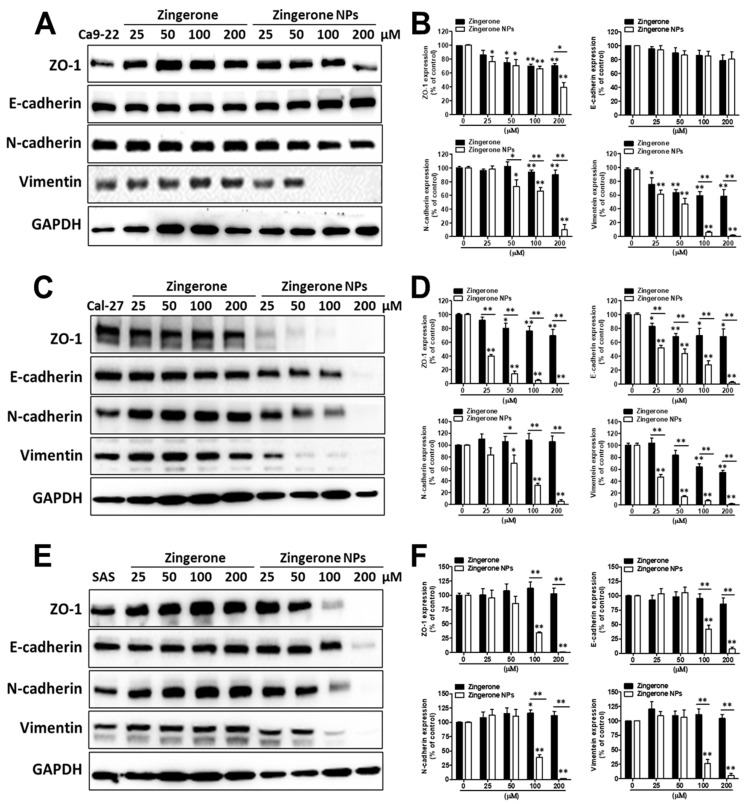
Zingerone NPs disturbed the expression levels of EMT-associated proteins in human OSCC cell lines. Cells were treated with zingerone and/or zingerone NPs for 24 h. The EMT-associated proteins, including ZO-1, E-cadherin, N-cadherin, and vimentin, were analyzed and quantitated on Ca9-22 cells (A,D), Ca1-27 cells (B,E), and SAS cells (C,F), respectively, using Western blotting assay. Data are expressed as mean ± SEM of three experiments. * p < 0.05, ** p < 0.01.
Figure 8
Figure 8
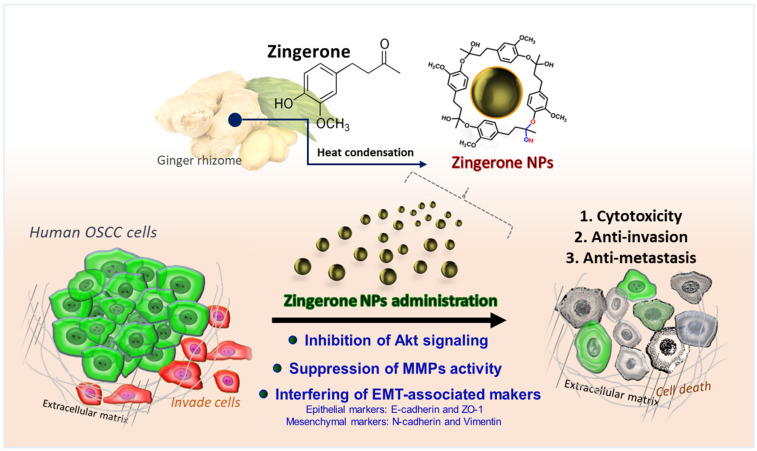
The phytochemically derived zingerone NPs elicited superior efficacy to inhibit the cell invasion and metastasis of human oral squamous cell carcinoma. The as-fabricated zingerone NPs significantly suppressed Akt signaling-mediated cell survival and cell motility, which led to obvious cytotoxicity and anti-proliferation. Moreover, the zingerone NP-mediated downregulation of MMP activity was also reflected in the harsh cell motility. In addition, the zingerone NPs substantially disturbed the expression levels of EMT-associated markers, including the mesenchymal markers N-cadherin and vimentin, and the epithelial markers ZO-1 and E-cadherin. These results suggested that the zingerone NPs exerted superior suppression on cell proliferation, tumorigenicity, and cell motility, and thus achieved an inhibitory effect against the cell invasion and metastasis of human oral squamous cell carcinoma.

References

    1. Global Cancer Observatory: Cancer Today. International Agency for Research on Cancer. [(accessed on 15 November 2021)]. Available online: https://gco.Iarc.Fr/today/fact-sheets-cancers.
    1. Bray F., Ferlay J., Soerjomataram I., Siegel R.L., Torre L.A., Jemal A. Global cancer statistics 2018: GLOBOCAN estimates of incidence and mortality worldwide for 36 cancers in 185 countries. CA Cancer J. Clin. 2018;68:394–424. doi: 10.3322/caac.21492. Erratum in CA Cancer J. Clin. 2020, 70, 313. - DOI - PubMed
    1. Anwar N., Pervez S., Chundriger Q., Awan S., Moatter T., Ali T.S. Oral cancer: Clinicopathological features and associated risk factors in a high risk population presenting to a major tertiary care center in Pakistan. PLoS ONE. 2020;15:e0236359. doi: 10.1371/journal.pone.0236359. - DOI - PMC - PubMed
    1. Tenore G., Nuvoli A., Mohsen A., Cassoni A., Battisti A., Terenzi V., Della Monaca M., Raponi I., Brauner E., De Felice F., et al. Tobacco, Alcohol and Family History of Cancer as Risk Factors of Oral Squamous Cell Carcinoma: Case-Control Retrospective Study. Appl. Sci. 2020;10:3896. doi: 10.3390/app10113896. - DOI
    1. Vargas-Ferreira F., Nedel F., Etges A., Gomes A.P.N., Furuse C., Tarquinio S.B.C. Etiologic factors associated with oral squamous cell carcinoma in non-smokers and non-alcoholic drinkers: A brief approach. Braz. Dent. J. 2012;23:586–590. doi: 10.1590/S0103-64402012000500020. - DOI - PubMed