


Resident-Related Factors Influencing Antibiotic Treatment Decisions for Urinary Tract Infections in Dutch Nursing Homes
- PMID: 35203742
- PMCID: PMC8868192
- DOI: 10.3390/antibiotics11020140
Resident-Related Factors Influencing Antibiotic Treatment Decisions for Urinary Tract Infections in Dutch Nursing Homes
Abstract
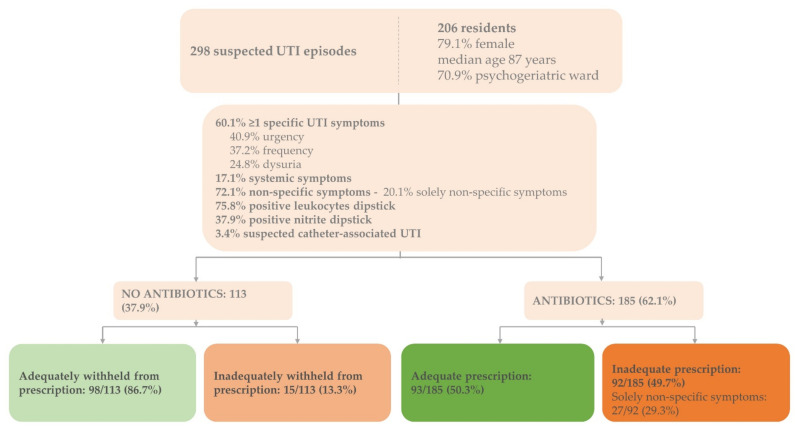
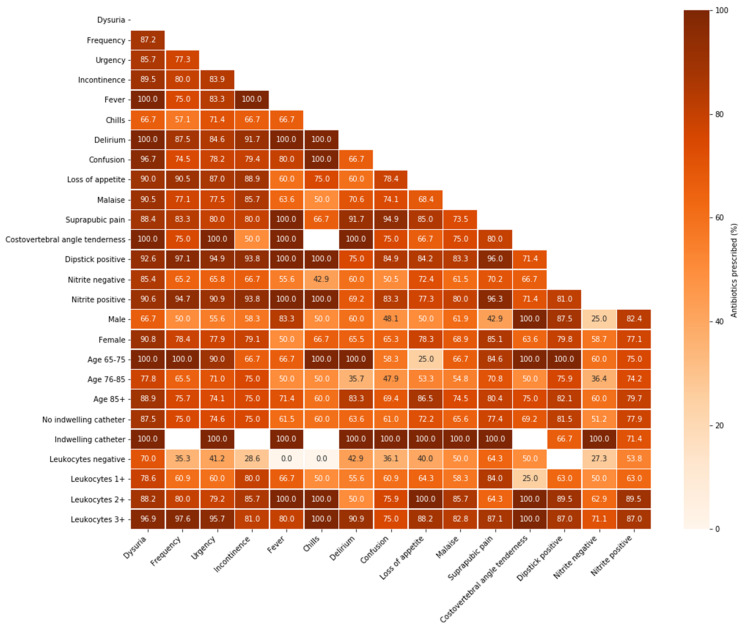
The aim of this cohort study was to identify resident-related factors that influence antibiotic treatment decisions for urinary tract infections (UTIs) in nursing home residents and to provide an overview of the appropriateness of antibiotic treatment decisions according to the updated Dutch guideline for UTIs in frail older adults. The PROGRESS study dataset, consisting of 298 suspected UTI episodes in Dutch nursing home residents, was used. The presence of dysuria was associated with the highest frequency of antibiotic prescription (87.8%). Positive leukocyte esterase dipstick results showed the greatest increase in the risk of antibiotic prescription (RR 2.1, 95% CI 1.44 to 3.06). Treatment decisions were considered adequate in 64.1% of the suspected UTI episodes. Overtreatment occurred more often than undertreatment. Of the inadequate treatment decisions, 29.3% was due to treatment of UTI episodes in which solely non-specific symptoms were present. A high proportion of nitrofurantoin prescriptions were incorrect in UTIs with signs of tissue invasion (54.8%), indwelling catheter-associated UTIs (37.5%), and UTIs in men (29.2%). Although this is considered inadequate, non-specific symptoms were associated with antibiotic prescription for suspected UTIs in Dutch nursing home residents and nitrofurantoin was inadequately prescribed in particular groups, such as men.
Keywords: antibiotic prescribing; nursing homes; urinary tract infection.
Conflict of interest statement
The authors declare no conflict of interest. The funder had no role in the design of this study; in the collection, analyses, or interpretation of data; in the writing of the manuscript; or in the decision to publish the results.
Figures
References
-
- Pulia M., Kern M., Schwei R.J., Shah M.N., Sampene E., Crnich C.J. Comparing appropriateness of antibiotics for nursing home residents by setting of prescription initiation: A cross-sectional analysis. Antimicrob. Resist. Infect. Control. 2018;7:74. doi: 10.1186/s13756-018-0364-7. - DOI - PMC - PubMed
-
- Van Buul L.W., Veenhuizen R.B., Achterberg W.P., Schellevis F.G., Essink R.T.G.M., de Greeff S.C., Natsch S., van der Steen J.T., Hertogh C.M.P.M. Antibiotic Prescribing in Dutch Nursing Homes: How Appropriate Is It? J. Am. Med. Dir. Assoc. 2015;16:229–237. doi: 10.1016/j.jamda.2014.10.003. - DOI - PubMed
Grants and funding
LinkOut - more resources
Full Text Sources
