Review
. 2022 Jan 20;12(2):168.
doi: 10.3390/biom12020168.

Passive Immunization in Alpha-Synuclein Preclinical Animal Models

Affiliations
Review

Passive Immunization in Alpha-Synuclein Preclinical Animal Models

Jonas Folke et al. Biomolecules. .

Abstract

Alpha-synucleinopathies include Parkinson's disease, dementia with Lewy bodies, pure autonomic failure and multiple system atrophy. These are all progressive neurodegenerative diseases that are characterized by pathological misfolding and accumulation of the protein alpha-synuclein (αsyn) in neurons, axons or glial cells in the brain, but also in other organs. The abnormal accumulation and propagation of pathogenic αsyn across the autonomic connectome is associated with progressive loss of neurons in the brain and peripheral organs, resulting in motor and non-motor symptoms. To date, no cure is available for synucleinopathies, and therapy is limited to symptomatic treatment of motor and non-motor symptoms upon diagnosis. Recent advances using passive immunization that target different αsyn structures show great potential to block disease progression in rodent studies of synucleinopathies. However, passive immunotherapy in clinical trials has been proven safe but less effective than in preclinical conditions. Here we review current achievements of passive immunotherapy in animal models of synucleinopathies. Furthermore, we propose new research strategies to increase translational outcome in patient studies, (1) by using antibodies against immature conformations of pathogenic αsyn (monomers, post-translationally modified monomers, oligomers and protofibrils) and (2) by focusing treatment on body-first synucleinopathies where damage in the brain is still limited and effective immunization could potentially stop disease progression by blocking the spread of pathogenic αsyn from peripheral organs to the brain.

Keywords: alpha-synuclein; disease stratification; passive immunization.


Conflict of interest statement

The authors declare no conflict of interest.

Figures
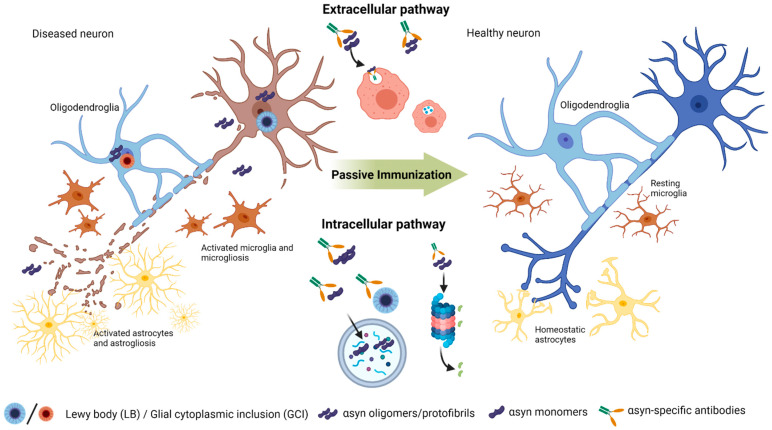
Figure 1
Figure 1
Clearing process of pathogenic alpha-synuclein (αsyn) using naturally occurring αsyn conformation-specific antibodies in passive immunization. In synucleinopathies, pathogenic αsyn species (proto/fibrillary or oligomeric) accumulate and potentially seed monomeric αsyn facilitating transmission, and additionally triggering microglial and astrocytic activation. In PD and DLB, αsyn aggregates in neurons form LBs. Whereas in MSA, αsyn accumulates in oligodendroglial cells, forming GCIs. Administration of αsyn-specific antibodies could facilitate clearance of pathogenic αsyn in the extracellular space by phagocytosis reducing transmission of pathogenic species or enable intracellular antibody-aided autophagy and proteosomic degradation, both pathways leading to reduced pathogenic αsyn and rescue of neuronal degradation. Created using Biorender.com (accessed on 30 November 2021).
Figure 2
Figure 2
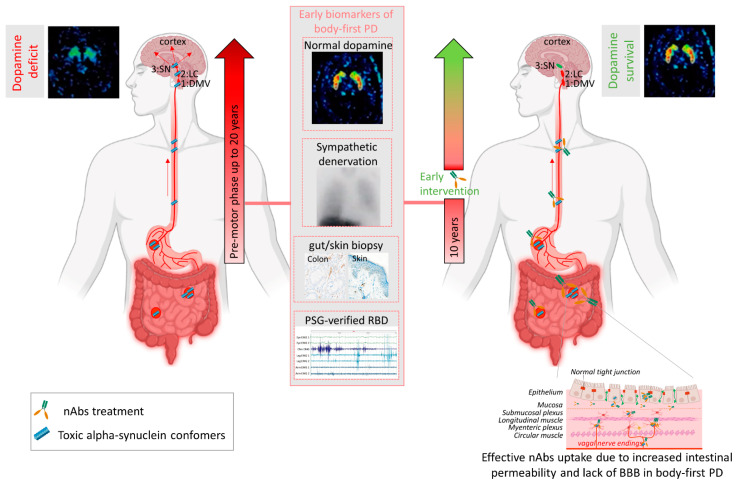
Passive immunization of pre-motor body-first PD patients enhances dopamine survival. Patients with probable prodromal body-first PD could be identified by a combination of several early biomarkers, such as the presence of pathological alpha-synuclein (αsyn) in skin and/or gut biopsies, polysomnography-verified RBD, cardiac sympathetic denervation on MIBG scintigraphies, but normal or near-normal nigrostriatal dopaminergic innervation on DaT SPECT. Such detailed phenotyping in the pre-motor phase might reveal body-first PD, allowing early intervention and optimal patient selection for clinical trials. Pre-motor start of nAbs treatment increases treatment efficacy by delaying or blocking peripheral-to-brain propagation of pathology, before any irreversible damage to the dopamine system is done, hereby enhancing the probability of dopamine survival in body-first PD. Furthermore, increased gut permeability in prodromal body-first PD patients with ‘leaky gut’ or increased intestinal permeability might yield a better uptake of the administered nAbs near the source of pathogenic αsyn conformers, resulting in a better treatment efficacy, as opposed to brain-first cases where the source is located in the brain and only 0.1–0.2% of nAbs cross the blood–brain barrier. Abbreviations: nAbs: naturally occurring autoantibodies; DMV: dorsal motor nucleus of the vagus; LC: locus coeruleus; SN: substantia nigra, PAF: pure autonomic failure, PSG: polysomnography, BBB: blood brain barrier. Created using Biorender.com (accessed on 30 November 2021).

References

    1. Spillantini M.G., Schmidt M.L., Lee V.M., Trojanowski J.Q., Jakes R., Goedert M. Alpha-synuclein in Lewy bodies. Nature. 1997;388:839–840. doi: 10.1038/42166. - DOI - PubMed
    1. Polymeropoulos M.H., Lavedan C., Leroy E., Ide S.E., Dehejia A., Dutra A., Pike B., Root H., Rubenstein J., Boyer R., et al. Mutation in the alpha-synuclein gene identified in families with Parkinson’s disease. Science. 1997;276:2045–2047. doi: 10.1126/science.276.5321.2045. - DOI - PubMed
    1. Chartier-Harlin M.-C., Kachergus J., Roumier C., Mouroux V., Douay X., Lincoln S., Levecque C., Larvor L., Andrieux J., Hulihan M., et al. Alpha-synuclein locus duplication as a cause of familial Parkinson’s disease. Lancet. 2004;364:1167–1169. doi: 10.1016/S0140-6736(04)17103-1. - DOI - PubMed
    1. Singleton A.B., Farrer M., Johnson J., Singleton A., Hague S., Kachergus J., Hulihan M., Peuralinna T., Dutra A., Nussbaum R., et al. alpha-Synuclein locus triplication causes Parkinson’s disease. Science. 2003;302:841. doi: 10.1126/science.1090278. - DOI - PubMed
    1. Visanji N.P., Lang A.E., Kovacs G.G. Beyond the synucleinopathies: Alpha synuclein as a driving force in neurodegenerative comorbidities. Transl. Neurodegener. 2019;8:28. doi: 10.1186/s40035-019-0172-x. - DOI - PMC - PubMed

Publication types

Substances

LinkOut - more resources