


Status and Prospects of Botanical Biopesticides in Europe and Mediterranean Countries
- PMID: 35204810
- PMCID: PMC8869379
- DOI: 10.3390/biom12020311
Status and Prospects of Botanical Biopesticides in Europe and Mediterranean Countries
Abstract
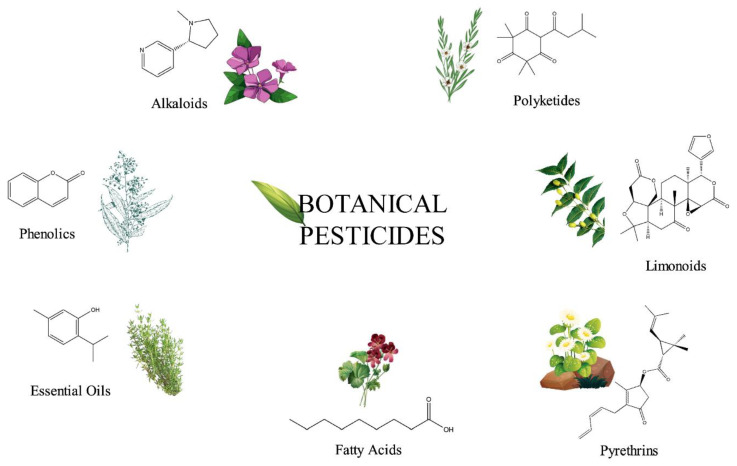
Concerning human and environmental health, safe alternatives to synthetic pesticides are urgently needed. Many of the currently used synthetic pesticides are not authorized for application in organic agriculture. In addition, the developed resistances of various pests against classical pesticides necessitate the urgent demand for efficient and safe products with novel modes of action. Botanical pesticides are assumed to be effective against various crop pests, and they are easily biodegradable and available in high quantities and at a reasonable cost. Many of them may act by diverse yet unexplored mechanisms of action. It is therefore surprising that only few plant species have been developed for commercial usage as biopesticides. This article reviews the status of botanical pesticides, especially in Europe and Mediterranean countries, deepening their active principles and mechanisms of action. Moreover, some constraints and challenges in the development of novel biopesticides are highlighted.
Keywords: Mediterranean region; bioactive substances; botanical fungicides; botanical herbicides; botanical insecticides; mechanism of action.
Conflict of interest statement
The authors declare no conflict of interest.
Figures


References
-
- Krüger M., Basiouni S., Ederk I., Rodloff A. Susceptibility of extended-spectrum ß-lactamase (ESBL)-producing Enterobacteriaaceae to Roundup. Ger. J. Microbiol. 2021;1:7–15. doi: 10.51585/gjm.2021.0003. - DOI
-
- Sola P., Mvumi B.M., Ogendo J.O., Mponda O., Kamanula J.F., Nyirenda S.P., Belmain S.R., Stevenson P.C. Botanical pesticide production, trade and regulatory mechanisms in sub-Saharan Africa: Making a case for plant-based pesticidal products. Food Secur. 2014;6:369–384. doi: 10.1007/s12571-014-0343-7. - DOI
Publication types
MeSH terms
Substances
LinkOut - more resources
Full Text Sources
Medical
