. 2022 Feb 18;12(2):328.
doi: 10.3390/biom12020328.

Abnormal RasGRP1 Expression in the Post-Mortem Brain and Blood Serum of Schizophrenia Patients

Affiliations

Abnormal RasGRP1 Expression in the Post-Mortem Brain and Blood Serum of Schizophrenia Patients

Arianna De Rosa et al. Biomolecules. .

Abstract

Schizophrenia (SCZ) is a polygenic severe mental illness. Genome-wide association studies (GWAS) have detected genomic variants associated with this psychiatric disorder and pathway analyses have indicated immune system and dopamine signaling as core components of risk in dorsolateral-prefrontal cortex (DLPFC) and hippocampus, but the mechanistic links remain unknown. The RasGRP1 gene, encoding for a guanine nucleotide exchange factor, is implicated in dopamine signaling and immune response. RasGRP1 has been identified as a candidate risk gene for SCZ and autoimmune disease, therefore representing a possible point of convergence between mechanisms involving the nervous and the immune system. Here, we investigated RasGRP1 mRNA and protein expression in post-mortem DLPFC and hippocampus of SCZ patients and healthy controls, along with RasGRP1 protein content in the serum of an independent cohort of SCZ patients and control subjects. Differences in RasGRP1 expression between SCZ patients and controls were detected both in DLPFC and peripheral blood of samples analyzed. Our results indicate RasGRP1 may mediate risk for SCZ by involving DLPFC and peripheral blood, thus encouraging further studies to explore its possible role as a biomarker of the disease and/or a target for new medication.

Keywords: DLPFC; RasGRP1; hippocampus; schizophrenia; serum.


Conflict of interest statement

The authors declare no conflict of interest.

Figures
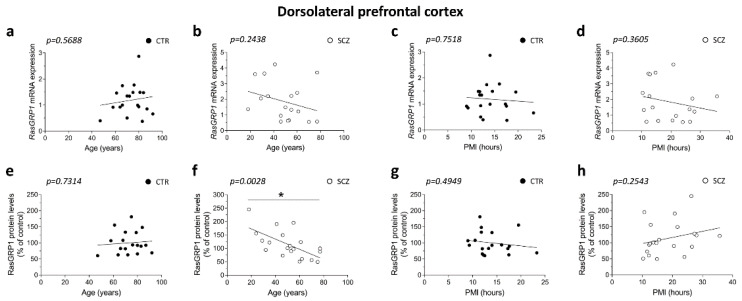
Figure 1
Figure 1
RasGRP1 protein levels negatively correlates with age but not with PMI in the DLPFC of schizophrenia patients. Analysis of correlation between age and mRNA/protein levels of RasGRP1 in the post-mortem DLPFC of (a,e) control subjects (CTR, n = 19) and (b,f) SCZ patients (SCZ, RasGRP1 mRNA: n = 18, RasGRP1 protein: n = 20). Analysis of correlation between PMI with mRNA and protein levels of RasGRP1 in the DLPFC of (c,g) control subjects (CTR, n = 19) and (d,h) SCZ patients (SCZ, RasGRP1 mRNA: n = 18, RasGRP1 protein: n = 20).
Figure 2
Figure 2
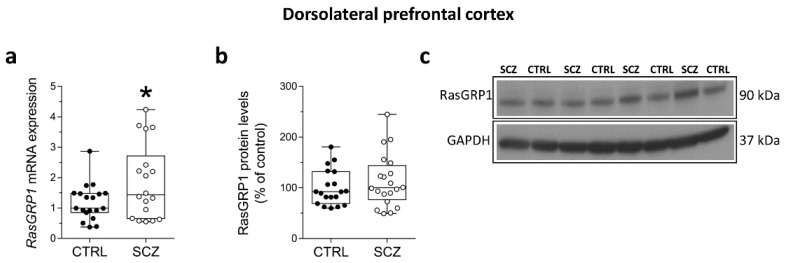
Increased RasGRP1 mRNA levels in the DLPFC of patients with SCZ. Expression levels of (a) RasGRP1 mRNA in the post-mortem DLPFC of SCZ patients (SCZ) (n = 18) and control subjects (CTRL) (n = 19). Quantification of western blot analysis of (b) RasGRP1 protein levels in the total homogenates of post-mortem DLPFC of SCZ-affected patients (SCZ) (n = 20) and control subjects (CTRL) (n = 19). The variations of RasGRP1 protein levels in patients affected by SCZ are expressed as percentage (%) of the control subjects. All markers were normalized to GAPDH for variation in loading and transfer; (c) representative images of immunoblots of RasGRP1 performed in the DLPFC of SCZ patients and control subjects. Each dot represents value from a single subject. * p < 0.05 compared to control group (Unpaired t-test). Multivariable regression analysis was performed against age and post-mortem interval (PMI).
Figure 3
Figure 3
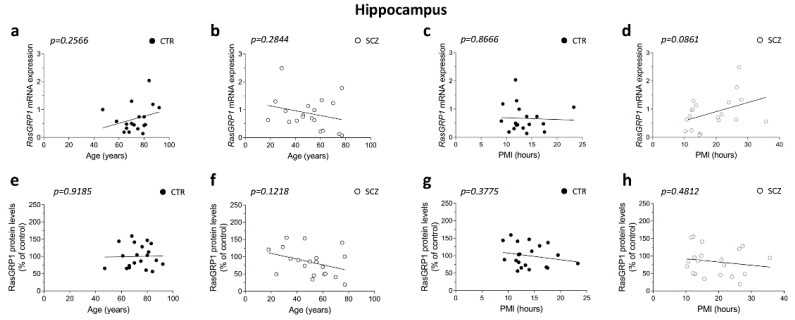
Lack of correlation between RasGRP1 mRNA and protein levels with age and PMI in the hippocampus of schizophrenia patients. Analysis of correlation between age and mRNA and protein levels of RasGRP1 in post-mortem hippocampus of (a,e) control subjects (CTR, RasGRP1 mRNA: n = 18, RasGRP1 protein: n = 20) and (b,f) SCZ patients (SCZ, RasGRP1 mRNA: n = 19, RasGRP1 protein: n = 20). Analysis of correlation between PMI with mRNA and protein levels of RasGRP1 in DLPFC of (c,g) control subjects (CTR, RasGRP1 mRNA: n = 18, RasGRP1 protein: n = 20) and (d,h) SCZ patients (SCZ, RasGRP1 mRNA: n = 19, RasGRP1 protein: n = 20).
Figure 4
Figure 4
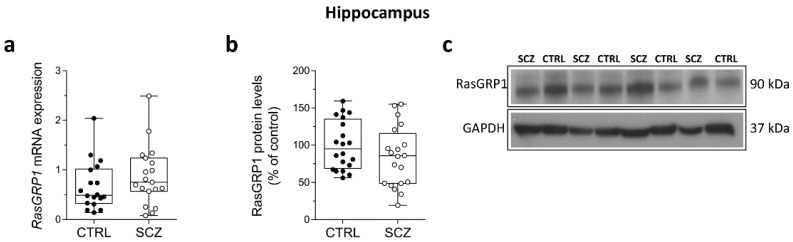
Unaltered RasGRP1 mRNA and protein levels in the hippocampus of schizophrenia patients. Expression levels of (a) RasGRP1 mRNA in the post-mortem hippocampus of SCZ-affected patients (SCZ) (n = 19) and control subjects (CTRL) (n = 18). Quantification of western blot analysis of (b) RasGRP1 protein levels in the total homogenates of post-mortem hippocampus of SCZ-affected patients (SCZ) (n = 20) and control subjects (CTRL) (n = 20). The variations of RasGRP1 protein levels in patients affected by SCZ are expressed as percentage (%) of the control subjects. All markers were normalized to GAPDH for variations in loading and transfer; (c) representative images of immunoblots of RasGRP1 performed in the hippocampus of SCZ patients and control subjects. Each dot represents value from a single subject. Unpaired t-test was performed in all analyses reported.
Figure 5
Figure 5
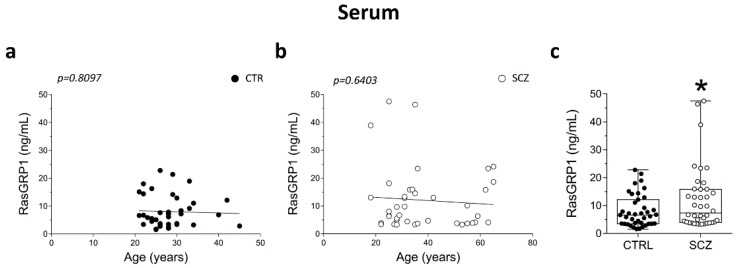
Detection of RasGRP1 protein concentration in the serum of healthy controls and schizophrenia patients. Analysis of correlation between age and RasGRP1 serum concentration of (a) control subjects (CTR, n = 39) and (b) SCZ patients (SCZ, n = 40). Analysis of (c) RasGRP1 concentration (ng/mL) in serum of SCZ-affected patients (SCZ, n = 40) and control subjects (CTR, 39). * p < 0.05 compared to control group (Unpaired t-test). Multivariable regression analysis was performed against age.

References

    1. Marder S.R., Galderisi S. The current conceptualization of negative symptoms in schizophrenia. World Psychiatry. 2017;16:14–24. doi: 10.1002/wps.20385. - DOI - PMC - PubMed
    1. Howes O.D., McCutcheon R., Owen M.J., Murray R. The Role of Genes, Stress, and Dopamine in the Development of Schizophrenia. Biol. Psychiatry. 2017;81:9–20. doi: 10.1016/j.biopsych.2016.07.014. - DOI - PMC - PubMed
    1. Conn K.-A., Burne T., Kesby J.P. Subcortical Dopamine and Cognition in Schizophrenia: Looking Beyond Psychosis in Preclinical Models. Front. Neurosci. 2020;14:542. doi: 10.3389/fnins.2020.00542. - DOI - PMC - PubMed
    1. O’Connor W.T., O’Shea S.D. Clozapine and GABA transmission in schizophrenia disease models: Establishing principles to guide treatments. Pharmacol. Ther. 2015;150:47–80. doi: 10.1016/j.pharmthera.2015.01.005. - DOI - PubMed
    1. Uno Y., Coyle J.T. Glutamate hypothesis in schizophrenia. Psychiatry Clin. Neurosci. 2019;73:204–215. doi: 10.1111/pcn.12823. - DOI - PubMed

Publication types

MeSH terms

LinkOut - more resources