. 2022 Jan 19;13(2):171.
doi: 10.3390/genes13020171.

Expression Profiles of miR-22-5p and miR-142-3p Indicate Hashimoto's Disease and Are related to Thyroid Antibodies

Affiliations

Expression Profiles of miR-22-5p and miR-142-3p Indicate Hashimoto's Disease and Are related to Thyroid Antibodies

Olivia Trummer et al. Genes (Basel). .

Abstract

Hashimoto's thyroiditis (HT) is the most prevalent autoimmune disorder of the thyroid (AITD) and characterized by the presence of circulating autoantibodies evoked by a, to date, not fully understood dysregulation of the immune system. Autoreactive lymphocytes and inflammatory processes in the thyroid gland can impair or enhance thyroid hormone secretion. MicroRNAs (miRNAs) are small noncoding RNAs, which can play a pivotal role in immune functions and the development of autoimmunity. The aim of the present study was to evaluate whether the expression of 9 selected miRNAs related to immunological functions differ in patients with HT compared to healthy controls. MiRNA profiles were analysed using quantitative reverse transcription polymerase chain reaction (qRT-PCR) in 24 patients with HT and 17 healthy controls. Systemic expressions of miR-21-5p, miR-22-3p, miR-22-5p, miR-142-3p, miR-146a-5p, miR-301-3p and miR-451 were significantly upregulated in patients with HT (p ≤ 0.01) and were suitable to discriminate between HT and healthy controls in AUC analysis. Altered expressions of miR-22-5p and miR-142-3p were associated with higher levels of thyroid antibodies, suggesting their contribution to the pathogenesis of HT.

Keywords: AITD; Hashimoto’s thyroiditis; autoimmune thyroid disease; miRNA.


Conflict of interest statement

The authors declare no conflict of interest. The funders had no role in the design of the study; in the collection, analyses, or interpretation of data; in the writing of the manuscript, or in the decision to publish the results.

Figures
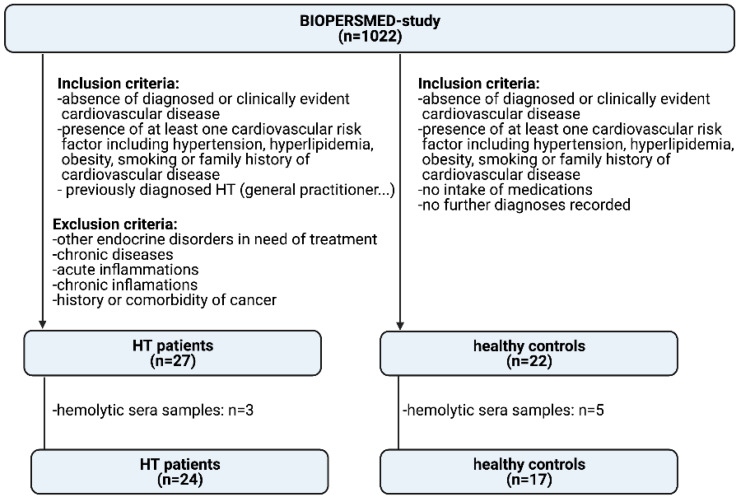
Figure 1
Figure 1
Study flow chart.
Figure 2
Figure 2
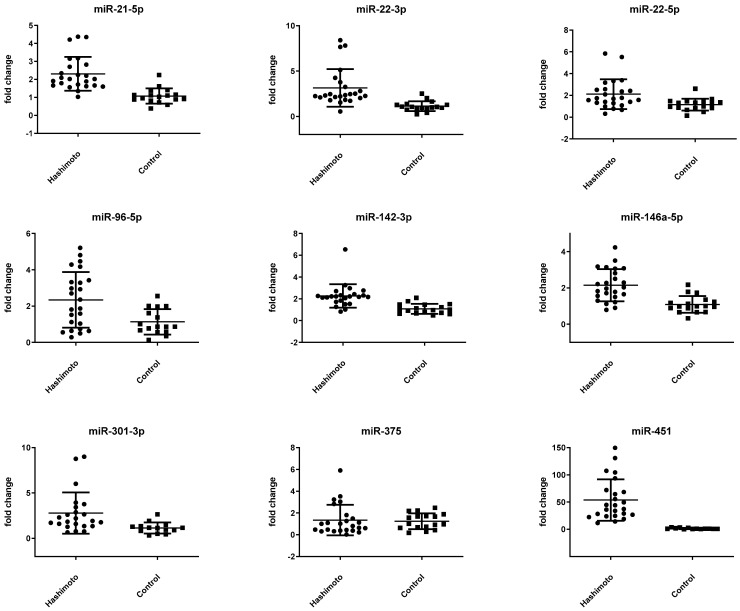
Expression of 9 miRNAs in serum of samples of HT patients and healthy controls. Data are displayed as scatter plots, where each dot represents the fold change as 2ΔΔct-value of one study sample. Significance was tested by unpaired Student’s t-test.
Figure 3
Figure 3
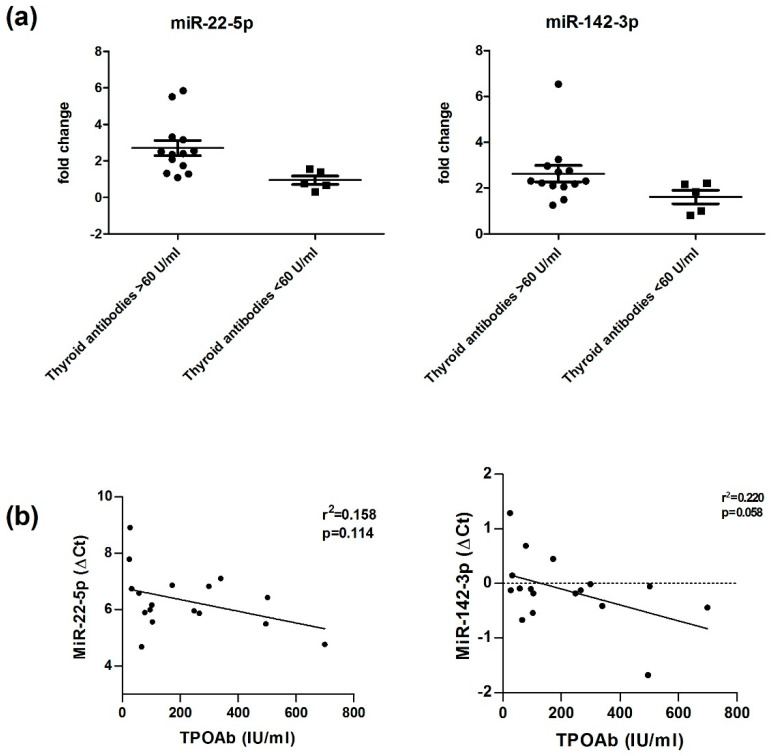
(a) Altered Expressions of miR-22-5p and miR-142-3p in serum of HT patients with higher levels of thyroid antibodies compared to HT patients with thyroid antibody levels <60 U/mL. Data are displayed as scatter plots, where each dot represents the ΔCt value of one HT patient. Significance was tested by unpaired Student’s t-test. (b)Thyroid Antibodies (TPOAb) did not correlate with higher expressions of miR-22-5p and miR-142-3p (ΔCt values). TgAb, thyroglobulin autoantibody; TPOAb, thyroid peroxidase autoantibody; ΔCt, delta Cycle threshold.
Figure 4
Figure 4
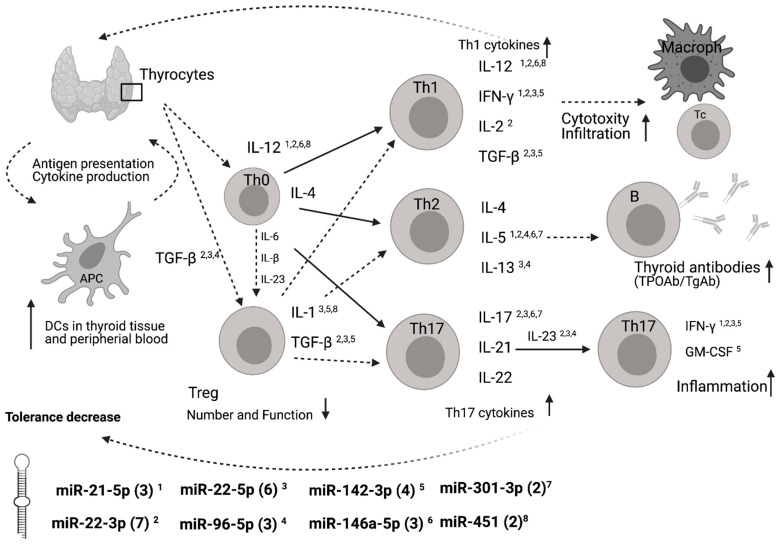
Summary of the main mechanisms related to autoimmunity of HT and potential interaction sites with differentially expressed miRNAs. Schematic representation of T cells differentiating into specific T cell subsets depending on the cytokines to which they are exposed and their main effects. MiRNA binding site predictions have been annotated by miRWalk database. Number of predicted binding sites are shown in brackets for each miRNA. Predicted binding sites of genes of HT immune-related molecules and/or their receptors are marked by superscript numbers. Adapted from [22]. APC, antigen presenting cell; Th, T helper cell; Macroph, macrophage; DC, dentritic cell; Treg, T-regulatory cells; TPOAb; peroxidase autoantibody; TgAb, thyroglobulin autoantibody, IL, interleukin; IFN-γ, interferon-γ; TGF-β, transforming growth factor β; GM-CSF, granulocyte-macrophage colony-stimulating factor; miR, miRNA.
Figure 5
Figure 5
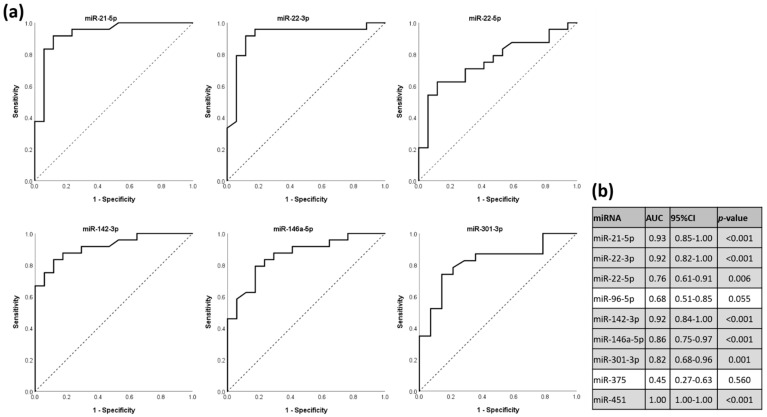
The potential of differentially expressed miRNAs to discriminate between HT status and healthy controls, shown in ROC curves. (a) ROC curves of selected differently expressed miRNAs. (b) Calculated AUC values, 95% CI and p-values of each investigated miRNA. ROC, receiver-operating characteristic; DE, differentially expressed; AUC, area under the curve; CI, confidence interval.

References

    1. Rapoport B., McLachlan S.M. Thyroid autoimmunity. J. Clin. Investig. 2001;108:1253–1259. doi: 10.1172/JCI14321. - DOI - PMC - PubMed
    1. Marwaha R.K., Sen S., Tandon N., Sahoo M., Walia R.P., Singh S., Ganguly S.K., Jain S.K. Familial aggregation of autoimmune thyroiditis in first-degree relatives of patients with juvenile autoimmune thyroid disease. Thyroid. 2003;13:297–300. doi: 10.1089/105072503321582114. - DOI - PubMed
    1. Zaletel K., Gaberšček S. Hashimoto’s Thyroiditis: From Genes to the Disease. Curr. Genom. 2011;12:576–588. doi: 10.2174/138920211798120763. - DOI - PMC - PubMed
    1. Baloch Z.W., LiVolsi V.A. Fine-needle aspiration of the thyroid: Today and tomorrow. Best Pract. Res. Clin. Endocrinol. Metab. 2008;22:929–939. doi: 10.1016/j.beem.2008.09.011. - DOI - PubMed
    1. Zhao L., Zhou X., Shan X., Qi L.W., Wang T., Zhu J., Zhu D., Huang Z., Zhang L., Zhang H., et al. Differential expression levels of plasma microRNA in Hashimoto’s disease. Gene. 2018;642:152–158. doi: 10.1016/j.gene.2017.10.053. - DOI - PubMed

Publication types

LinkOut - more resources