


hPG80 (Circulating Progastrin), a Novel Blood-Based Biomarker for Detection of Poorly Differentiated Neuroendocrine Carcinoma and Well Differentiated Neuroendocrine Tumors
- PMID: 35205614
- PMCID: PMC8870162
- DOI: 10.3390/cancers14040863
hPG80 (Circulating Progastrin), a Novel Blood-Based Biomarker for Detection of Poorly Differentiated Neuroendocrine Carcinoma and Well Differentiated Neuroendocrine Tumors
Abstract
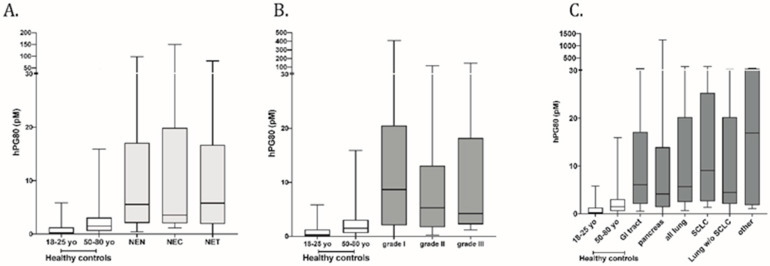
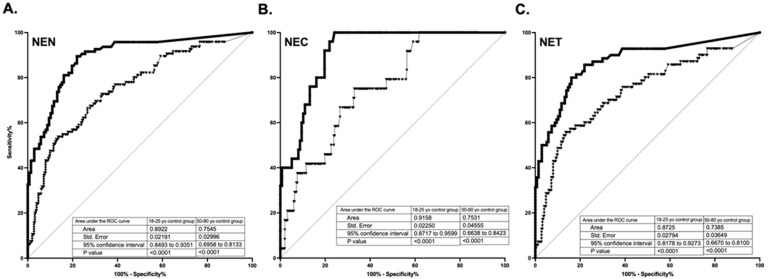
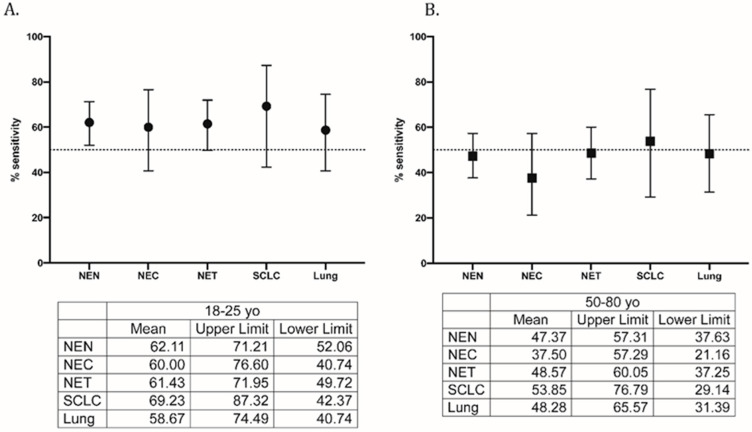
Current blood-based biomarkers for neuroendocrine neoplasms (NENs) lack both sensitivity and specificity. Human circulating progastrin (hPG80) is a novel biomarker that can be easily measured in plasma by ELISA. This study is the first to examine hPG80 in NENs. Plasma hPG80 was quantified from 95 stage IV NEN patients, using DxPG80 technology (ECS Progastrin, Switzerland) and compared with hPG80 concentrations in two cohorts of healthy donor controls aged 50-80 (n = 252) and 18-25 (n = 137). Median hPG80 in NENs patients was 5.54 pM compared to 1.5 pM for the 50-80 controls and 0.29 pM the 18-25 cohort (p < 0.0001). Subgroup analysis revealed median hPG80 levels significantly higher than for either control cohort in neuroendocrine carcinoma (NEC; n = 25) and neuroendocrine tumors (NET; n = 70) including the small-cell lung cancer (SCLC) sub-cohort (n = 13). Diagnostic accuracy, estimated by AUCs, was high for NENs, as well as both sub-groups (NEC/NET) when compared to the younger and older control groups. Plasma hPG80 in NENs may be a diagnostic blood biomarker for both low- and high-grade NENs; further study is warranted. A prospective multi-center trial is ongoing in NET to evaluate hPG80 as a means of monitoring disease (NCT04750954).
Keywords: blood-based diagnostic biomarker; circulating progastrin; hPG80; neuroendocrine carcinoma; neuroendocrine neoplasms; neuroendocrine tumors; small-cell carcinoma.
Conflict of interest statement
The employees of ECS Progastrin are A.P., Y.M., B.V. and D.J. Those with no competing interest are J.K., S.A., L.P., M.S., B.M.E. and L.A.
Figures
References
-
- Rehfeld J.F., Zhu X., Norrbom C., Bundgaard J.R., Johnsen A.H., Nielsen J.E., Vikesaa J., Stein J., Dey A., Steiner D.F., et al. Prohormone convertases 1/3 and 2 together orchestrate the site-specific cleavages of progastrin to release gastrin-34 and gastrin-17. Biochem. J. 2008;415:35–43. doi: 10.1042/BJ20080881. - DOI - PubMed
Associated data
Grants and funding
LinkOut - more resources
Full Text Sources
Medical
