


Increasing Terbinafine Resistance in Danish Trichophyton Isolates 2019-2020
- PMID: 35205904
- PMCID: PMC8879722
- DOI: 10.3390/jof8020150
Increasing Terbinafine Resistance in Danish Trichophyton Isolates 2019-2020
Erratum in
-
Correction: Astvad et al. Increasing Terbinafine Resistance in Danish Trichophyton Isolates 2019-2020. J. Fungi 2022, 8, 150.J Fungi (Basel). 2022 Jul 29;8(8):801. doi: 10.3390/jof8080801. J Fungi (Basel). 2022. PMID: 36012877 Free PMC article.
Abstract
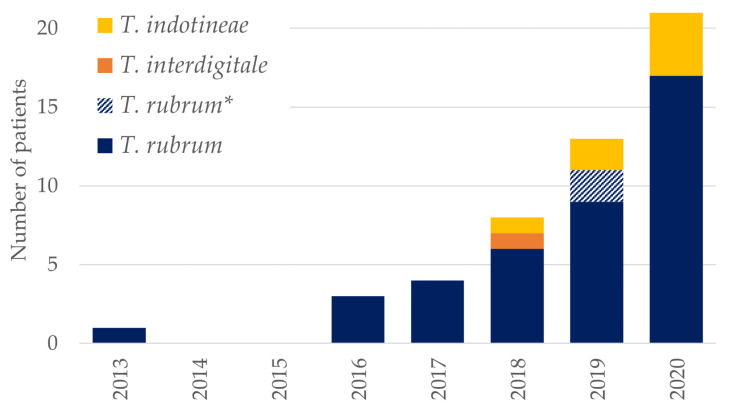
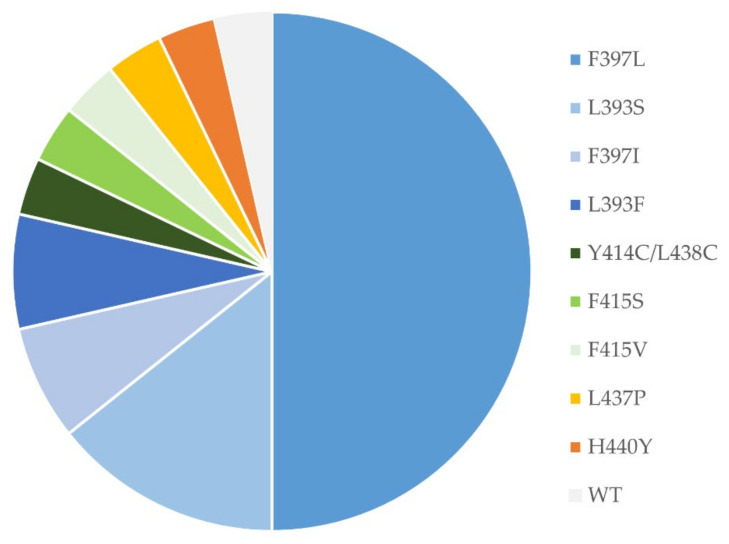
Terbinafine resistance in Trichophyton species has emerged and appears to be increasing. A new EUCAST susceptibility testing method and tentative ECOFFs were recently proposed for Trichophyton. Terbinafine resistance and target gene mutations were detected in 16 Danish isolates in 2013-2018. In this study, samples/isolates submitted for dermatophyte susceptibility testing 2019-2020 were examined. Species identification (ITS sequencing for T. mentagrophytes/T. interdigitale species complex (SC) isolates), EUCAST MICs and squalene epoxidase (SQLE) profiles were obtained. Sixty-three isolates from 59 patients were included. T. rubrum accounted for 81% and T. mentagrophytes/T. interdigitale SC for 19%. Approximately 60% of T. rubrum and T. mentagrophytes/interdigitale SC isolates were terbinafine non-wildtype and/or had known/novel SQLE mutations with possible implications for terbinafine MICs. All infections with terbinafine-resistant T. mentagrophytes/interdigitale SC isolates were caused by Trichophyton indotineae. Compared to 2013-2018, the number of patients with terbinafine-resistant Trichophyton isolates increased. For T. rubrum, this is partly explained by an increase in number of requests for susceptibility testing. Terbinafine-resistant T. indotineae was first detected in 2018, but accounted for 19% of resistance (4 of 21 patients) in 2020. In conclusion, terbinafine resistance is an emerging problem in Denmark. Population based studies are warranted and susceptibility testing is highly relevant in non-responding cases.
Keywords: SQLE; Trichophtyon mentagrophytes; Trichophyton benhamiae; Trichophyton indotineae; Trichophyton interdigitale; Trichophyton rubrum; dermatophyte resistance; squalene epoxidase; terbinafine.
Conflict of interest statement
Outside of this study, the authors declare the following potential conflicts of interest. KMTA has, over the past five years, received travel grants and speaker fees (personal honoraria) from Gilead and Pfizer. RKH has, over the past five years, received travel and an unrestricted research grant from Gilead. KMJ has, over the past five years, received a meeting grant from MSD and travel grants from Amplyx and F2G. DMLS was paid as a consultant for an advisory board meeting by AbbVie, Janssen, Sanofi, Leo Pharma, Novartis and received speaker’s honoraria and/or received grants from the following companies: Abbvie, Desitin, Pfizer, Galderma, Novartis and Leo Pharma during the last 5 years. PKT declares no conflicts of interest. MCA has, over the past 5 years, received research grants/contract work (paid to the SSI) from Amplyx, Basilea, Cidara, F2G, Gilead, Novabiotics and Scynexis, and speaker honoraria (personal fee) from Astellas, Chiesi, Gilead, MSD, and SEGES. She is the current chairman of the EUCAST-AFST.
Figures
References
-
- Tang C., Kong X., Ahmed S.A., Thakur R., Chowdhary A., Nenoff P., Uhrlass S., Verma S.B., Meis J.F., Kandemir H., et al. Taxonomy of the Trichophyton mentagrophytes/T. interdigitale Species Complex Harboring the Highly Virulent, Multiresistant Genotype T. indotineae. Mycopathologia. 2021;186:315–326. doi: 10.1007/s11046-021-00544-2. - DOI - PMC - PubMed
-
- Saunte D.M., Arendrup M.C. Månedsbladet Rationel Farmakoterapi 2015, nr. 3. Svampeinfektioner i Hud, Hår og Negle. [(accessed on 16 December 2021)]. Available online: https://www.sst.dk/da/udgivelser/2015/rationel-farmakoterapi-3-2015/svam....
LinkOut - more resources
Full Text Sources
