


Quantitative Microbial Risk Assessment Applied to Legionella Contamination on Long-Distance Public Transport
- PMID: 35206148
- PMCID: PMC8872098
- DOI: 10.3390/ijerph19041960
Quantitative Microbial Risk Assessment Applied to Legionella Contamination on Long-Distance Public Transport
Abstract
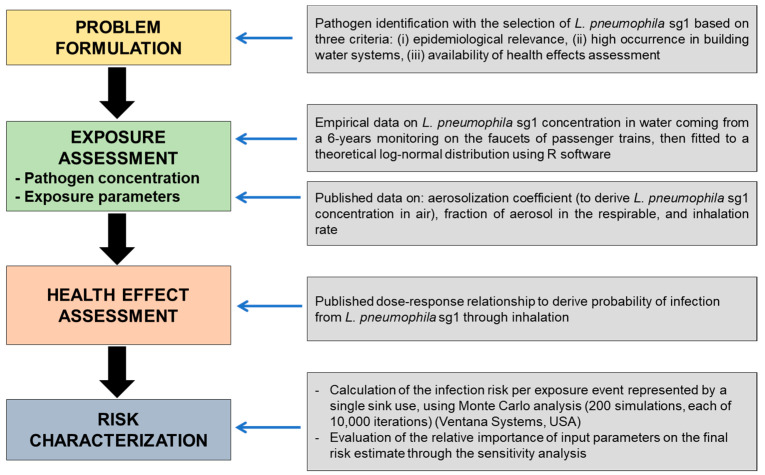
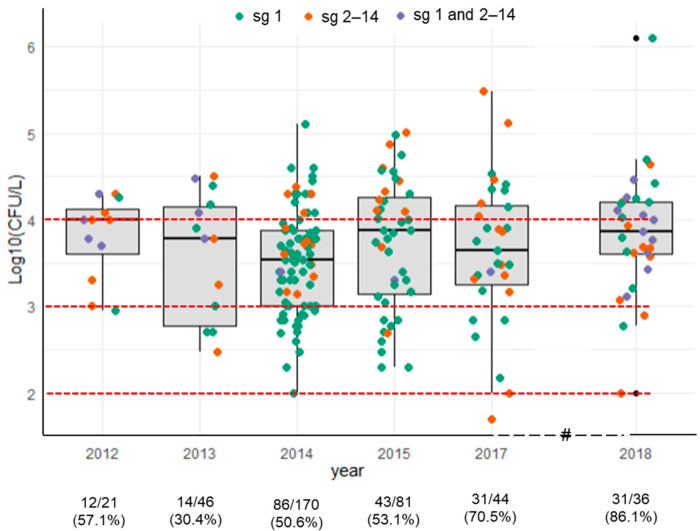
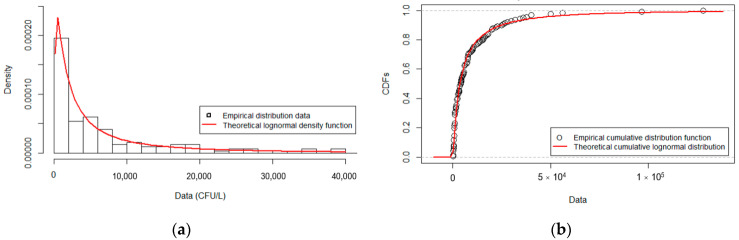
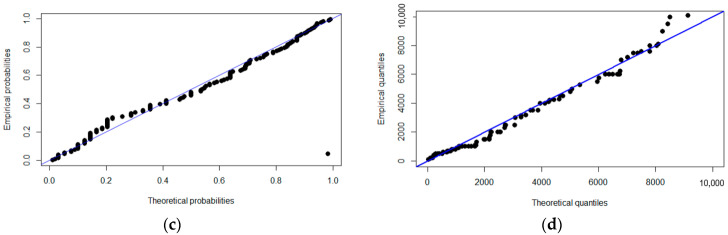
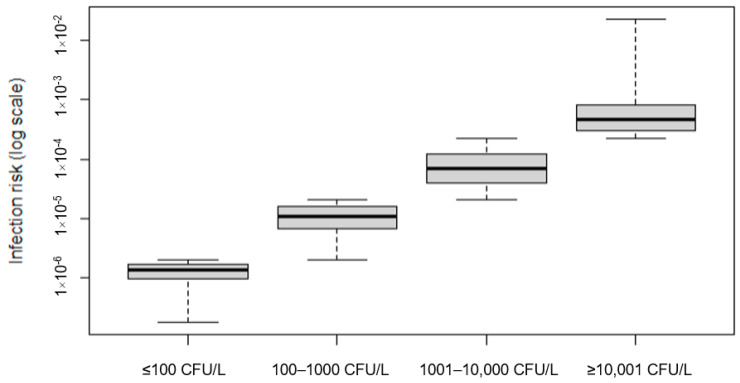
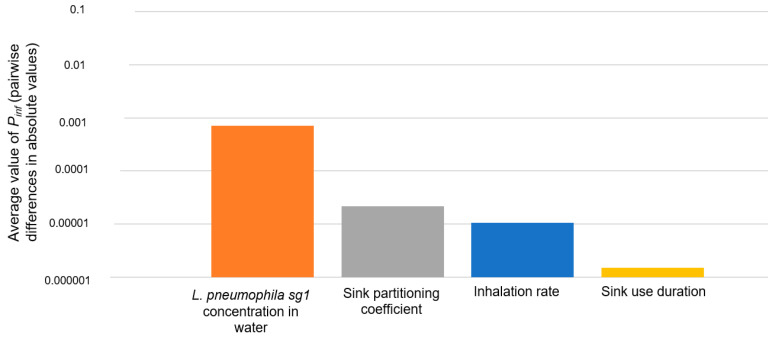
The quantitative microbial risk assessment (QMRA) framework is used for assessing health risk coming from pathogens in the environment. In this paper, we used QMRA to evaluate the infection risk of L. pneumophila attributable to sink usage in a toilet cabin on Italian long-distance public transportation (LDT). LDT has water distribution systems with risk points for Legionella proliferation, as well as premise plumbing for drinking water, but they are not considered for risk assessment. Monitoring data revealed that approximately 55% of water samples (217/398) were positive for L. pneumophila, and the most frequently isolated was L. pneumophila sg1 (64%, 139/217); therefore, such data were fitted to the best probability distribution function to be used as a stochastic variable in the QMRA model. Then, a sink-specific aerosolization ratio was applied to calculate the inhaled dose, also considering inhalation rate and exposure time, which were used as stochastic parameters based on literature data. At L. pneumophila sg1 concentration ≤100 CFU/L, health risk was approximately 1 infection per 1 million exposures, with an increase of up to 5 infections per 10,000 exposures when the concentrations were ≥10,000 CFU/L. Our QMRA results showed a low Legionella infection risk from faucets on LDT; however, it deserves consideration since LDT can be used by people highly susceptible for the development of a severe form of the disease, owing to their immunological status or other predisposing factors. Further investigations could also evaluate Legionella-laden aerosols from toilet flushing.
Keywords: Legionella pneumophila; bioaerosol; long-distance public transport; monitoring; premise plumbing; public health; risk assessment; train; water distribution system.
Conflict of interest statement
The authors declare no conflict of interest.
Figures
References
-
- WHO . In: Health Aspects of Plumbing. World Health Organization; World Council of Plumbing, editor. World Health Organization (WHO); Geneva, Switzerland: 2006. [(accessed on 1 December 2021)]. Available online: https://www.who.int/publications/i/item/9241563184.
-
- Benedict K.M., Reses H., Vigar M., Roth D.M., Roberts V.A., Mattioli M., Cooley L.A., Hilborn E.D., Wade T.J., Fullerton K.E., et al. Surveillance for waterborne disease outbreaks associated with drinking water—United States, 2013–2014. MMWR Morb. Mortal Wkly. Rep. 2017;66:1216–1221. doi: 10.15585/mmwr.mm6644a3. - DOI - PMC - PubMed
MeSH terms
Substances
LinkOut - more resources
Full Text Sources
Medical
