Review
. 2022 Feb 13;19(4):2099.
doi: 10.3390/ijerph19042099.

Review of Novel Potential Insulin Resistance Biomarkers in PCOS Patients-The Debate Is Still Open

Affiliations
Review

Review of Novel Potential Insulin Resistance Biomarkers in PCOS Patients-The Debate Is Still Open

Jagoda Kruszewska et al. Int J Environ Res Public Health. .

Abstract

Research on proteins and peptides that play roles in metabolic regulation, which may be considered potential insulin resistance markers in some medical conditions, such as diabetes mellitus, obesity and polycystic ovarian syndrome (PCOS), has recently gained in interest. PCOS is a common endocrine disorder associated with hyperandrogenemia and failure of ovulation, which is often accompanied by metabolic abnormalities, including obesity, dyslipidemia, hyperinsulinemia, and insulin resistance. In this review, we focus on less commonly known peptides/proteins and investigate their role as potential biomarkers for insulin resistance in females affected by PCOS. We summarize studies comparing the serum fasting concentration of particular agents in PCOS individuals and healthy controls. Based on our analysis, we propose that, in the majority of studies, the levels of nesfastin-1, myonectin, omentin, neudesin were decreased in PCOS patients, while the levels of the other considered agents (e.g., preptin, gremlin-1, neuregulin-4, xenopsin-related peptide, xenin-25, and galectin-3) were increased. However, there also exist studies presenting contrary results; in particular, most data existing for lipocalin-2 are inconsistent. Therefore, further research is required to confirm those hypotheses, as well as to elucidate the involvement of these factors in PCOS-related metabolic complications.

Keywords: galectin; gremlin; insulin resistance; myonectin; nesfatin; neuregulin; omentin; polycystic ovarian syndrome; preptin; xenin.


Conflict of interest statement

The authors declare no conflict of interest.

Figures
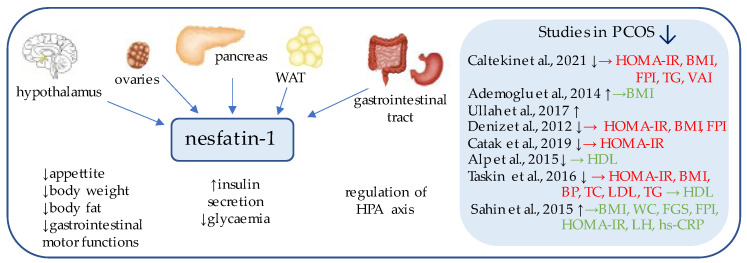
Figure 1
Figure 1
Role of nesfatin-1 in the pathogenesis of insulin resistance and PCOS. List of the studies assessing serum nesfatin level in the PCOS patients. ↑/↓ indicates whether concentration level of serum nesfatin was increased/decreased in PCOS individuals (p < 0.05); → (green)—indicates positive correlation between serum nesfatin and particular indicators; → (red)—indicates negative correlation between serum nesfatin and particular indicator; HOMA-IR—Homeostatic Model Assessment for Insulin Resistance; BMI—body mass index; FPI—fasting plasma insulin; TG—triglycerides; VAI—Visceral Adiposity Index; HDL—high density lipoprotein; BP—blood pressure; TC—total cholesterol; LDL—low-density lipoproteins; WC—waist circumference; FGS—Ferriman–Gallwey Score; LH—Luteinizing Hormone; hs-CRP—high-sensitivity C-Reactive Protein; WAT—white adipose tissue; HPA axis—Hypothalamic–Pituitary–Adrenal axis.
Figure 2
Figure 2
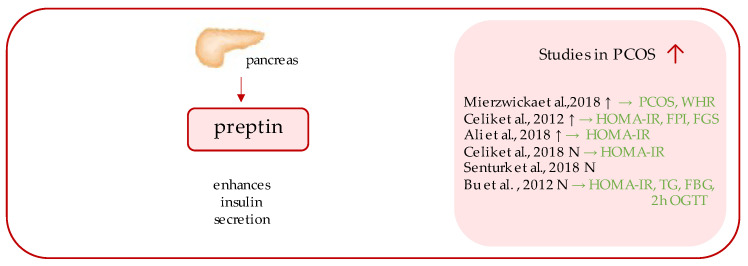
Role of preptin in the pathogenesis of insulin resistance and PCOS. List of the studies assessing serum nesfatin level in the PCOS patients. ↑/N indicates whether concentration level of serum preptin was increased/unchanged in PCOS individuals (p < 0.05); → (green)—indicates positive correlation between serum nesfatin and particular indicators; PCOS—polycystic ovarian syndrome; WHR—waist-to-hip ratio; HOMA-IR—Homeostatic Model Assessment for Insulin Resistance; FPI—fasting plasma insulin; FGS—Ferriman–Gallwey score; TG—triglycerides; FBG—fasting blood glucose; OGTT—oral glucose tolerance test.
Figure 3
Figure 3
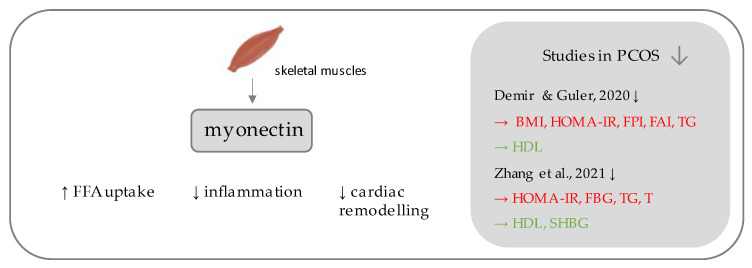
Role of myonectin in the pathogenesis of insulin resistance and PCOS. List of the studies assessing serum nesfatin level in the PCOS patients. ↓ indicates that concentration level of serum myonectin was decreased in PCOS individuals (p < 0.05); → (green)—indicates positive correlation between serum myonectin and particular indicators; → (red)—indicates negative correlation between serum myonectin and particular indicator; BMI—Body Mass Index; HOMA-IR—Homeostatic Model Assessment for Insulin Resistance; FPI—fasting plasma insulin; FAI—free androgen index; TG—triglycerides; HDL—high density lipoproteins; FBG—fasting blood glucose; T—testosterone; SHBG—sex hormone binding globulin.
Figure 4
Figure 4
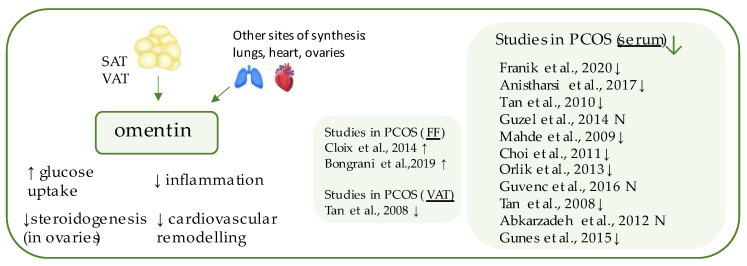
Role of omentin in the pathogenesis of insulin resistance and PCOS. List of the studies assessing nesfatin level in serum, follicular fluid (FF), and visceral adipose tissue (VAT) of the patients with PCOS. ↓/N indicates that concentration level of omentin was decreased/unchanged in PCOS individuals (p < 0.05).
Figure 5
Figure 5
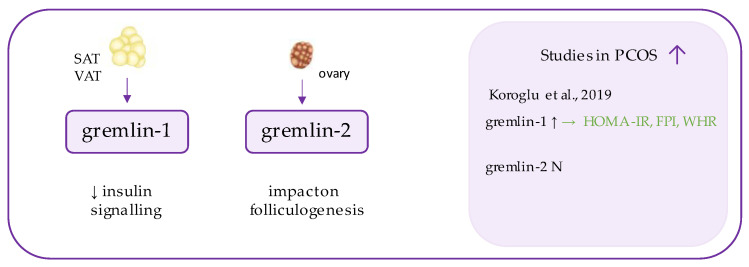
Role of gremlin in the pathogenesis of insulin resistance and PCOS. List of the studies assessing gremlins level in serum of the patients with PCOS. ↑/N indicates whether concentration level of gremlin was increased/unchanged in PCOS individuals (p < 0.05); → (green)—indicates positive correlation between serum omentin and particular indicators; HOMA-IR—Homeostatic Model Assessment for Insulin Resistance, FPI—fasting plasma insulin, WHR—waist-to-hip ratio.
Figure 6
Figure 6
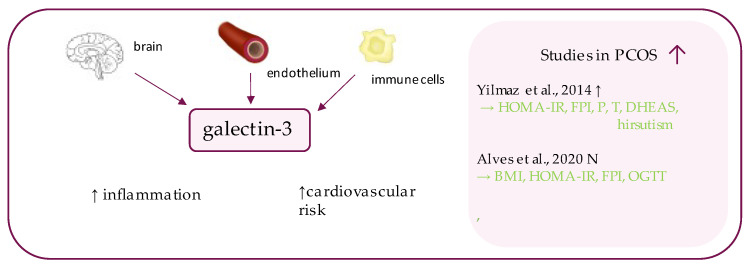
Role of galectin-3 in the pathogenesis of insulin resistance and PCOS. List of the studies assessing galectin-3 level in serum of the patients with PCOS. ↑/N indicates whether concentration level of galectin-3 was increased/ unchanged in PCOS individuals (p < 0.05); → (green)—indicates positive correlation between serum galectin-3 and particular indicators; HOMA-IR—Homeostatic Model Assessment for Insulin Resistance, FPI—fasting plasma insulin, P—progesterone, T—testosterone, DHEAS—dehydroepiandrosterone sulphate, BMI—body mass index, OGTT—oral glucose tolerance test.
Figure 7
Figure 7
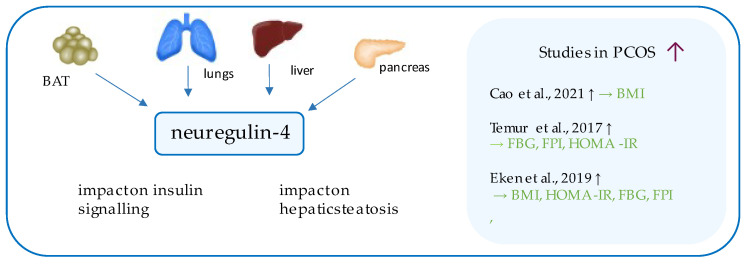
Role of neuregulin-4 in the pathogenesis of insulin resistance and PCOS. List of the studies assessing neuregulin-4 level in serum of the patients with PCOS. ↑ indicates that concentration level of neuregulin-4 was increased in PCOS individuals (p < 0.05); → (green)—indicates positive correlation between serum neuregulin-4 and particular indicators; BMI—body mass index; FBG—fasting blood glucose, FPI—fasting plasma insulin, HOMA-IR—Homeostatic Model Assessment for Insulin Resistance.
Figure 8
Figure 8
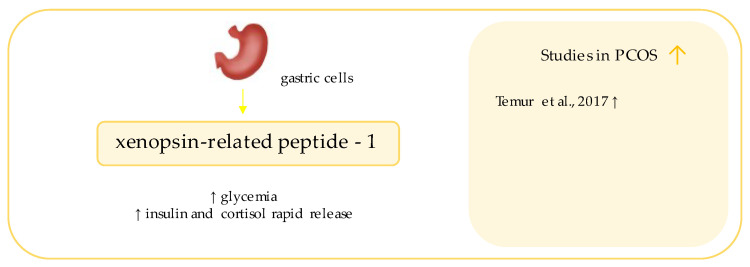
Role of xenopsin-related pepide in the pathogenesis of insulin resistance and PCOS. List of the studies assessing xenopsin-related peptide level in serum of the patients with PCOS. ↑ indicates that concentration level of neuregulin-4 was increased in PCOS individuals (p < 0.05).
Figure 9
Figure 9
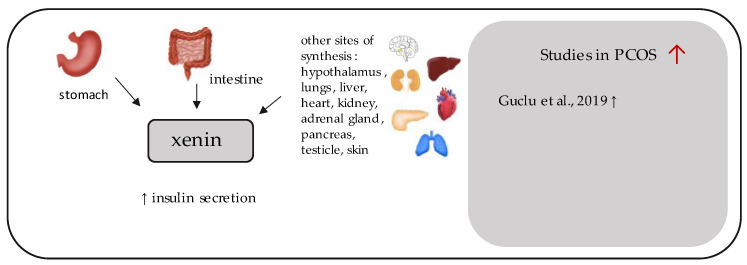
Role of xenin in the pathogenesis of insulin resistance and PCOS. List of the studies assessing xenin in serum of the patients with PCOS. ↑ indicates that concentration level of xenin was increased in PCOS individuals (p < 0.05).
Figure 10
Figure 10
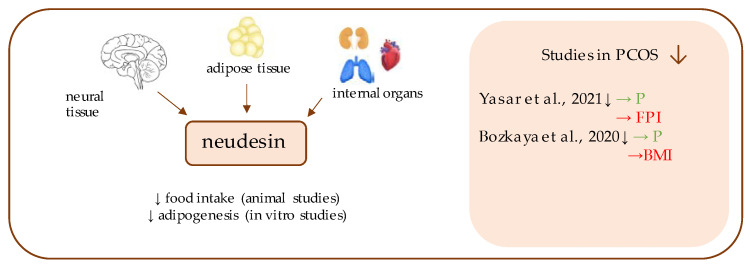
Role of neudesin in the pathogenesis of insulin resistance and PCOS. List of the studies assessing neudesin in serum of the patients with PCOS. ↓ indicates that concentration level of neudesin was decreased in PCOS individuals (p < 0.05); → (green)—indicates positive correlation between serum neudesin and particular indicators; → (red)—indicates negative correlation between serum neudesin and particular indicator; P—progesterone; FPI—fasting plasma insulin; BMI—body mass index.
Figure 11
Figure 11
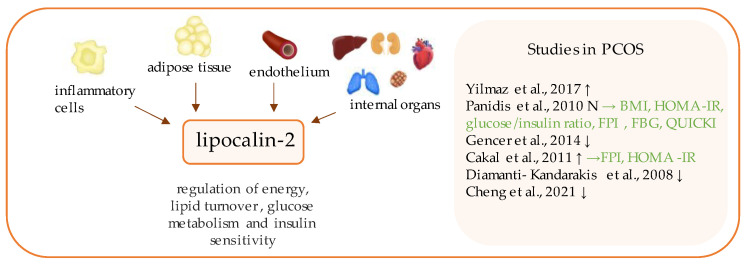
Role of lipocalin-2 in the pathogenesis of insulin resistance and PCOS. List of the studies assessing lipocalin-2 in serum of the patients with PCOS. ↑/↓/N indicates whether concentration level of lipocalin-2 was increased/decreased/unchanged in PCOS individuals (p < 0.05); → (green)—indicates positive correlation between serum lipocalin-2 and particular indicators; BMI—body mass index; HOMA-IR—Homeostatic Model Assessment—Insulin Resistance; FPI—fasting plasma insulin; FBG—fasting blood glucose; QUICKI—quantitative insulin sensitivity check index.

References

    1. Mierzwicka A., Bolanowski M. New peptides players in metabolic disorders. Postępy Higieny i Medycyny Doświadczalnej. 2016;70:881–886. doi: 10.5604/17322693.1216271. - DOI - PubMed
    1. Czerwińska M., Czarzasta K., Cudnoch-Jędrzejewska A. New Peptides as Potential Players in the Crosstalk Between the Brain and Obesity, Metabolic and Cardiovascular Diseases. Front. Physiol. 2021;12:692642. doi: 10.3389/fphys.2021.692642. - DOI - PMC - PubMed
    1. Kahn S.E., Hull R.L., Utzschneider K.M. Mechanisms linking obesity to insulin resistance and type 2 diabetes. Nature. 2006;444:840–846. doi: 10.1038/nature05482. - DOI - PubMed
    1. Aydin S. Three new players in energy regulation: Preptin, adropin and irisin. Peptides. 2014;56:94–110. doi: 10.1016/j.peptides.2014.03.021. - DOI - PubMed
    1. Polak K., Czyzyk A., Simoncini T., Meczekalski B. New markers of insulin resistance in polycystic ovary syndrome. J. Endocrinol. Investig. 2017;40:1–8. doi: 10.1007/s40618-016-0523-8. - DOI - PMC - PubMed