


White Spots Prevalence and Tooth Brush Habits during Orthodontic Treatment
- PMID: 35206934
- PMCID: PMC8872019
- DOI: 10.3390/healthcare10020320
White Spots Prevalence and Tooth Brush Habits during Orthodontic Treatment
Abstract
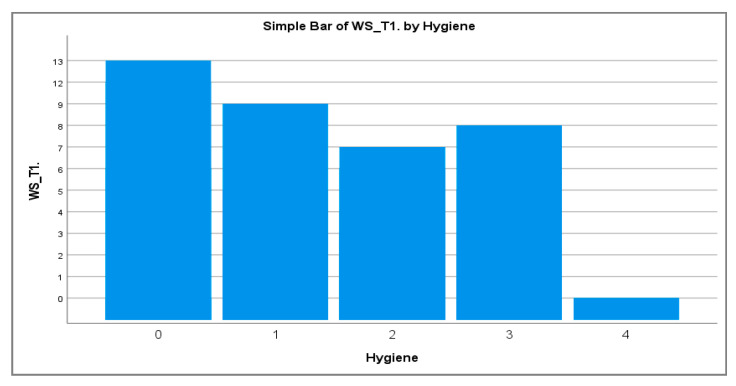
White spots (WS) are one of the most undesirable side effects in patients undergoing orthodontic therapy and are usually located around bracket bases and even detected under the molar bands. The aim of the present cross-sectional study was to evaluate the WS lesion during orthodontic therapy and the correlation between WS and oral hygiene habits. Patients requiring orthodontic treatment with a fixed appliance were screened for the inclusion/exclusion criteria, and 74 subjects were finally enrolled. Each patient received three examinations: at T0, the day of the application of the fixed appliance; at T1, three months later; and at T2, six months after treatment start. After calculating descriptive statistics, differences between groups were evaluated with an independent sample t-test. The first type error was set as p ≤ 0.01. The observed prevalence of WS lesions was 59.5% on T1 and 60.8% on T2. The most affected teeth result to be upper molars, lower left first molar, upper right central incisor and upper left lateral incisor, upper right canine, upper left first premolar, and lower right first molar. A higher frequency of daily tooth brushing was accompanied by a lower prevalence of WS. No significant effect of sex was observed.
Keywords: enamel tooth demineralization; oral health; orthodontics; white spots.
Conflict of interest statement
The authors declare no conflict of interest.
Figures
References
-
- Tavares M.I., Saraiva J., do Vale F., Coelho A.S., Amaro I.F., Marto C.M., Francisco I., Ferreira M.M., Paula A.B., Carrilho E.V. Resin infiltration in white spot lesions caused by orthodontic hypomineralisation: A minimally invasive therapy. Br. Dent. J. 2021;231:387–392. doi: 10.1038/s41415-021-3476-z. - DOI - PubMed
LinkOut - more resources
Full Text Sources
