


Adult Langerhans Cell Histiocytosis and the Skeleton
- PMID: 35207181
- PMCID: PMC8875624
- DOI: 10.3390/jcm11040909
Adult Langerhans Cell Histiocytosis and the Skeleton
Abstract
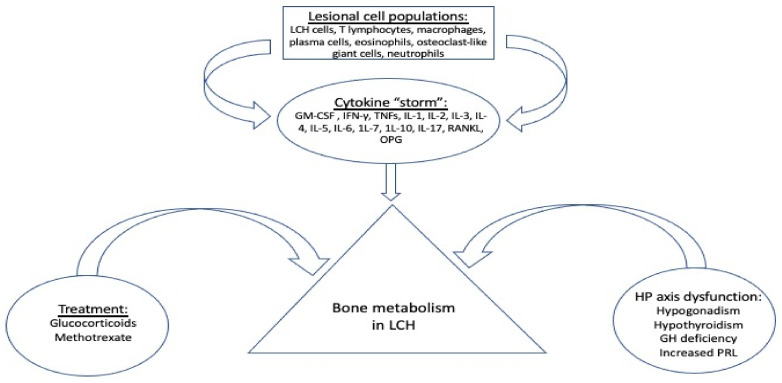
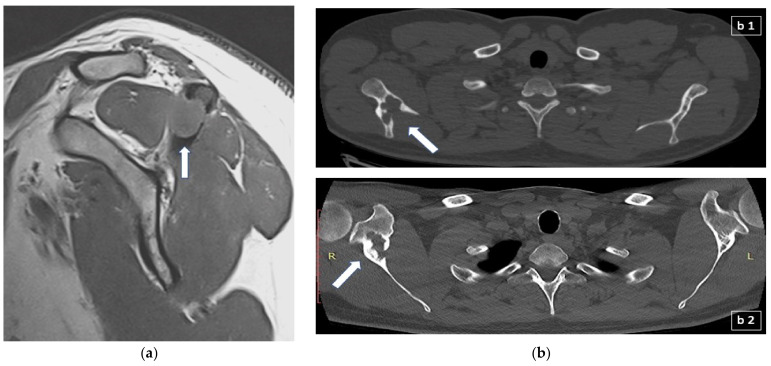
Langerhans cell histiocytosis (LCH) is a rare inflammatory neoplasia in which somatic mutations in components of the MAPK/ERK pathway have been identified. Osseous involvement is evident in approximately 80% of all patients and may present as a single osteolytic lesion, as a multi-ostotic single system disease or as part of multisystem disease. Both exogenous, such as treatment with glucocorticoids, and endogenous parameters, such as anterior pituitary hormone deficiencies and inflammatory cytokines, may severely affect bone metabolism in LCH. Computed tomography (CT) or magnetic resonance imaging (MRI) are usually required to precisely assess the degree of bone involvement; 18F-fluorodeoxyglucose (FDG) positron emission tomography-CT can both detect otherwise undetectable LCH lesions and differentiate metabolically active from inactive or resolved disease, while concomitantly being useful in the assessment of treatment response. Treatment of skeletal involvement may vary depending on location, extent, size, and symptoms of the disease from close observation and follow-up in unifocal single-system disease to chemotherapy and gene-targeted treatment in cases with multisystem involvement. In any case of osseous involvement, bisphosphonates might be considered as a treatment option especially if pain relief is urgently needed. Finally, a patient-specific approach is suggested to avoid unnecessary extensive surgical interventions and/or medical overtreatment.
Keywords: Langerhans cell histiocytosis (LCH); bone; skeleton; treatment.
Conflict of interest statement
A.D.A. reports lecture fees from Amgen, Bianex, Eli-Lilly, ITF, Unifarma, and UCB; P.M. reports fees for lectures/advisory boards and research grants from Amgen and fees for lectures/advisory boards from UCB, Elpen, and Galenica; D.G. has nothing to declare.
Figures
Similar articles
-
18F-fluorodeoxyglucose positron emission tomography-computed tomography in the management of adult multisystem Langerhans cell histiocytosis.Eur J Nucl Med Mol Imaging. 2017 Apr;44(4):598-610. doi: 10.1007/s00259-016-3521-3. Epub 2016 Sep 20. Eur J Nucl Med Mol Imaging. 2017. PMID: 27645693
-
Discrepancies between F-18-FDG PET/CT findings and conventional imaging in Langerhans cell histiocytosis.Pediatr Blood Cancer. 2021 Apr;68(4):e28891. doi: 10.1002/pbc.28891. Epub 2021 Jan 14. Pediatr Blood Cancer. 2021. PMID: 33442960
-
[18F]FDG- PET/CT in Diagnosis, Staging, and Management of Patients with Langerhans Cell Histiocytosis.Indian J Nucl Med. 2024 Sep-Oct;39(5):341-346. doi: 10.4103/ijnm.ijnm_46_24. Epub 2025 Jan 25. Indian J Nucl Med. 2024. PMID: 40061494 Free PMC article.
-
Comprehensive considerations for dermatologists: the application of FDG-PET in evaluating cutaneous lesions in pediatric Langerhans cell histiocytosis.Front Med (Lausanne). 2024 Jul 10;11:1378638. doi: 10.3389/fmed.2024.1378638. eCollection 2024. Front Med (Lausanne). 2024. PMID: 39071084 Free PMC article. Review.
-
Childhood Langerhans cell histiocytosis: a disease with many faces.World J Pediatr. 2019 Dec;15(6):536-545. doi: 10.1007/s12519-019-00304-9. Epub 2019 Aug 28. World J Pediatr. 2019. PMID: 31456157 Review.
Cited by
-
Langerhans Cell Histiocytosis: A Population-based Study of Anatomical Distribution and Treatment Patterns.J Bone Oncol. 2022 Sep 27;36:100454. doi: 10.1016/j.jbo.2022.100454. eCollection 2022 Oct. J Bone Oncol. 2022. PMID: 36204417 Free PMC article.
-
Langerhans Cell Histiocytosis Mimicking a Meningeal Lesion with Temporal Bone and Muscle Compromise in an Adult Patient: A Case Report.J Neurol Surg Rep. 2024 Apr 30;85(2):e43-e47. doi: 10.1055/s-0044-1786360. eCollection 2024 Apr. J Neurol Surg Rep. 2024. PMID: 38690582 Free PMC article.
-
Posterior Instrumentation without Curettage Promotes Rapid Restoration of Adult Spinal Langerhans Cell Histiocytosis.Spine Surg Relat Res. 2024 Jun 10;8(6):637-643. doi: 10.22603/ssrr.2024-0040. eCollection 2024 Nov 27. Spine Surg Relat Res. 2024. PMID: 39659370 Free PMC article.
-
A challenging diagnosis of Langerhans' cell histiocytosis with hypothalamic-pituitary and mandibular involvement: case report and literature review.Ann Med Surg (Lond). 2024 May 15;86(7):4191-4196. doi: 10.1097/MS9.0000000000002160. eCollection 2024 Jul. Ann Med Surg (Lond). 2024. PMID: 38989240 Free PMC article.
-
Primary intraosseous papillary intralymphatic angioendothelioma of the distal femoral epiphysis: a case report with literature review.Skeletal Radiol. 2025 Jan;54(1):125-130. doi: 10.1007/s00256-024-04674-8. Epub 2024 Apr 15. Skeletal Radiol. 2025. PMID: 38619614 Review.
References
Publication types
LinkOut - more resources
Full Text Sources
Miscellaneous
