Review
. 2022 Feb 18;11(4):1078.
doi: 10.3390/jcm11041078.

Update on Suture Techniques in Corneal Transplantation: A Systematic Review

Affiliations
Review

Update on Suture Techniques in Corneal Transplantation: A Systematic Review

Luca Pagano et al. J Clin Med. .

Abstract

Effective suturing remains key to achieving successful outcomes in corneal surgery, especially anterior lamellar keratoplasty and full thickness transplantation. Limitations in the technique may result in complications such as wound leak, infection, or high astigmatism post corneal graft. By using a systematic approach, this study reviews articles and conducts content analysis based on update 2020 PRISMA (Preferred Reporting Items for Systematic Reviews and Meta-Analyses criteria). The aim of this paper is to summarize the state of the art of corneal suturing techniques for every type of corneal transplant and patient age and also their outcomes regarding astigmatism and complications. Future developments for corneal transplantation will be also discussed. This is important because especially the young surgeon must have knowledge of the implications of every suture performed in order to achieve consistent and predictable post-operative outcomes and also be aware of all the possible complications.

Keywords: DALK; PK; continuous suture; graft; interrupted suture; lamellar keratoplasty; nylon; penetrating keratoplasty; running suture; suture.


Conflict of interest statement

The authors declare no conflict of interest.

Figures

Figure 1
Figure 1
The corneal wound healing process summarized as four steps. (1) Lag phase immediately after injury: cellular remodeling and expression of matrix metalloproteinases (MMP) and fibronectin (FN). Deeper stromal keratocytes undergo fibroblastic change via transforming growth factor β (TGFβ) and platelet-derived growth factor (PDGF). (2) Migration phase. Deposition of extracellular matrix (ECM) materials and reorganization of the provisional matrix. Temporary connections form via cell–ECM focal adhesions. (3) Proliferation phase. Epithelial cell proliferation with continued ECM secretion and traction to close wound. (4) Maturation phase. Restoration of epithelial basement membrane, decreased cellular activity, and apoptosis.
Figure 2
Figure 2
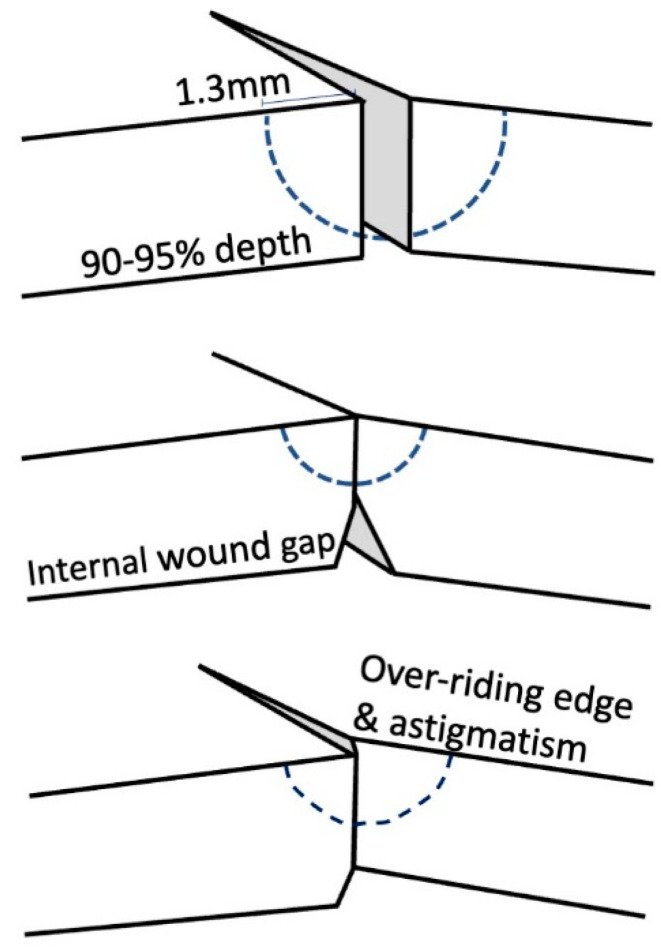
Demonstration of suture depth. 1. Ideal suture depth. 2. Shallow suture. 3. Unequal sutures.
Figure 3
Figure 3
Types of corneal sutures. SIS = single interrupted sutures, CICS = combined interrupted and continuous sutures, Single CRS = single continuous running suture, DCS = double continuous suture.
Figure 4
Figure 4
Unicameral Dsaek delivery with suturing of the posterior lamellar graft. (A) A double ended 10/0 straight prolene needle (STC-6) is passed through the donor (B) both ends of the suture are pre placed through the cornea opposite to the main incision; then, only after the delivery and centration of the graft, the suture is tightened.
Figure 5
Figure 5
Variations in wound shapes for penetrating keratoplasty. From top to bottom; conventional, zigzag, mushroom, and top-hat morphology.
Figure 6
Figure 6
Flow diagram regarding paper selection process using Prisma 2020 statement [95].

References

    1. Liu C.-Y., Kao W.W.-Y. Progress in Molecular Biology and Translational Science. Volume 134. Academic Press; Waltham, MA, USA: 2015. Corneal Epithelial Wound Healing; pp. 61–71. - DOI - PubMed
    1. Ljubimov A.V., Saghizadeh M. Progress in corneal wound healing. Prog. Retin. Eye Res. 2015;49:17–45. doi: 10.1016/j.preteyeres.2015.07.002. - DOI - PMC - PubMed
    1. Eraslan M., Toker E. Mechanisms of Corneal Wound Healing and Its Modulation Following Refractive Surgery. Marmara Med. J. 2009;22:169–178.
    1. Shin H.-G., Park I., Kim K., Kim H.-K., Chung W.-K. Sensor-Embedded Automatic Grasping Forceps for Precise Corneal Suture in Penetrating Keratoplasty. Micromachines. 2021;12:484. doi: 10.3390/mi12050484. - DOI - PMC - PubMed
    1. Landau D., Siganos C.S., Mechoulam H., Solomon A., Frucht-Pery J. Astigmatism After Mersilene and Nylon Suture Use for Penetrating Keratoplasty. Cornea. 2006;25:691–694. doi: 10.1097/01.ico.0000208821.32614.49. - DOI - PubMed

LinkOut - more resources