Review
. 2022 Feb 2;13(2):254.
doi: 10.3390/mi13020254.

Wearable Multi-Functional Sensing Technology for Healthcare Smart Detection

Affiliations
Review

Wearable Multi-Functional Sensing Technology for Healthcare Smart Detection

Xu Zeng et al. Micromachines (Basel). .

Abstract

In recent years, considerable research efforts have been devoted to the development of wearable multi-functional sensing technology to fulfill the requirements of healthcare smart detection, and much progress has been achieved. Due to the appealing characteristics of flexibility, stretchability and long-term stability, the sensors have been used in a wide range of applications, such as respiration monitoring, pulse wave detection, gait pattern analysis, etc. Wearable sensors based on single mechanisms are usually capable of sensing only one physiological or motion signal. In order to measure, record and analyze comprehensive physical conditions, it is indispensable to explore the wearable sensors based on hybrid mechanisms and realize the integration of multiple smart functions. Herein, we have summarized various working mechanisms (resistive, capacitive, triboelectric, piezoelectric, thermo-electric, pyroelectric) and hybrid mechanisms that are incorporated into wearable sensors. More importantly, to make wearable sensors work persistently, it is meaningful to combine flexible power units and wearable sensors and form a self-powered system. This article also emphasizes the utility of self-powered wearable sensors from the perspective of mechanisms, and gives applications. Furthermore, we discuss the emerging materials and structures that are applied to achieve high sensitivity. In the end, we present perspectives on the outlooks of wearable multi-functional sensing technology.

Keywords: health monitoring; multi-functional sensors; self-powered microsystems; sensing mechanisms; wearable electronics.


Conflict of interest statement

The authors declare no conflict of interest.

Figures
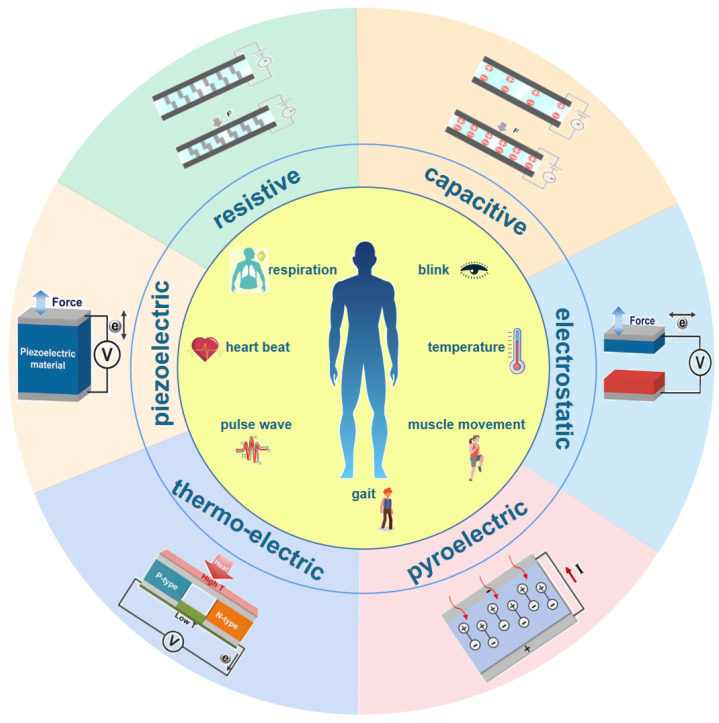
Figure 1
Figure 1
The functionalities of wearable multi-functional sensors and mechanisms, which are resistive, capacitive, triboelectric, piezoelectric, thermo-electric and pyroelectric. Reproduced with permission from Wiley (2019) [11]. Reproduced with permission from Elsevier (2021) [12]. Reproduced with permission from Elsevier (2017) [13].
Figure 2
Figure 2
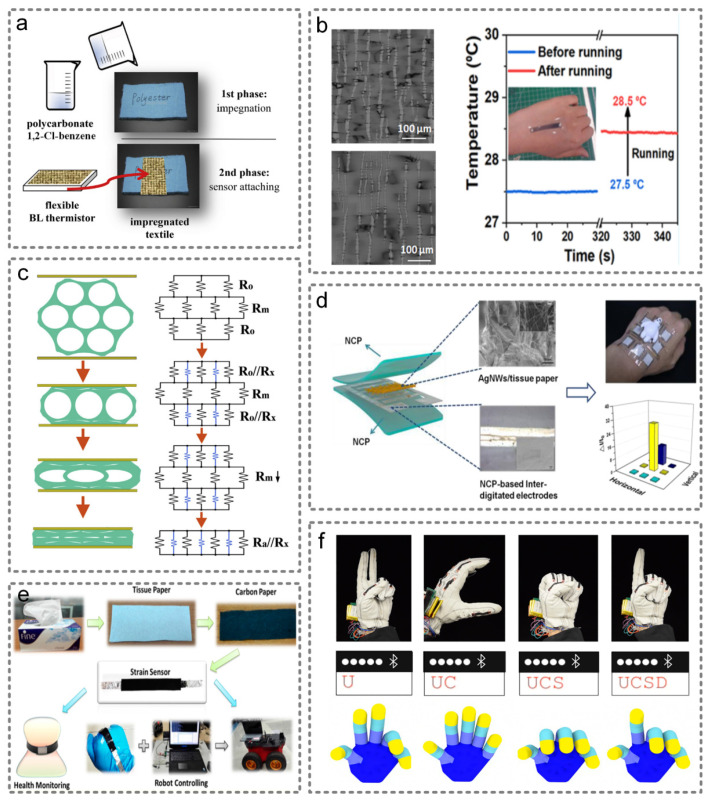
Resistive wearable sensors. (a) The impregnation procedure to fabricate a thermistor into a textile. Reproduced with permission from Elsevier (2017) [29]. (b) The optical microscope images of different cracks within PEDOT:PSS−PDMS sensors, which could improve the temperature sensitivity and the application of health detection. Reproduced with permission from Elsevier (2020) [30]. (c) Schematic illustrations of a network structure and its equivalent circuit diagram. Reproduced with permission from Elsevier (2017) [32]. (d) The structure of the piezoresistive senser based on tissue paper coated with silver nanowires (AgNWs). Reproduced with permission from the American Chemical Society (2019) [36]. (e) A highly flexible resistive-type strain sensor composed of carbon paper (CP) and polydimethylsiloxane (PDMS) elastomer. Reproduced with permission from the American Chemical Society (2016) [38]. (f) The smart glove that can translate American Sign Language into text. Reproduced with permission from Public Library Science (2017) [39].
Figure 3
Figure 3
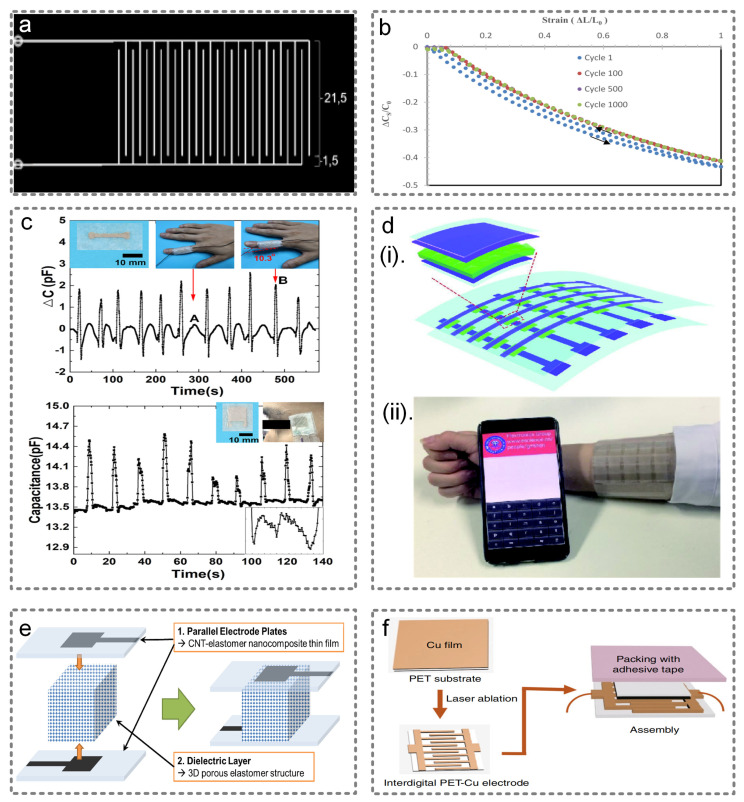
Capacitive wearable sensors. (a) A capacitive sensor using barium titanate–EcoflexTM 00-30 composite as the substrate and CB/EcoflexTM 00-30 composite conductive ink as the interdigital electrodes. (b) The relative capacitance change strained up to 100% after 1, 100, 500 and 1000 stretch/relax cycles. Reproduced with permission from MDPI (2018) [42]. (c) The capacitance profile of finger motion and eye blinking. Reproduced with permission from MDPI (2019) [43]. (d) The structure and its application as a flexible keyboard. Reproduced with permission from Springer Nature (2018) [46]. (e) Schematic illustration of the sensor with a foamy dielectric layer [48]. (f) The structure of the flexible pressure sensor based on MXene/PVP membrane and interdigital PET-Cu electrodes. Reproduced with permission from Springer Nature (2021) [45].
Figure 4
Figure 4
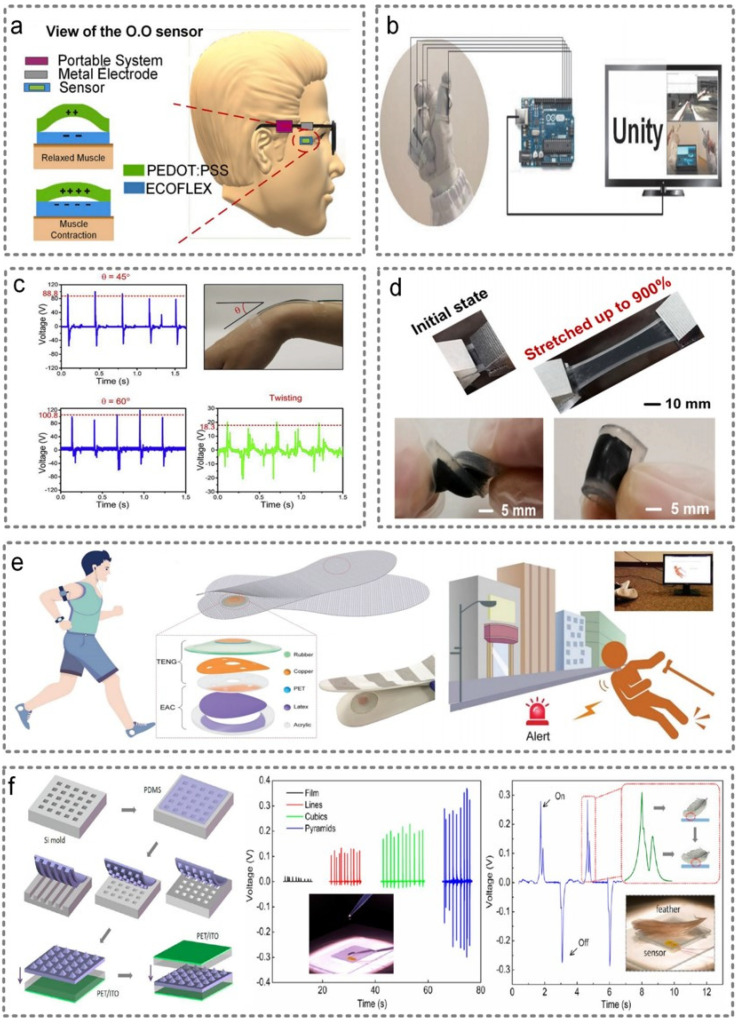
Triboelectric wearable sensors. (a) A novel structure named Non-Attached Electrode-Dielectric Triboelectric Sensor (NEDTS) that can detect eye motion. Reproduced with permission from Elsevier (2020) [56]. (b) The minimalistic design of a glove made up of several triboelectric textile sensors. Reproduced with permission from Wiley (2020) [57]. (c) The printed silk fibroin-based triboelectric nanogenerator that could realize the recognition of joint motion. Reproduced with permission from Elsevier (2019) [58]. (d) The mechanical characterization of the super-stretchable TENG. Reproduced with permission from Elsevier (2019) [59]. (e) Smart insoles assembled into the shoes to serve as a self-powered gait monitoring system and a warning system for falling down. Reproduced with permission from Wiley (2018) [60]. (f) Three kinds of polymer pattern arrays (line, cube and pyramid) in the electrification layer that could improve their sensitivity. Reproduced with permission from the American Chemical Society (2012) [63].
Figure 5
Figure 5
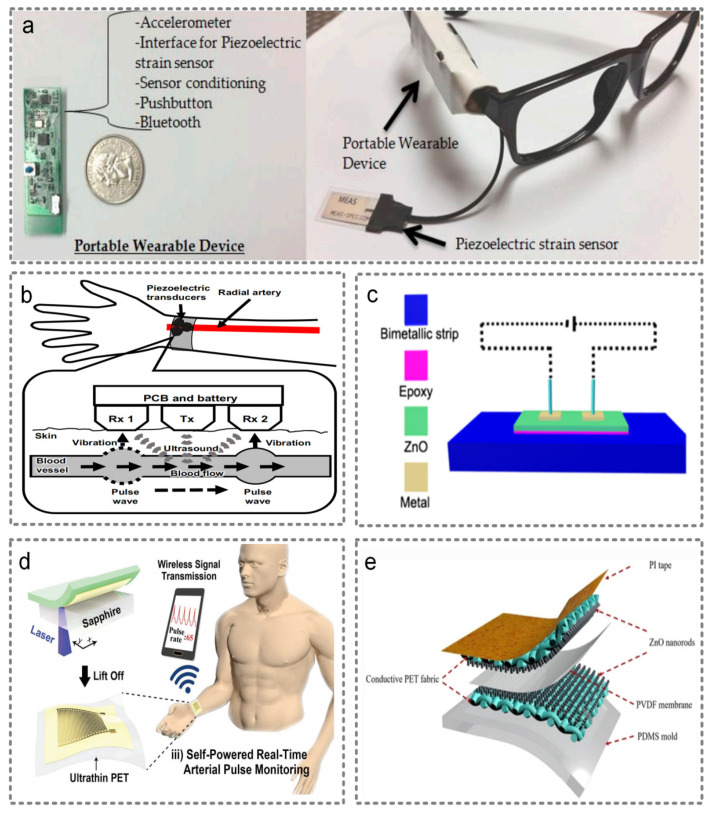
Piezoelectric wearable sensors. (a) A novel wearable piezoelectric sensor placed on the temporalis muscle to detect food intake. Reproduced with permission from MDPI (2016) [69]. (b) The structure of the multiple piezoelectric transducers that can measure blood flow velocity and pulse simultaneously. Reproduced with permission from Springer Nature (2018) [70]. (c) The structure of the piezoelectric sensor based on ZnO nanowire (NW) film that is able to sense temperature. Reproduced with permission from American Chemical Society (2014) [71]. (d) An ultra-thin flexible self-powered piezoelectric pulse sensor based on PZT film. Reproduced with permission from Wiley (2017) [73]. (e) A textile piezoelectric pressure sensor (T-PEPS). Reproduced with permission from Springer Nature (2021) [76].
Figure 6
Figure 6
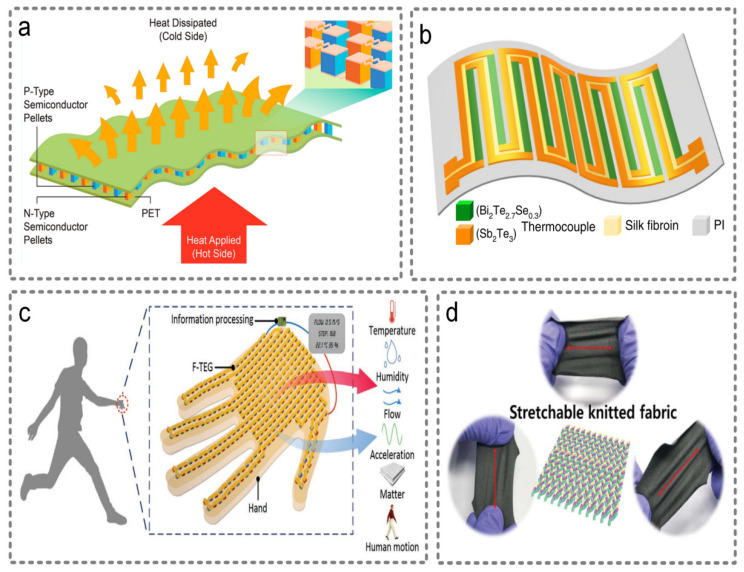
Thermo-electric wearable sensors. (a) The structure of a thermo-electric nanogenerator (FTEG), which is constructed with 126 thermo-electric legs laid in an array to sense temperature. Reproduced with permission from the American Chemical Society (2019) [82]. (b) The structure of a double-chain thermo-electric generator. Reproduced with permission from Springer Nature (2020) [84]. (c) The e-skin that can sense temperature, humidity, acceleration, motion and so on. Reproduced with permission from Wiley (2020) [85]. (d) The textile-based sensor processed with commercial thermo-electric inks. Reproduced with permission from the Royal Society of Chemistry (2018) [86].
Figure 7
Figure 7
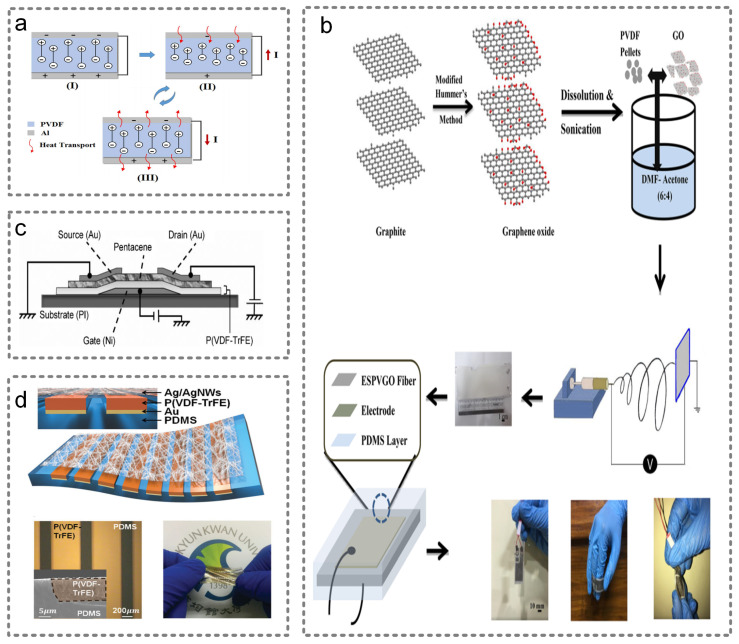
Pyroelectric wearable sensors. (a) The working mechanism of the pyroelectric nanogenerator. Reproduced with permission from Elsevier (2017) [13]. (b) The fabrication route of an ultra-sensitive temperature sensor based on PVDF/graphene oxide (GO) nanofibers. Reproduced with permission from the American Chemical Society (2019) [89]. (c) The organic field-effect transistor with P(VDF-TrFE) layer. Reproduced with permission from Wiley (2009) [90]. (d) The structure, OM image and the photo image of the stretchable pyroelectric device. Reproduced with permission from Wiley (2015) [91].
Figure 8
Figure 8
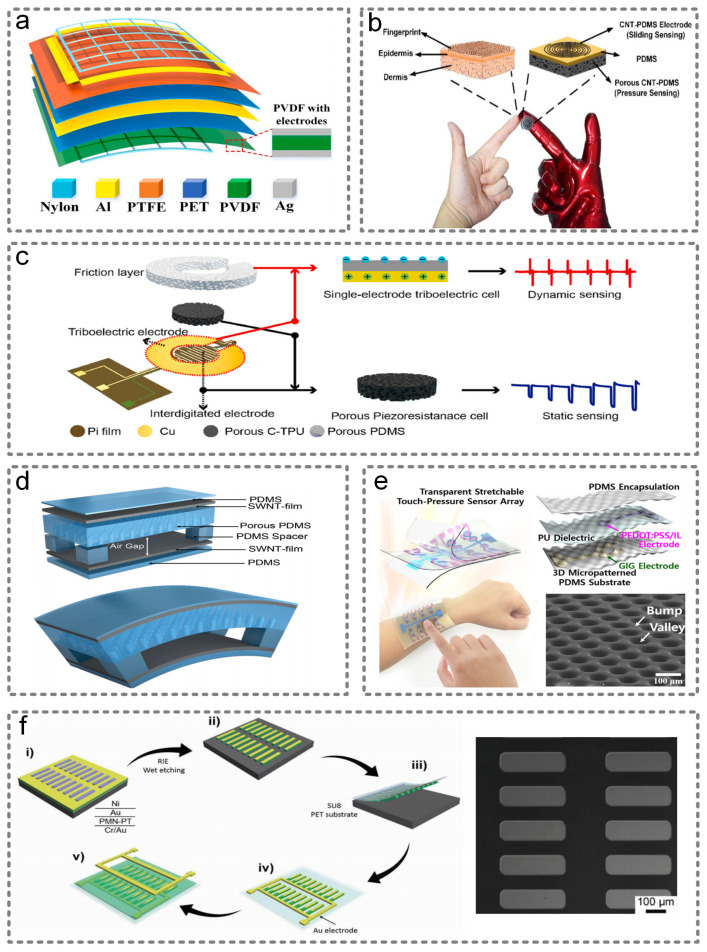
Two-principle integrated wearable sensors. (a) A self-powered sensor based on the integration of the triboelectric and piezoelectric mechanisms, which can detect the finger sliding trace and vertical force. Reproduced with permission from Elsevier (2021) [94]. (b) A comparison diagram of fingertip and e-skin. Reproduced with permission from Elsevier (2017) [96]. (c) A triboelectric active sensing unit based on porous polydimethylsiloxane (PDMS) and a piezoresistive sensing unit based on a conductive carbon black (CB)/thermoplastic polyurethane (TPU) composite that are vertically integrated. Reproduced with permission from Elsevier (2020) [97]. (d) The structure of e-skin that can not only detect the usual pressure, strain and bending, but also perceive lateral strain. Reproduced with permission from Wiley (2014) [100]. (e) The transparent flexible sensor that can detect touch and pressure through capacitive and piezoresistive effect. Reproduced with permission from Springer Nature (2019) [101]. (f) Schematic illustration of the fabrication process for a flexible PMN-PT ribbon-based generator and sensor on plastic substrates, and its SEM image. Reproduced with permission from Wiley (2017) [103].
Figure 9
Figure 9
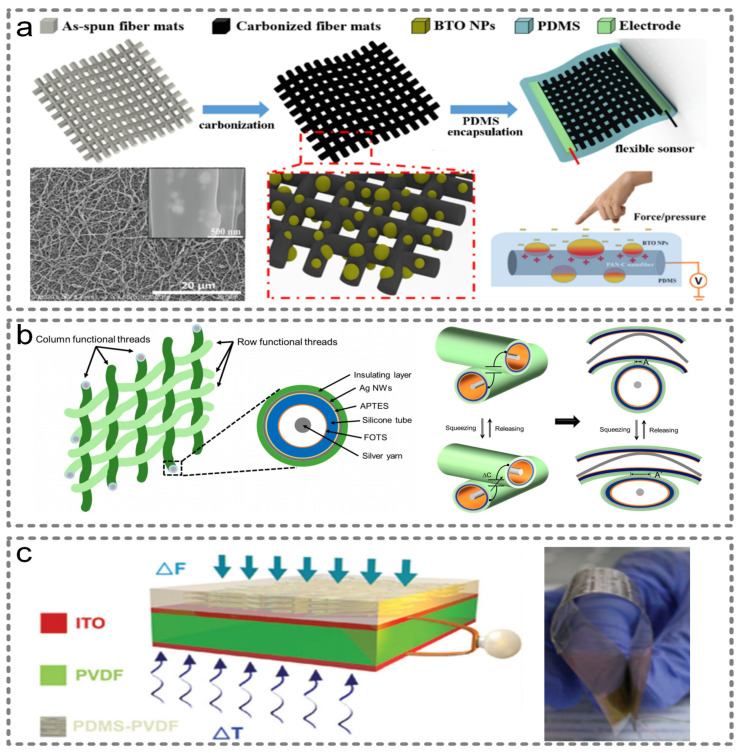
Three-principle integrated wearable sensors. (a) A multi-functional sensor made up of carbonized electrospun polyacrylonitrile/barium titanate (PAN-C/BTO) nanofiber film. Reproduced with permission from the American Chemical Society (2018) [104]. (b) A power-generating sensor based on the integration of the capacitive, resistive and triboelectric mechanisms. Reproduced with permission from MDPI (2017) [105]. (c) A flexible multi-functional sensor combining triboelectric, piezoelectric and pyroelectric effects. Reproduced with permission from Wiley (2016) [106].

References

    1. Honda W., Harada S., Arie T., Akita S., Takei K. Printed Wearable Temperature Sensor for Health Monitoring; Proceedings of the SENSORS, 2014 IEEE; Valencia, Spain. 2–5 November 2014; pp. 2227–2229.
    1. Trung T.Q., Dang T.M.L., Ramasundaram S., Toi P.T., Park S.Y., Lee N.-E. A Stretchable Strain-Insensitive Temperature Sensor Based on Free-Standing Elastomeric Composite Fibers for On-Body Monitoring of Skin Temperature. ACS Appl. Mater. Interfaces. 2019;11:2317–2327. doi: 10.1021/acsami.8b19425. - DOI - PubMed
    1. Han Z. Using Adaptive Wireless Transmission of Wearable Sensor Device for Target Heart Rate Monitoring of Sports Information. IEEE Sens. J. 2021;21:25027–25034. doi: 10.1109/JSEN.2020.3034434. - DOI
    1. Harraghy M., Calderon D., Lietz R., Brady J., Makedon F., Becker E. A Review of Wearable Heart Rate Sensors in Research; Proceedings of the 12th ACM International Conference on PErvasive Technologies Related to Assistive Environments, Association for Computing Machinery; New York, NY, USA. June 2019; pp. 315–316.
    1. Li G., Wen D. Sensing Nanomaterials of Wearable Glucose Sensors. Chin. Chem. Lett. 2021;32:221–228. doi: 10.1016/j.cclet.2020.10.028. - DOI

LinkOut - more resources