


MALDI-TOF MS Using a Custom-Made Database, Biomarker Assignment, or Mathematical Classifiers Does Not Differentiate Shigella spp. and Escherichia coli
- PMID: 35208889
- PMCID: PMC8878589
- DOI: 10.3390/microorganisms10020435
MALDI-TOF MS Using a Custom-Made Database, Biomarker Assignment, or Mathematical Classifiers Does Not Differentiate Shigella spp. and Escherichia coli
Abstract
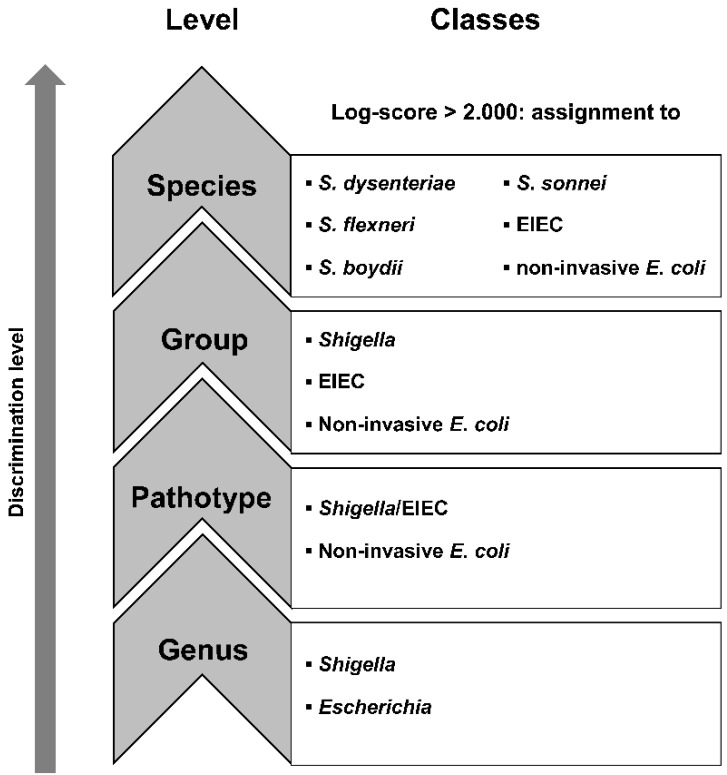
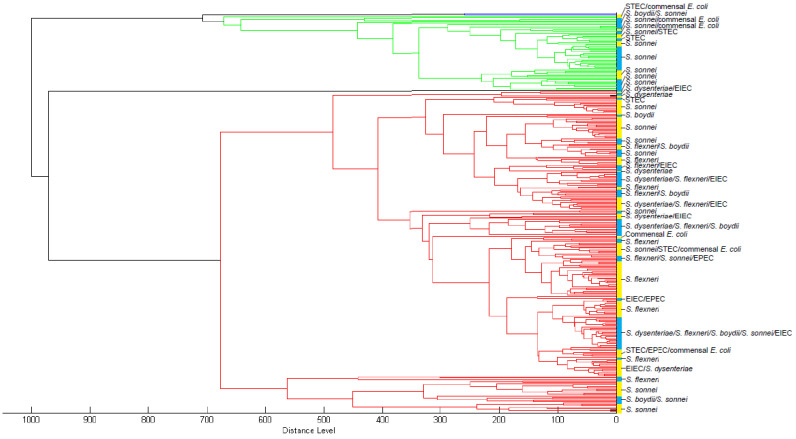
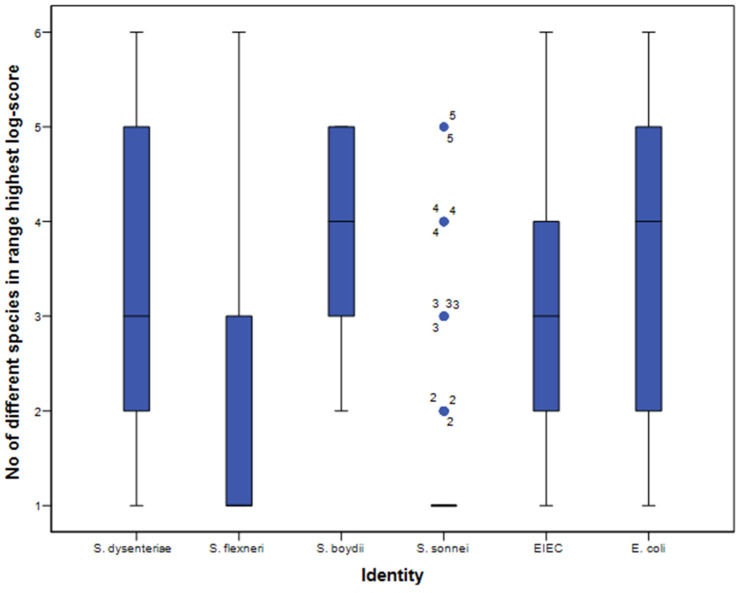
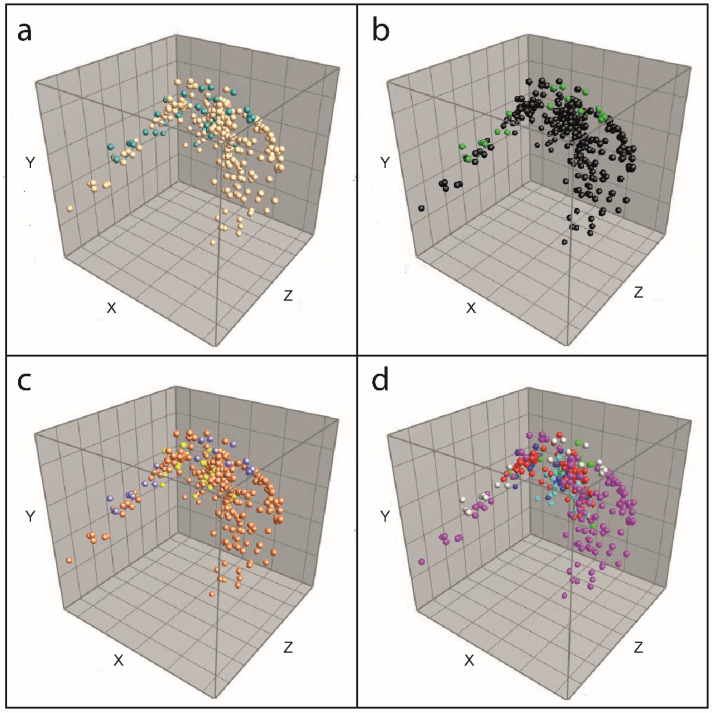
Shigella spp. and E. coli are closely related and cannot be distinguished using matrix-assisted laser desorption-ionization time-of-flight mass spectrometry (MALDI-TOF MS) with commercially available databases. Here, three alternative approaches using MALDI-TOF MS to identify and distinguish Shigella spp., E. coli, and its pathotype EIEC were explored and evaluated using spectra of 456 Shigella spp., 42 E. coli, and 61 EIEC isolates. Identification with a custom-made database resulted in >94% Shigella identified at the genus level and >91% S. sonnei and S. flexneri at the species level, but the distinction of S. dysenteriae, S. boydii, and E. coli was poor. With biomarker assignment, 98% S. sonnei isolates were correctly identified, although specificity was low. Discriminating markers for S. dysenteriae, S. boydii, and E. coli were not assigned at all. Classification models using machine learning correctly identified Shigella in 96% of isolates, but most E. coli isolates were also assigned to Shigella. None of the proposed alternative approaches were suitable for clinical diagnostics for identifying Shigella spp., E. coli, and EIEC, reflecting their relatedness and taxonomical classification. We suggest the use of MALDI-TOF MS for the identification of the Shigella spp./E. coli complex, but other tests should be used for distinction.
Keywords: EIEC; Escherichia coli; MALDI-TOF MS; Shigella spp.; biomarker assignment; custom-made database; machine-learning classifiers.
Conflict of interest statement
After the results of this study were concluded, J.W.A.R. is consulting for IDbyDNA, and Polpharma Biologics employs N.E. These companies had no role in the study’s design, in the collection, analyses, or interpretation of data, in the writing of the manuscript, or in the decision to publish the results. The other authors declare no conflict of interest.
Figures
References
-
- Pettengill E.A., Pettengill J.B., Binet R. Phylogenetic Analyses of Shigella and Enteroinvasive Escherichia coli for the Identification of Molecular Epidemiological Markers: Whole-Genome Comparative Analysis Does Not Support Distinct Genera Designation. Front. Microbiol. 2016;6:1573. doi: 10.3389/fmicb.2015.01573. - DOI - PMC - PubMed
-
- Brenner D.J., Family I. Enterobacteriaceae. In: Krieg N.R., editor. Bergey’s Manual of Systematic Bacteriology. 1984. pp. 408–420.
LinkOut - more resources
Full Text Sources
Molecular Biology Databases
Miscellaneous
