. 2022 Feb 20;10(2):471.
doi: 10.3390/microorganisms10020471.

Lactobacilli Strain Mixture Alleviates Bacterial Vaginosis through Antibacterial and Antagonistic Activity in Gardnerella vaginalis-Infected C57BL/6 Mice

Affiliations

Lactobacilli Strain Mixture Alleviates Bacterial Vaginosis through Antibacterial and Antagonistic Activity in Gardnerella vaginalis-Infected C57BL/6 Mice

Soo-Im Choi et al. Microorganisms. .

Abstract

The present study investigated the anti-bacterial vaginitis (BV) effects of a mixture of five lactobacilli strains (LM5), containing equal amounts of Ligilactobacillus salivarius MG242, Limosilactobacillus fermentum MG901, Lactiplantibacillus plantarum MG989, Lacticaseibacillus paracasei MG4272, and Lacticaseibacillus rhamnosus MG4288), in HeLa cells and Gardnerella vaginalis (GV)-infected BV mice. All strains produced lactic acid and hydrogen peroxide, and were resistant to nonoxynol-9. LM5 significantly inhibited GV growth by 80%, exhibited good adhesion to HeLa cells, and significantly inhibited GV adhesion to these cells. In GV-infected mice, LM5 administered orally at 5 × 10⁹ CFU/mouse significantly inhibited GV proliferation in the vaginal tract and significantly reduced myeloperoxidase activity, pro-inflammatory cytokine (TNF-α, IL-1β, and IL-6) levels, and nitric oxide levels in vaginal tissue lysates. Histopathological analysis of vaginal tissues revealed that LM5 markedly suppressed the exfoliation of vaginal epithelial cells. Overall, these results suggest that LM5 might alleviate BV by direct antibacterial and antagonistic activity in vaginal tissues of GV-infected mice.

Keywords: Gardnerella vaginalis; bacterial vaginosis; epithelial exfoliation; lactobacilli strains mixture.


Conflict of interest statement

No potential conflict of interest was reported by the authors.

Figures
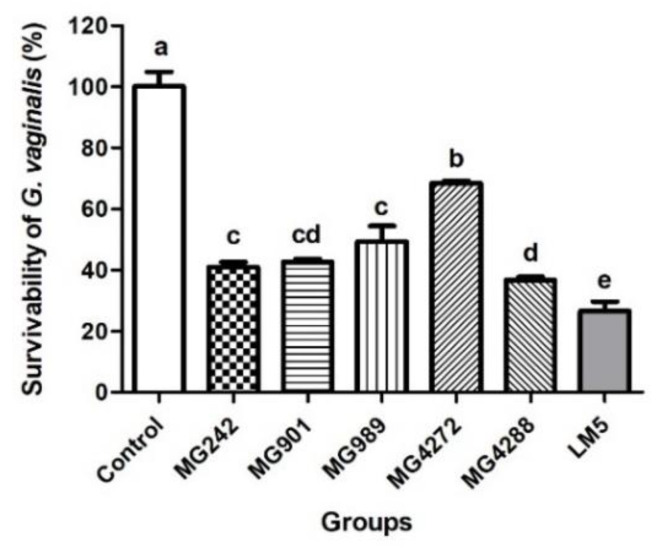
Figure 1
Figure 1
Survival rates of Gardnerella vaginalis (GV) alone or when treated with cell-free supernatants (CFS) of lactobacilli strains. GV was inoculated into BHI broth added with MRS broth (control) or the CFS of each of the strains and cultured for 24 h at 37 °C. LM5: mixture of five strains in the same ratio. Results are presented as mean ± SD (n = 3). Different letters indicate significant differences between means at p < 0.05 by Duncan’s multiple range test.
Figure 2
Figure 2
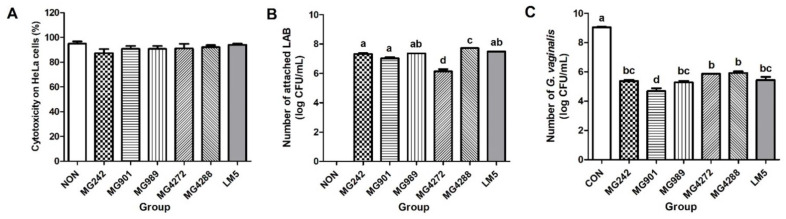
Antagonistic activity of lactobacilli strains against GV-adhesion to HeLa cells: (A) cytotoxic effects of cell-free culture supernatant (CFS) of lactobacilli on HeLa cells, (B) adhesion abilities of lactobacilli strains to HeLa cells, and (C) antagonistic effect of lactobacillus strains on GV adhesion to HeLa cells. NON: HeLa cells treated only with culture media, CON: HeLa cells treated only with GV without lactobacilli strains, LM5: mixture of five strains in the same ratio. Results are presented as mean ± SD (n = 3). Different letters indicate a significant difference between means at p < 0.05 by Duncan’s multiple range test.
Figure 3
Figure 3
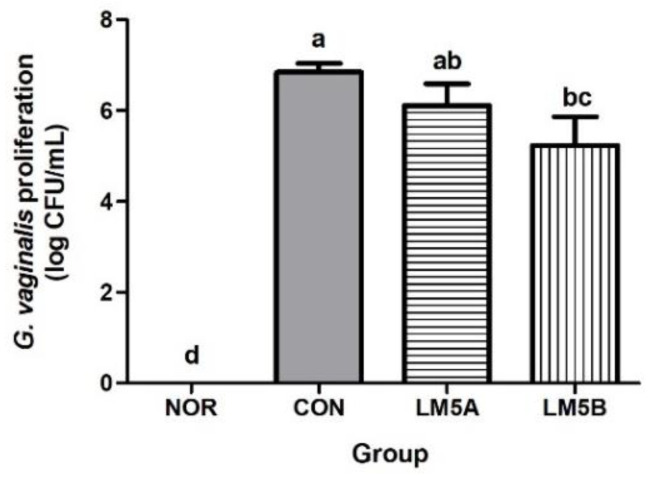
Effect of the lactobacilli strains mixture (LM5) on GV proliferation in GV-infected BV mice. Mice were fed with or without LM5A (5 × 10⁸ CFU/mouse) or LM5B (5 × 10⁹ CFU/mouse) for 2 weeks starting the day after GV inoculation. NOR: normal mice without GV infection, CON: GV infection mice without lactobacillus mixture administration. GV proliferation in mice was assessed using GV-selective agar and vaginal washes. Results are presented as mean ± SD (n = 6). Different letters indicate a significant difference between means at p < 0.05 by Duncan’s multiple range test.
Figure 4
Figure 4
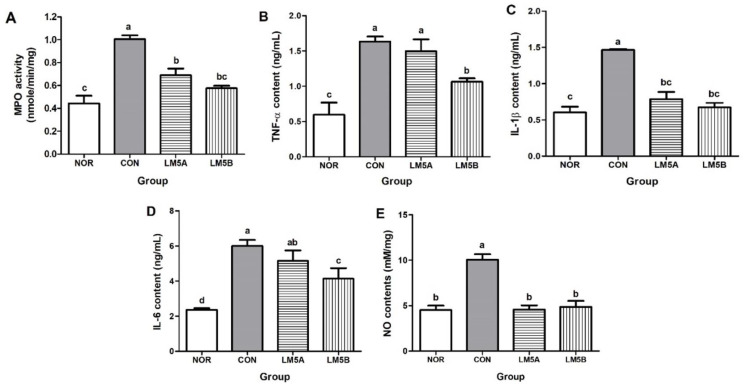
Effect of the lactobacilli strains mixture (LM5) administration on MPO activity (A), proinflammatory cytokines (BD), and nitric oxide (NO) production (E) in GV-infected BV mice. Mice were fed with or without the LM5A (5 × 10⁸ CFU/mouse) or LM5B (5 × 10⁹ CFU/mouse) from the day after GV was inoculated for 2 weeks. MPO activity, and proinflammatory cytokine and NO levels were measured using vaginal tissue lysate. NOR: normal mice without GV infection, CON: GV infection mice without lactobacillus mixture administration. Results are presented as mean ± SD (n = 6). Different letters indicate a significant difference between means at p < 0.05 by Duncan’s multiple range test.
Figure 5
Figure 5
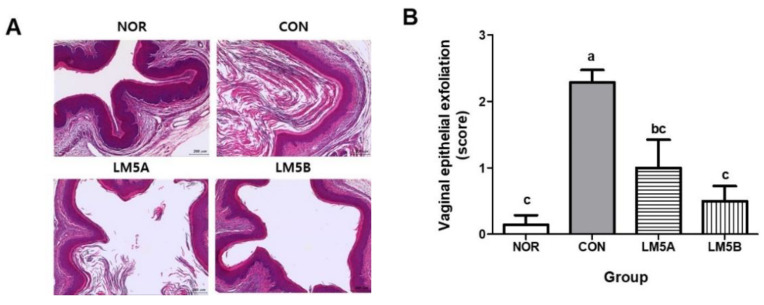
Histopathological analysis of vaginal tissues of GV-infected BV mice. (A) representative histopathological image of vaginal tissue, (B) vaginal epithelial exfoliation score. Mice were fed with or without LM5A (5 × 10⁸ CFU/mouse) or LM5B (5 × 10⁹ CFU/mouse) for 2 weeks starting the day after GV inoculation. NOR: normal mice without GV infection, CON: GV infection mice without lactobacillus mixture administration. After completing the experiment, vaginal tissues were fixed, embedded in paraffin, sectioned, and stained with hematoxylin and eosin (H&E). Results are presented as mean ± SD (n = 6). Different letters indicate a significant difference between means at p < 0.05 by Duncan’s multiple range test.

References

    1. Mendling W. Vaginal microbiota. Adv. Exp. Med. Biol. 2016;902:83–93. - PubMed
    1. Moosa Y., Kwon D., de Oliveira T., Wong E.B. Determinants of vaginal microbiota composition. Front. Cell. Infect. Microbiol. 2020;10:467. doi: 10.3389/fcimb.2020.00467. - DOI - PMC - PubMed
    1. Paladine H.L., Desai U.A. Vaginitis: Diagnosis and treatment. Am. Fam. Physician. 2018;97:321–329. - PubMed
    1. Redelinghuys M.J., Geldenhuys J., Jung H., Kock M.M. Bacterial vaginosis: Current diagnostic avenues and future opportunities. Front. Cell. Infect. Microbiol. 2020;10:354. doi: 10.3389/fcimb.2020.00354. - DOI - PMC - PubMed
    1. Muzny C.A., Blanchard E., Taylor C.M., Aaron K.J., Talluri R., Griswold M.E., Redden D.T., Luo M., Welsh D.A., Van Der Pol W.J. et al. Identification of key bacteria involved in the induction of incident bacterial vaginosis: A prospective study. J. Infect. Dis. 2018;218:966–978. - PMC - PubMed