. 2022 Feb 21;10(2):484.
doi: 10.3390/microorganisms10020484.

Cupriavidus metallidurans CH34 Possesses Aromatic Catabolic Versatility and Degrades Benzene in the Presence of Mercury and Cadmium

Affiliations

Cupriavidus metallidurans CH34 Possesses Aromatic Catabolic Versatility and Degrades Benzene in the Presence of Mercury and Cadmium

Pablo Alviz-Gazitua et al. Microorganisms. .

Abstract

Heavy metal co-contamination in crude oil-polluted environments may inhibit microbial bioremediation of hydrocarbons. The model heavy metal-resistant bacterium Cupriavidus metallidurans CH34 possesses cadmium and mercury resistance, as well as genes related to the catabolism of hazardous BTEX aromatic hydrocarbons. The aims of this study were to analyze the aromatic catabolic potential of C. metallidurans CH34 and to determine the functionality of the predicted benzene catabolic pathway and the influence of cadmium and mercury on benzene degradation. Three chromosome-encoded bacterial multicomponent monooxygenases (BMMs) are involved in benzene catabolic pathways. Growth assessment, intermediates identification, and gene expression analysis indicate the functionality of the benzene catabolic pathway. Strain CH34 degraded benzene via phenol and 2-hydroxymuconic semialdehyde. Transcriptional analyses revealed a transition from the expression of catechol 2,3-dioxygenase (tomB) in the early exponential phase to catechol 1,2-dioxygenase (catA1 and catA2) in the late exponential phase. The minimum inhibitory concentration to Hg (II) and Cd (II) was significantly lower in the presence of benzene, demonstrating the effect of co-contamination on bacterial growth. Notably, this study showed that C. metallidurans CH34 degraded benzene in the presence of Hg (II) or Cd (II).

Keywords: Cupriavidus metallidurans; aromatic catabolism; bacterial multicomponent monooxygenase; benzene; cadmium; mercury.


Conflict of interest statement

The authors declare no conflict of interest. The funders had no role in the design of the study; in the collection, analyses, or interpretation of data; in the writing of the manuscript; or in the decision to publish the results.

Figures
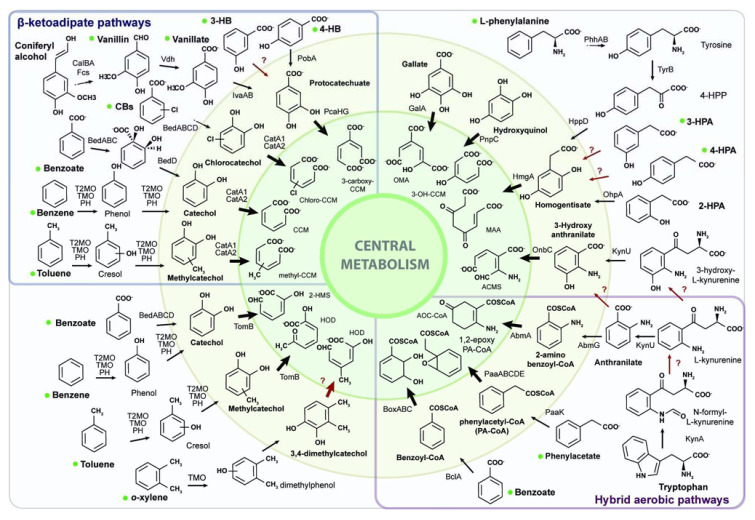
Figure 1
Figure 1
Schematic representation of aromatic peripheral and central catabolic pathways/reactions present in C. metallidurans CH34. The inner circle (yellow) includes ring cleavage product structures of aromatic central catabolic pathways. The outer circle (blue) includes the structure of dihydroxylated and aryl-CoA ring cleavage intermediates. Dashed arrows indicate multiple steps. Red arrows represent enzymes not encountered in C. metallidurans CH34 genome. Bacterial growth was observed on peripheral compounds marked with a green dot as the only carbon and energy source.
Figure 2
Figure 2
Gene cluster organization of bacterial multicomponent monooxygenases (BMMs) of C. metallidurans CH34 and other Proteobacteria. BMM gene clusters were classified as described by Notomista et al. (2003) into group I (A) and group II (B) according to the synteny of their hydroxylase components. Each group was further organized by phylogenetic analysis of their most divergent hydroxylase subunit (Bayesian inference method and mid-rooted). The orientations of ORFs are represented by open arrows. Genes and intergenic regions are on scale. (A) BMM gene cluster I. Three clades were identified by phylogenetic analysis of the α-hydroxylase subunit (PhyC, PhlN, DmpN, PhyC, TbmD, Tbc1D AphN, and TomA3). Strain CH34 phy and tom gene clusters belonged to clades 1 and 2, respectively. (B) BMM gene cluster II (arranged by γ-hydroxylase subunit: TmoE, TbuC, TbcF, and Tbc2F). C. metallidurans CH34 tmo gene cluster formed a singleton.
Figure 3
Figure 3
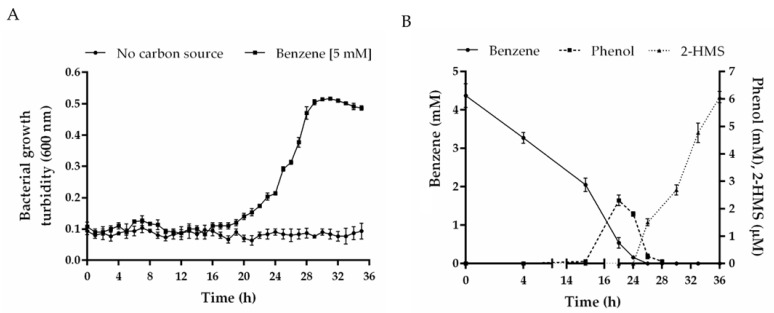
Formation of the metabolic intermediates phenol and 2-hydroxymuconic semialdehyde (2-HMS) during C. metallidurans CH34 growth on benzene. (A) CH34 cells were grown in LPTMS minimal medium using benzene (5 mM) as sole carbon and energy sources. Control assays without carbon source are also depicted. (B) The metabolic intermediates were analyzed by HPLC. Benzene degradation (square), phenol formation (triangle), and the generation of 2-hydroxymuconic semialdehyde (2-HMS; circle) after meta-cleavage of the catechol ring are indicated. Control assays without bacteria showed no degradation (data not shown). Each point is an average ± SDs of results from at least three independent assays.
Figure 4
Figure 4
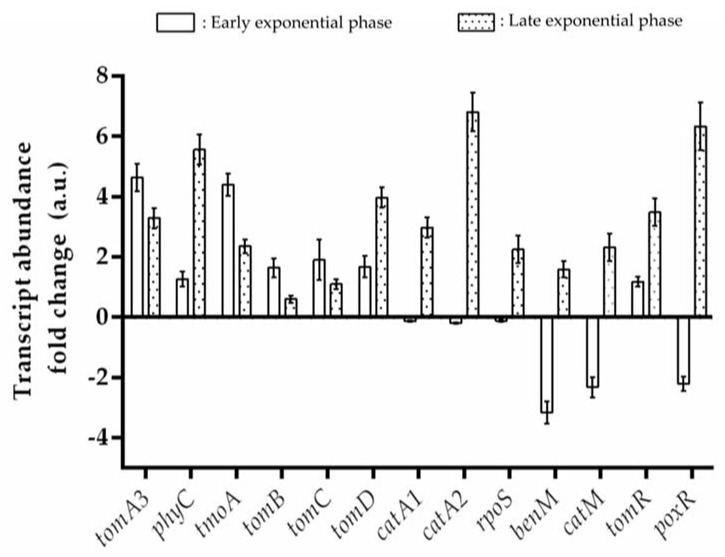
Transcriptional analysis of C. metallidurans CH34 benzene catabolic pathway genes. RT-qPCR assays were performed using mRNA from CH34 cells grown in LPTMS minimal medium supplemented with benzene (5 mM) until early exponential phase (turbidity at 600 nm of 0.2–0.3, ≈24 h; white column) and late exponential phase (turbidity at 600 nm of 0.5–0.6; ≈28 h, dotted column). The genes encode for toluene 2-monooxygenase (tomA3), toluene monooxygenase (tmoA), phenol hydroxylase (phyC), catechol 2,3-dioxygenase (tomB), catechol 1,2-dioxygenase (catA1 and catA2), hydroxymuconic semialdehyde dehydrogenase (tomC), 2-hydroxymuconic semialdehyde hydrolase (tomD), sigma factor 38 (rpoS), LysR-type transcriptional regulators (benM and catM), and XylR/NtrC-type transcriptional regulators (tomR and poxR). The gyrB gene was used as a reference gene. The primer pairs used are listed in Table S2. The fold-change in gene expression was calculated relative to CH34 cells grown on succinate. p value = 0.1%.
Figure 5
Figure 5
Proposed benzene catabolic pathways in C. metallidurans CH34. Main pathway for benzene degradation in strain CH34 is indicated with continuous arrows, whereas the oxidation pathway that was not preferred is indicated with dashed arrows. Intermediate metabolites with experimental data are underlined. (A) Upper pathway for benzene degradation via consecutive monooxygenation. The substrates and products are as follows: 1, benzene; 2, phenol; 3, catechol. The enzymes involved are as follows: T2MO (toluene 2-monooxygenase), TMO (toluene monooxygenase), PH (phenol hydroxylase). (B) Lower pathway for catechol via meta-cleavage. The substrates and products are as follows: 4, 2-hydroxymuconic semialdehyde; 5, 2-hydroxymuconate; 6, 4-oxalocrotonate; 7, 2-oxopenta-4-enoate; 8, 4-hydroxy-2-oxopentanoate; 9, pyruvate; 10, acetaldehyde; 11, acetyl-CoA. The enzymes involved are as follows: TomB (catechol 2,3-dioxygenase), TomC (semialdehyde-2-hydroxymuconate dehydrogenase), TomI (4-oxalocrotonate tautomerase), TomH (4-oxalocrotonate decarboxylase), TomD (semialdehyde-2-hydroxymuconate hydrolase), TomE (2-hydroxypent-2,4-dienoate hydratase), TomG (4-hydroxy-2-ketovalerate aldolase), TomF (acetaldehyde-CoA dehydrogenase). (C) Lower pathway for catechol via ortho-cleavage. The substrates and products are as follows: 12, cis-cis muconate; 13, muconolactone; 14, 3-oxoadipate-enol-lactone; 15, 3-oxoadipate; 16, 3-oxoadipyl-CoA; 17, succinyl-CoA. The enzymes involved are as follows: CatA (catechol 1,2-dioxygenase), CatB (muconate cycloisomerase), CatC (muconolactone delta-isomerase), CatD/PcaD (3-oxoadipate enol-lactonase), PcaIJ (3-oxoadipate CoA-transferase), PcaF (3-oxoadipyl-CoA thiolase).
Figure 6
Figure 6
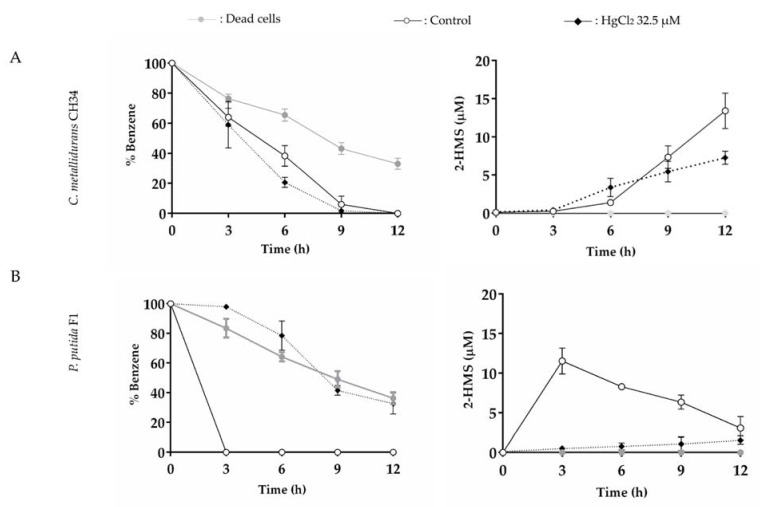
Effects of mercury on benzene degradation (5 mM) and 2-HMS formation by C. metallidurans CH34 and P. putida F1. Effects of HgCl2 (32.5 µM) on (A) C. metallidurans CH34 and (B) P. putida F1. Each point is an average ± SDs of results from three independent resting cell assays.
Figure 7
Figure 7
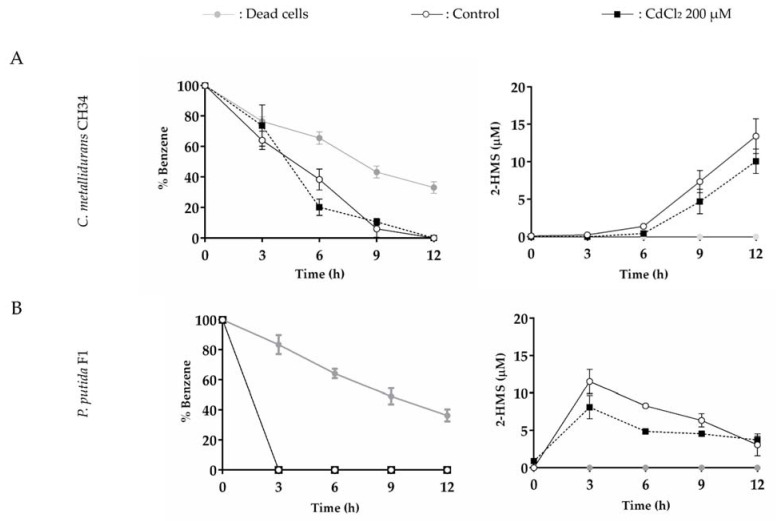
Effects of cadmium on benzene degradation (5 mM) and 2-HMS formation by C. metallidurans CH34 and P. putida F1. Effects of CdCl2 (200 µM) on (A) C. metallidurans CH34 and (B) P. putida F1. Each point is an average ± SDs of results from three independent resting cells assays.

References

    1. Fuchs G., Boll M., Heider J. Microbial degradation of aromatic compounds- From one strategy to four. Nat. Rev. Microbiol. 2011;9:803–816. doi: 10.1038/nrmicro2652. - DOI - PubMed
    1. Fuentes S., Méndez V., Aguila P., Seeger M. Bioremediation of petroleum hydrocarbons: Catabolic genes, microbial communities, and applications. App. Microbiol. Biotech. 2014;98:4781–4794. doi: 10.1007/s00253-014-5684-9. - DOI - PubMed
    1. Liu S.H., Lai C.Y., Ye J.W., Lin C.W. Increasing removal of benzene from groundwater using stacked tubular air-cathode microbial fuel cells. J. Clean. Prod. 2018;194:78–84. doi: 10.1016/j.jclepro.2018.05.138. - DOI
    1. van der Perk M. Soil and Water Contamination. 2nd ed. CRC Press; Leiden, The Netherland: 2014. p. 167. Organic Pollutants.
    1. Nojiri H., Tsuda M., Kamagata Y., Fukuda M. Biodegradative Bacteria: How Bacteria Degrade, Survive, Adapt, and Evolve. Springer; Tokyo, Japan: 2014. p. 228. - DOI

LinkOut - more resources