


Inflammation, Aging, and Cardiovascular Disease: JACC Review Topic of the Week
- PMID: 35210039
- PMCID: PMC8881676
- DOI: 10.1016/j.jacc.2021.12.017
Inflammation, Aging, and Cardiovascular Disease: JACC Review Topic of the Week
Abstract
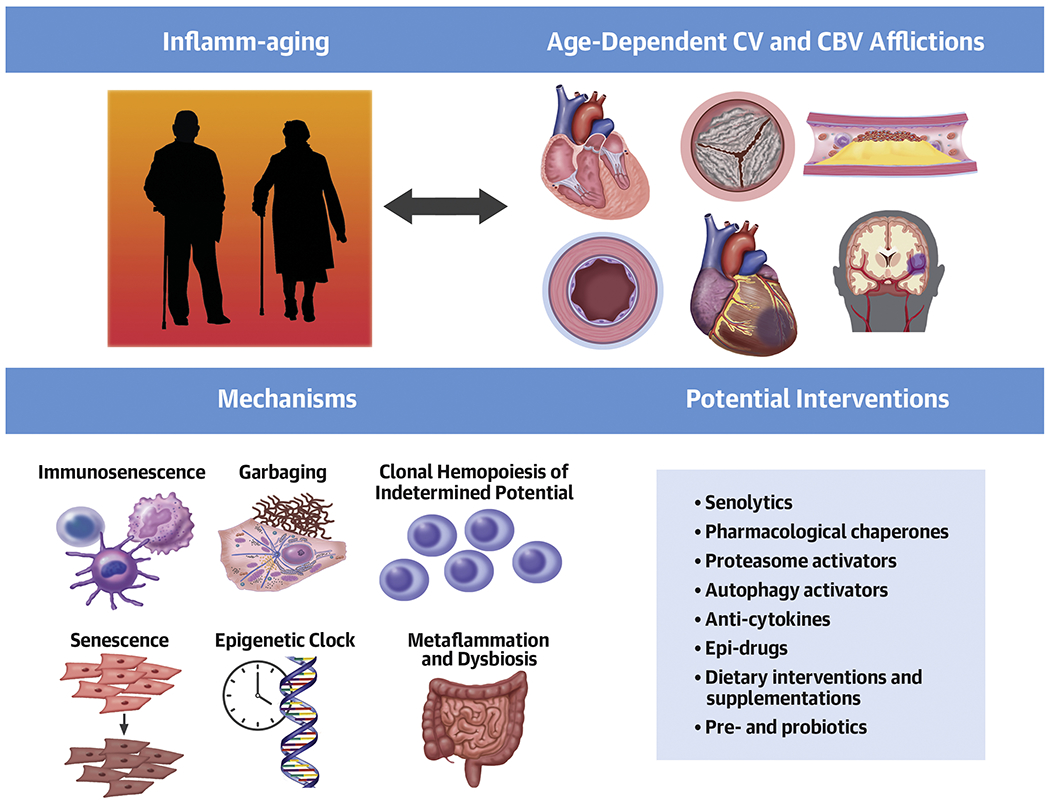
Aging and inflammation both contribute pivotally to cardiovascular (CV) and cerebrovascular disease, the leading causes of death and disability worldwide. The concept of inflamm-aging recognizes that low-grade inflammatory pathways observed in the elderly contribute to CV risk. Understanding the mechanisms that link inflammation and aging could reveal new therapeutic targets and offer options to cope with the growing aging population worldwide. This review reports recent scientific advances in the pathways through which inflamm-aging mediates age-dependent decline in CV function and disease onset and considers critically the translational potential of such concepts into everyday clinical practice.
Keywords: cardiovascular disease; inflamm-aging; inflammation; vascular aging.
Copyright © 2022 American College of Cardiology Foundation. All rights reserved.
Conflict of interest statement
Funding Support and Author Disclosures Dr Camici has received support for this work from the Swiss National Science Foundation (310030_175546), the Swiss Heart Foundation, Alfred and Annemarie von Sick Grants for Translational and Clinical Research Cardiology and Oncology, and the Foundation for Cardiovascular Research–Zurich Heart House; and is the recipient of a Sheikh Khalifa's Foundation Assistant Professorship at the Faculty of Medicine, University of Zurich. Dr Liberale has received support from the Swiss Heart Foundation and the Novartis Foundation for Medical-Biological Research. Dr Libby has received funding support from the National Heart, Lung, and Blood Institute (1R01HL134892), the American Heart Association (18CSA34080399), the RRM Charitable Fund, and the Simard Fund. Dr Montecucco has received support from the “Rete Cardiologica” of Italian Ministry of Health (#2754291). Drs Liberale, Libby, and Camici are coinventors on the International Patent WO/2020/226993 filed in April 2020; the patent relates to the use of antibodies which specifically bind interleukin-1α to reduce various sequelae of ischemia-reperfusion injury to the central nervous system. Dr Liberale has received speaker fees outside of this work from Daichi-Sankyo. Dr Badimon is founder of 2 spin-offs (Glycardial Diagnostics and Ivestatin Therapeutics); has several patents; has received consultancy fees from Sanofi and Novartis; and has received speaker fees from Lilly, Pfizer, and AstraZeneca (all unrelated to this work). Dr Lüscher has received educational and research grants outside this work from Abbott, Amgen, AstraZeneca, Boehringer Ingelheim, Daichi-Sankyo, Novartis, Servier, Sanofi, and Vifor; and has received speaker fees from Amgen and Daiichi-Sankyo. Dr Libby has served as an unpaid consultant to or been involved in clinical trials for Amgen, AstraZeneca, Baim Institute, Beren Therapeutics, Esperion Therapeutics, Genentech, Kancera, Kowa Pharmaceuticals, Medimmune, Merck, Norvo Nordisk, Novartis, Pfizer, and Sanofi-Regeneron; has served as a member of scientific advisory board for Amgen, Caristo, Cartesian, Corvidia Therapeutics, CSL Behring, DalCor Pharmaceuticals, Dewpoint, Kowa Pharmaceuticals, Olatec Therapeutics, Medimmune, Novartis, PlaqueTec, and XBiotech; his laboratory has received research funding in the last 2 years from Novartis; has served on the Board of Directors of XBiotech, Inc; has a financial interest in XBiotech, a company developing therapeutic human antibodies; and his interests were reviewed and are managed by Brigham and Women’s Hospital and Partners HealthCare in accordance with their conflict-of-interest policies. Dr Montecucco has reported that he has no relationships relevant to the contents of this paper to disclose.
Figures
References
-
- Liberale L, Montecucco F, Schwarz L, Luscher TF, Camici GG. Inflammation and cardiovascular diseases: lessons from seminal clinical trials. Cardiovasc Res 2021;117:411–422. - PubMed
-
- Libby P Inflammation in Atherosclerosis-No Longer a Theory. Clin Chem 2021;67:131–142. - PubMed
-
- Poulain M, Pes GM, Grasland C et al. Identification of a geographic area characterized by extreme longevity in the Sardinia island: the AKEA study. Exp Gerontol 2004;39:1423–9. - PubMed
Publication types
MeSH terms
Grants and funding
LinkOut - more resources
Full Text Sources
Medical
