. 2022 Feb 24;12(1):3129.
doi: 10.1038/s41598-022-07029-2.

A role for cortical dopamine in the paradoxical calming effects of psychostimulants

Affiliations

A role for cortical dopamine in the paradoxical calming effects of psychostimulants

Sharonda S Harris et al. Sci Rep. .

Abstract

Psychostimulants have a paradoxical calming effect in the treatment of attention deficit hyperactivity disorder (ADHD), but their mechanism of action is unclear. Studies using dopamine (DA) transporter (DAT) knockout (KO) mice have suggested that the paradoxical calming effect of psychostimulants might occur through actions on serotonin (5-HT) neurotransmission. However, newer non-stimulant drugs, such as atomoxetine and guanfacine, suggest that targeting the norepinephrine (NE) system in the prefrontal cortex (PFC) might explain this paradoxical calming effect. Thus, we sought to clarify the mechanism of this paradoxical action of psychostimulants. Our ex vivo efflux experiments reveal that the NE transporter (NET) blocker desipramine elevates both norepinephrine (NE) and dopamine (DA), but not 5-HT levels, in PFC tissue slices from wild-type (WT) and DAT-KO, but not NET-KO mice. However, the 5-HT transporter (SERT) inhibitor fluoxetine elevates only 5-HT in all three genotypes. Systemic administration of desipramine or fluoxetine inhibits hyperactivity in DAT-KO mice, whereas local PFC infusion of desipramine alone produced this same effect. In contrast, pharmacological NE depletion and DA elevation using nepicastat also inhibits hyperactivity in DAT-KO mice. Together, these data suggest elevation of PFC DA and not NE or 5-HT, as a convergent mechanism for the paradoxical effects of psychostimulants observed in ADHD therapy.


Conflict of interest statement

The authors declare no competing interests.

Figures
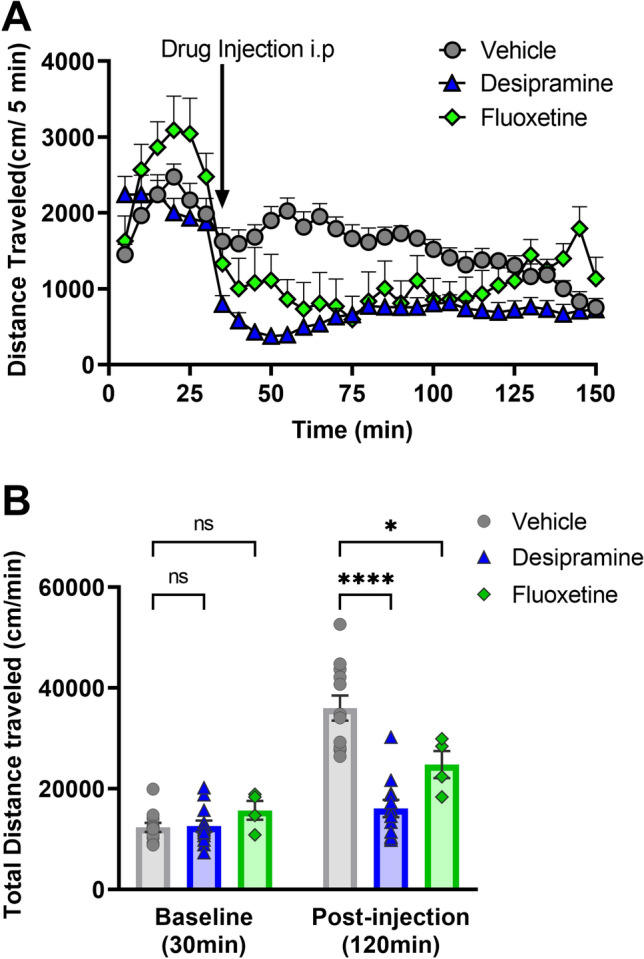
Figure 1
Figure 1
Effect of monoamine transporter drugs on DAT-KO hyperactivity. Hyperactive DAT-KO mice were systemically injected with vehicle (saline) or the transporter blockers desipramine (NET) (i.p.) or fluoxetine (SERT) (s.c). (A) Locomotor activity (cm/5 min) was recorded for 120 min, preceded by a 30 min baseline recording. (B) Total distance traveled for baseline (cm/30 min) and post-injections sessions (cm/120 min) were calculated. N = 6–12 mice per group. F (2, 26) = 23.44, *P < 0.05, ****P < 0.0001 using two-way ANOVA, compared to Vehicle-treated controls, ns- not significant.
Figure 2
Figure 2
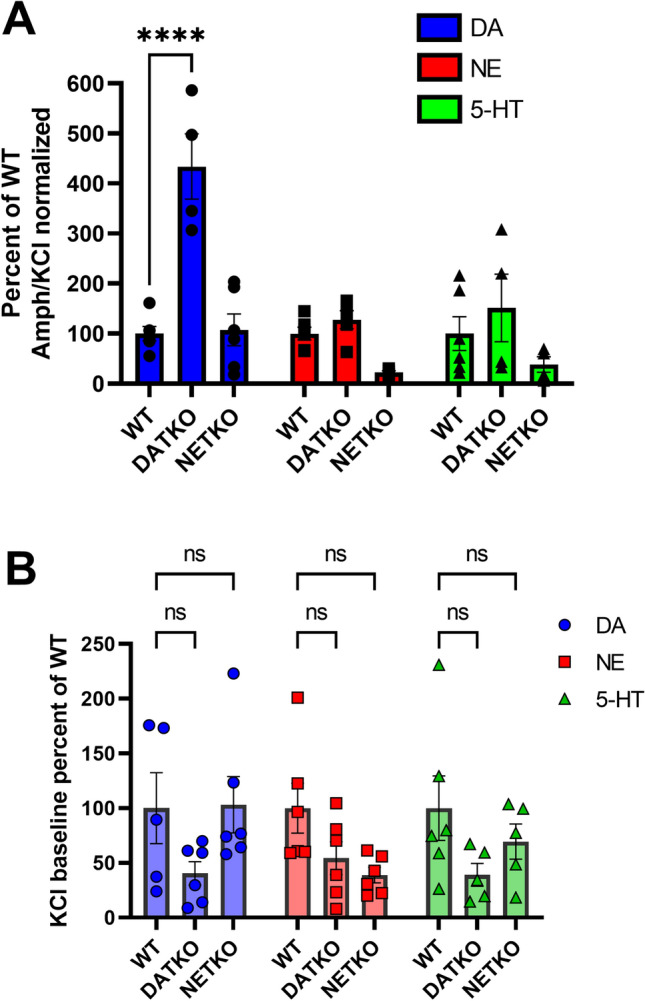
Effect of Amphetamine on monoamine efflux in PFC tissue. (A) PFC tissue slices from WT, DAT-KO and NET-KO mice were treated with amphetamine (AMPH, 10uM), and monoamines released into the KH incubation buffer were analyzed by HPLC. For each monoamine, Amph-induced release was normalized to KCl-induced release (shown in B) for each respective genotype and then normalized to WT levels. F (2, 42) = 7.325 for genotype comparisons. ****P < 0.0001 using two-way ANOVA, compared to WT mice. n = 2 experiments with 3 mice in each experiment. (B) PFC tissue slices from WT, DAT-KO and NET-KO mice were treated with 40 mM KCl, and monoamines released into the KH incubation buffer were analyzed by HPLC. For each monoamine, KCl-induced release was normalized to WT levels. ns Not significant using two-way ANOVA, compared to WT mice. n = 3–4 experiments with 4 mice in each experiment.
Figure 3
Figure 3
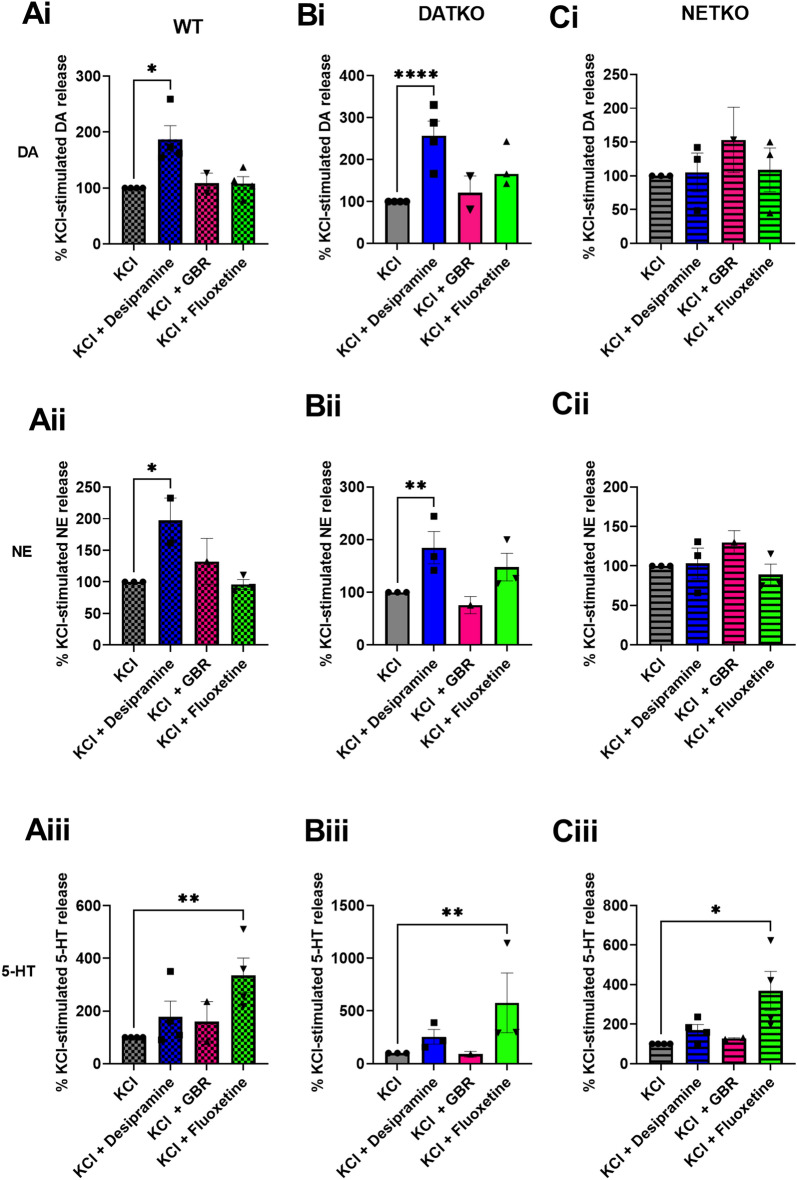
Effect of monoamine transporter blockers on monoamine efflux in PFC tissue. PFC tissue slices from WT, DAT-KO and NET-KO mice were treated with KCl alone (40 mM) or KCl + 10 µM desipramine, GBR12909 (GBR) or fluoxetine. Monoamines released into the KH incubation buffer were analyzed by HPLC. F (3, 21) = 3.712 WT NE, F (3, 34) = 3.284 WT DA, F (3, 35) = 5.957 WT 5-HT, F (3, 32) = 10.85 DAT-KO DA, F (3, 24) = 5.003 DAT-KO NE, F (3, 20) = 8.410 DAT-KO 5-HT, F (3, 24) = 0.5012 NET-KO DA, F (3, 24) = 0.4536 NET-KO NE, F (3, 35) = 3.578 NET-KO 5-HT, for drug treatment comparisons. *P < 0.05, **P < 0.01, ****P < 0.0001 using two-way ANOVA, compared to KCl-treated controls. n = 3–4 experiments with 4 mice in each experiment.
Figure 4
Figure 4
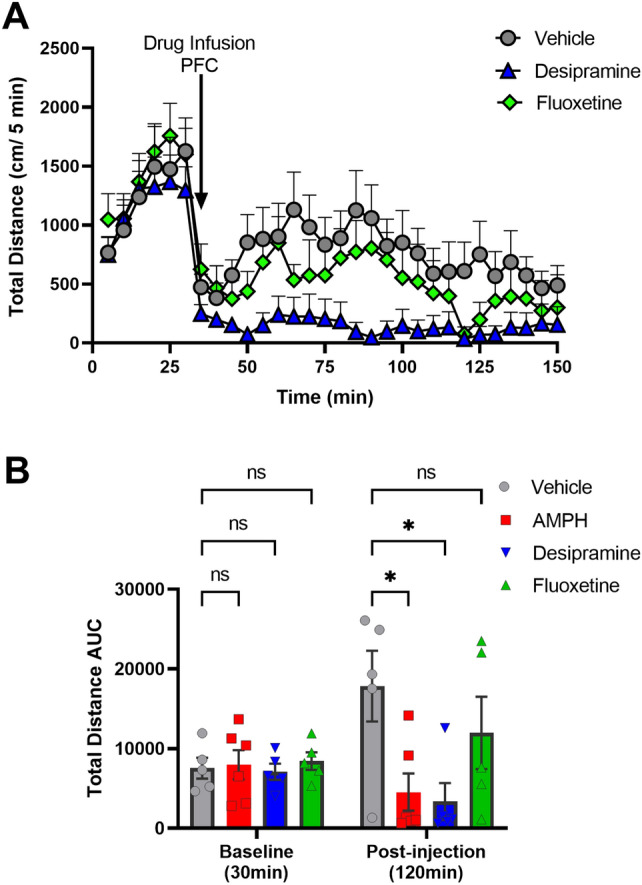
Effect of PFC infusion of monoamine transporter drugs on DAT-KO hyperactivity. (A) Hyperactive DATKO mice were infused (drug infusion PFC) with vehicle (aCSF) or 4ug/0.5ul of desipramine or fluoxetine (dissolved in aCSF) in the PFC, after a 30 min baseline, and locomotor activity (cm/5 min) was recorded for 120 min post-infusion. (B) Baseline (cm/30 min) and post-infusion (cm/120 min) total distance traveled was measured upon local infusion of desipramine, amphetamine (AMPH) or fluoxetine. n = 6–8 mice per group. Pairwise comparisons using Two-way ANOVA, F (4, 52) = 2.973 *p < 0.05, ns not significant.
Figure 5
Figure 5
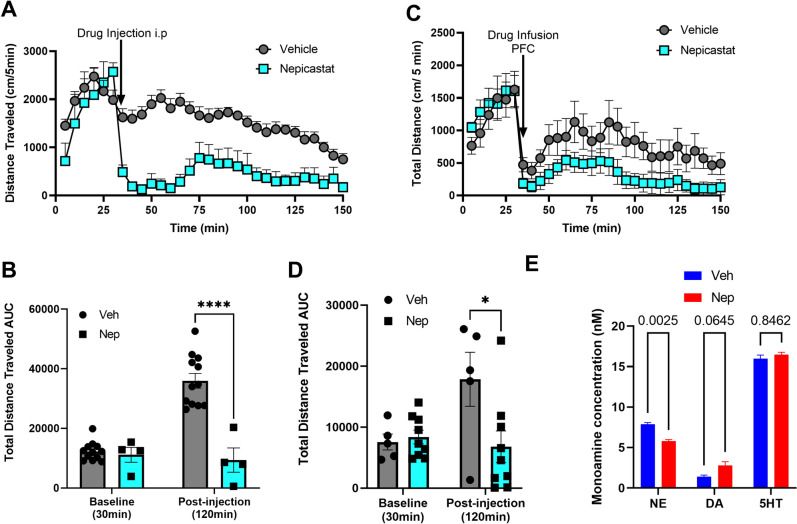
Effect of systemic or local PFC nepicastat administration on DAT-KO hyperactivity. (A) Locomotor activity (cm/5 min) of hyperactive DAT-KO mice was recorded for a 30 min baseline measurement followed by systemic injection with nepicastat or vehicle, and an additional 120 min of post-injection activity was recorded. (B) Total distance traveled (cm/150 min) was calculated. n = 6–12 mice per group. Pairwise comparisons using Two Way ANOVA, ****p < 0.0001. DAT-KO mice were infused with vehicle or 4ug/0.5ul of nepicastat in the PFC. (C) Locomotor activity (cm/5 min) was recorded for a 30 min baseline and an additional post-infusion recording of 120 min. (D) Total distance traveled (AUC) was calculated for baseline (cm/30 min) and post-infusion (cm/120 min). Pairwise comparisons using Two-way ANOVA, F (4, 52) = 2.973, *p < 0.05. (E) DAT-KO PFC tissue was analyzed upon nepicastat (Nep) i.p. injection for NE, DA or 5-HT levels by HPLC. P-values calculated using Two-way ANOVA, F (2, 18) = 1016, Nep compared to vehicle (veh) treated, n = 4.

References

    1. Gainetdinov RR, et al. Role of serotonin in the paradoxical calming effect of psychostimulants on hyperactivity. Science (New York, N.Y.) 1999;283:397–401. doi: 10.1126/science.283.5400.397. - DOI - PubMed
    1. Giros B, Jaber M, Jones SR, Wightman RM, Caron MG. Hyperlocomotion and indifference to cocaine and amphetamine in mice lacking the dopamine transporter. Nature. 1996;379:606–612. doi: 10.1038/379606a0. - DOI - PubMed
    1. Bymaster FP, et al. Fluoxetine, but not other selective serotonin uptake inhibitors, increases norepinephrine and dopamine extracellular levels in prefrontal cortex. Psychopharmacology. 2002;160:353–361. doi: 10.1007/s00213-001-0986-x. - DOI - PubMed
    1. Tanda G, Carboni E, Frau R, Di Chiara G. Increase of extracellular dopamine in the prefrontal cortex: A trait of drugs with antidepressant potential? Psychopharmacology. 1994;115:285–288. doi: 10.1007/BF02244785. - DOI - PubMed
    1. Xu F, et al. Mice lacking the norepinephrine transporter are supersensitive to psychostimulants. Nat. Neurosci. 2000;3:465–471. doi: 10.1038/74839. - DOI - PubMed

Publication types

MeSH terms

Substances