


Ensuring a safe(r) harbor: Excising personally identifiable information from structured electronic health record data
- PMID: 35211336
- PMCID: PMC8826001
- DOI: 10.1017/cts.2021.880
Ensuring a safe(r) harbor: Excising personally identifiable information from structured electronic health record data
Abstract
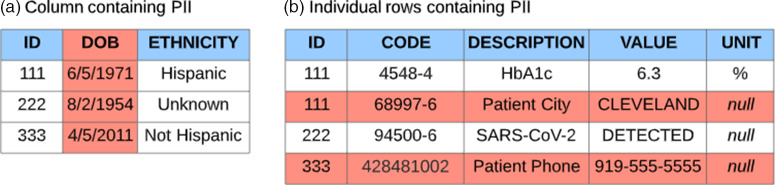
Recent findings have shown that the continued expansion of the scope and scale of data collected in electronic health records are making the protection of personally identifiable information (PII) more challenging and may inadvertently put our institutions and patients at risk if not addressed. As clinical terminologies expand to include new terms that may capture PII (e.g., Patient First Name, Patient Phone Number), institutions may start using them in clinical data capture (and in some cases, they already have). Once in use, PII-containing values associated with these terms may find their way into laboratory or observation data tables via extract-transform-load jobs intended to process structured data, putting institutions at risk of unintended disclosure. Here we aim to inform the informatics community of these findings, as well as put out a call to action for remediation by the community.
Keywords: Electronic health records; data privacy; medical terminologies.
© The Author(s) 2021.
Conflict of interest statement
Melissa Haendel is a co-founder of Pryzm Health. Kristin Kostka reports consulting fees from the National Institutes of Health. Matvey Palchuk is a full-time employee of TriNetX, LLC. Emily Niehaus is a full-time employee of Palantir Technologies. All other authors have no competing interests to declare.
Figures
References
-
- Office of the Secretary. Department of Health and Human Services. Federal Register 2013; 78(17): 5566–5702.
-
- Methods for De-identification of PHI. HHS.gov [Internet], 2021. (https://www.hhs.gov/hipaa/for-professionals/privacy/special-topics/de-id...)
-
- Pintus R, Yang Y, Rushmeier H. Athena. Journal on Computing and Cultural Heritage 2015; 8(1): 1–25. DOI 10.1145/2659020. - DOI
Grants and funding
LinkOut - more resources
Full Text Sources
Research Materials
Miscellaneous