. 2021 Dec 27;6(1):e13.
doi: 10.1017/cts.2021.884. eCollection 2022.

Clinical and translational science award T32/TL1 training programs: program goals and mentorship practices

Affiliations

Clinical and translational science award T32/TL1 training programs: program goals and mentorship practices

Fátima Sancheznieto et al. J Clin Transl Sci. .

Abstract

Introduction: A national survey characterized training and career development for translational researchers through Clinical and Translational Science Award (CTSA) T32/TL1 programs. This report summarizes program goals, trainee characteristics, and mentorship practices.

Methods: A web link to a voluntary survey was emailed to 51 active TL1 program directors and administrators. Descriptive analyses were performed on aggregate data. Qualitative data analysis used open coding of text followed by an axial coding strategy based on the grounded theory approach.

Results: Fifty out of 51 (98%) invited CTSA hubs responded. Training program goals were aligned with the CTSA mission. The trainee population consisted of predoctoral students (50%), postdoctoral fellows (30%), and health professional students in short-term (11%) or year-out (9%) research training. Forty percent of TL1 programs support both predoctoral and postdoctoral trainees. Trainees are diverse by academic affiliation, mostly from medicine, engineering, public health, non-health sciences, pharmacy, and nursing. Mentor training is offered by most programs, but mandatory at less than one-third of them. Most mentoring teams consist of two or more mentors.

Conclusions: CTSA TL1 programs are distinct from other NIH-funded training programs in their focus on clinical and translational research, cross-disciplinary approaches, emphasis on team science, and integration of multiple trainee types. Trainees in nearly all TL1 programs were engaged in all phases of translational research (preclinical, clinical, implementation, public health), suggesting that the CTSA TL1 program is meeting the mandate of NCATS to provide training to develop the clinical and translational research workforce.

Keywords: CTSA; Career development; Clinical & translational research training; Mentorship training; TL1.


Conflict of interest statement

The authors have no conflicts of interest to declare.

Figures

Fig. 1.
Fig. 1.
CTSA T32/TL1 Program Evolution and Growth. A. Major programmatic changes of the Clinical & Translational Science Award (CTSA) T32/TL1 program. B. Number of TL1 programs supporting each of the TL1 trainee types that were initiated during each calendar year (2006-2018) at CTSA institutions.
Fig. 2.
Fig. 2.
Current TL1 Trainee Types by Program and Number of Training Slots by Trainee Type. A. TL1 trainee types and number of trainee slots by TL1 program. Each column represents a TL1 program. Filled boxes represent the trainee types (Predoctoral, Postdoctoral, Short Term, and Year Out) supported by each TL1 program. The white numbers represent the number of slots reported by a hub for that trainee type. Total numbers of trainee slots for each hub are reported below each column. Programs are clustered by Clinical & Translational Science Award (CTSA) program size as defined by the National Center for Advancing Translational Sciences (NCATS) [5]. B. Distribution of training slots awarded per TL1 program for each TL1 trainee type. Each data point represents an individual TL1 program. The numbers above the box plot represent the total number of slots awarded across all TL1 programs for each TL1 trainee type.
Fig. 3.
Fig. 3.
Academic Home of TL1 Eligible Trainees, TL1 Applicants, and TL1 Awardees. Numbers of TL1 programs with trainees from each academic home (school/college) who were eligible to apply for TL1 funding (orange), applied for TL1 funding (green), and awarded TL1 funding (purple). A. Predoctoral programs (N = 40). B. Postdoctoral programs (N = 38). C. Year-Out programs (N = 8). D. Short-Term programs (N = 11). Abbreviation used: Non-Univ Research Inst, Non-University Research Institute.
Fig. 4.
Fig. 4.
Distribution of Types of Translational Research in TL1 Programs. A. Each column represents a TL1 program (programs are not in the same order as in Fig. 1). Filled boxes indicate that TL1 trainees are engaged in basic, preclinical (T0), clinical (T1-T2), Implementation (T3), and/or public health (T4) research. Gray boxes indicate absence of trainee type. Other colors correspond to four patterns of research, summarized in part B. B. Percentage of programs with TL1 trainees engaged in any combinations of translational research (T0-T4) only (orange), basic research plus some, but not all, phases of translational research (green), basic research plus all phases of translational research (blue), and basic research only (red).
Fig. 5.
Fig. 5.
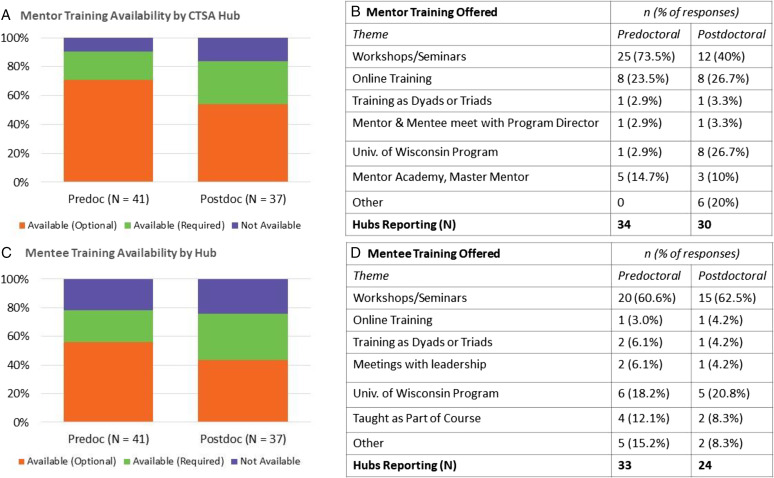
CTSA Hub Mentorship Training. A. Mentor training availability and requirements at Clinical & Translational Science Award (CTSA) hubs by program. Percentages are out of total N hubs reporting. B. Summary of qualitative analysis of mentor trainings across CTSAs by program type and example quotes for each code. Note that percentages do not add up to 100% as some responses were coded with multiple categories. C. Same as A except for available mentee training. D. Same as B except for available mentee training.
Fig. 6.
Fig. 6.
TL1 Program Mentorship Practices. A-B. Average mentor team size for predoctoral (A) and postdoctoral (B) TL1 trainees. Percentage of TL1 Programs out of the total N that reported an average size of mentor teams of 1, 2, 3, or greater than 3 mentors in their programs. C. Frequency of mentor team meetings with the trainee. (W) at least once per week; (M) at least once per month; (Q) at least once per quarter; (6) at least once every six months; (12) at least once every year; (O) other.
Fig. 7.
Fig. 7.
Individual Development Plans (IDP) in TL1 Programs. A. Percentage of Clinical & Translational Science Award (CTSA) TL1 programs reporting the different combinations of Trainee (T), Mentor (M), and Director (D) contributing to the trainee’s individual development plan (IDP). B. Usage of IDPs by predoctoral trainees at individual TL1 programs. Each column represents an individual predoctoral training program. C. Usage of IDPs by postdoctoral trainees at individual TL1 programs.

References

    1. Institutional Clinical and Translational Science Award, Request For Applications (RFA) Number: RFA-RM-06-002 [Internet], 2005 [cited November 5, 2021]. (https://grants.nih.gov/grants/guide/rfa-files/rfa-rm-06-002.html)
    1. Addendum to Institutional Clinical and Translational Science Award RFA, Notice Number: NOT-RM-06-008 [Internet], 2006 [cited November 5, 2021]. (https://grants.nih.gov/grants/guide/notice-files/NOT-RM-06-008.html)
    1. Clarification: Support for TL1/T32 Postdoctoral Trainees at Institutional Clinical and Translational Science Awards, Notice Number: NOT-RM-08-023 [Internet], 2008 [cited November 5, 2021]. (https://grants.nih.gov/grants/guide/notice-files/not-rm-08-023.html)
    1. Institutional Clinical and Translational Science Award (U54), Request For Applications (RFA) Number: RFA-RM-09-004 [Internet], 2009 [cited November 5, 2021]. (https://grants.nih.gov/grants/guide/rfa-files/rfa-rm-09-004.html)
    1. Institutional Clinical and Translational Science Award (U54), Request For Applications (RFA) Number: RFA-RM-09-019 [Internet], 2009 [cited November 5, 2021]. (https://grantsnih.gov/grants/guide/rfa-files/rfa-rm-09-019.html)

LinkOut - more resources