


Case Report: Giant Multiloculated Pseudocystic Jejunal Leiomyosarcoma in a Dog: Atypical Morphologic Features of Canine Intestinal Leiomyosarcoma
- PMID: 35211538
- PMCID: PMC8861198
- DOI: 10.3389/fvets.2022.791133
Case Report: Giant Multiloculated Pseudocystic Jejunal Leiomyosarcoma in a Dog: Atypical Morphologic Features of Canine Intestinal Leiomyosarcoma
Abstract
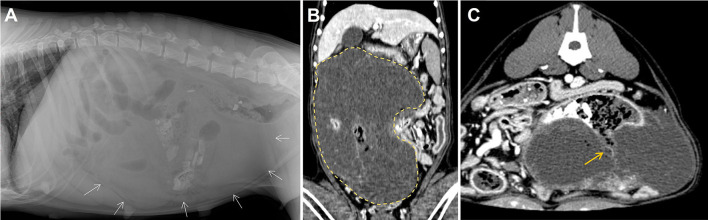
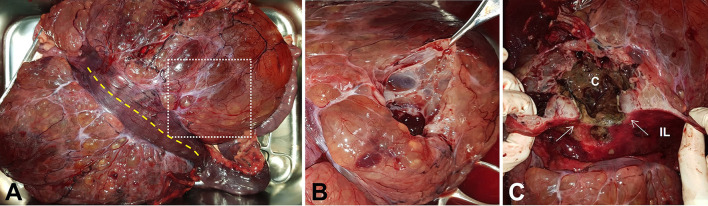
A 10-year-old intact female Rottweiler dog weighing 29 kg presented with 2 days history of vomiting, anorexia, and lethargy to KonKuk University Teaching Hospital, Seoul, South Korea. Ultrasonography and computed tomography (CT) scannings revealed a well-demarcated, large mass (29 × 19 × 11 cm) with numerous fluid-filled cavities. Metastases to adjacent lymph nodes were also identified on CT. This large mass and the affected intestinal segments were excised for palliative purposes. Postoperatively, the dog recovered uneventfully without any complications. The cut surface of the mass showed an exophytic growth pattern of multiloculated cystic lesions filled with serosanguineous fluid, large cavities filled with necrotic exudate, and fistulous connections between the intestinal lumen and the necrotic cavity in the mass. On histopathology, the mass was a spindle cell neoplasm expanding from the jejunal muscular layer and with pseudocystic changes. Additional immunohistochemical analysis using antibodies against smooth muscle actin, desmin, and CD-117 demonstrated that the mass was consistent with a leiomyosarcoma. Six months post-operatively, plain radiography revealed an abdominal mass, suspected to be recurrence from jejunal leiomyosarcoma. The owner decided to euthanize the dog due to financial constraints. This case report describes the atypical morphology and clinical progression of a large canine jejunal leiomyosarcoma, which had similar clinical features as those of human leiomyoma and leiomyosarcoma.
Keywords: dog; giant; jejunal; leiomyosarcoma; necrotic cavitation.
Copyright © 2022 Kim, Lee, Mietelka and Han.
Conflict of interest statement
Authors JL and KM were employed by Idexx Laboratories. The remaining authors declare that the research was conducted in the absence of any commercial or financial relationships that could be construed as a potential conflict of interest.
Figures


References
-
- Cooper BJ, Valentine BA. Tumors of muscle. In: Meuten DJ. editor. Tumors in Domestic Animals, 5th ed. Ames: Wiley Blackwell; (2017). p. 425–66. 10.1002/9781119181200.ch11 - DOI
-
- Bruecker KA, Withrow SJ. Intestinal leiomyosarcoma in six dogs. J Am Anim Hosp Assoc. (1988) 24:281–4.
-
- Chen HC, Parris LS, Parris RG. Duodenal leiomyosarcoma with multiple metastases in a dog. J Am Vet Med Assoc. (1984) 184:1506. - PubMed
-
- Cohen M, Post GS. Nephrogenic diabetes insipidus in a dog with intestinal leiomyosarcoma. J Am Vet Med A. (1999) 215:1818–20. - PubMed
Publication types
LinkOut - more resources
Full Text Sources
