Observational Study
. 2022 Aug;61(5):2517-2530.
doi: 10.1007/s00394-022-02822-1. Epub 2022 Feb 25.

The establishment of the gut microbiota in 1-year-aged infants: from birth to family food

Affiliations
Observational Study

The establishment of the gut microbiota in 1-year-aged infants: from birth to family food

Mirco Vacca et al. Eur J Nutr. 2022 Aug.

Erratum in

Abstract

Purpose: With the aim of characterizing the gastrointestinal (GI) microbiota and contextually determine how different prenatal, perinatal, and postnatal factors affected its composition in early childhood, infants were enrolled in a longitudinal-prospective study named "A.MA.MI." (Alimentazione MAmma e bambino nei primi MIlle giorni; NCT04122612, October 2019).

Methods: Forty-five fecal samples were collected at 12 months of infants' age, identified as the 3rd follow-up (T3). The evaluated variables were pre-gestational weight and weight gain during pregnancy, delivery mode, feeding, timing of weaning, and presence/absence of older siblings. Fecal alpha and beta-diversities were analyzed. Noteworthy, to determine the impact of the influencing factors, multivariate analyses were conducted.

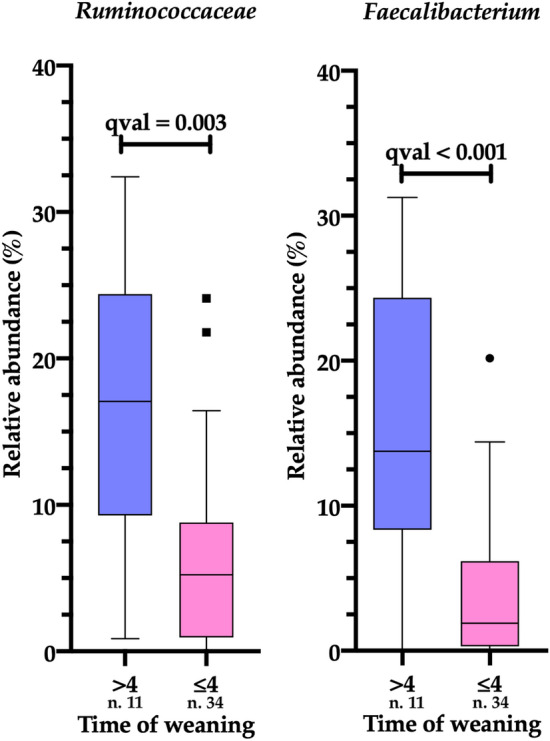
Results: At T3, all prenatal and perinatal variables did not result to be significant whereas, among the postnatal variables, type of milk-feeding and weaning showed the greatest contribution in shaping the microbiota. Although aged 1 year, infants exclusively breastfed until 6 months were mainly colonized by Lactobacillaceae and Enterobacteriaceae. Differently, Bacteroidaceae characterized the microbiota of infants that were never breastfed in an exclusive way. Moreover, although an early introduction of solid foods determined higher values of Faith's PD, high abundances of Ruminococcaceae and Faecalibacterium mainly associated with infants weaned after the 4th month of age.

Conclusion: The microbial colonization during the first year of life is likely affected by a simultaneous effect of multiple variables playing a significant role at different times. Therefore, these data contribute to add evidence concerning the complex multifactorial interaction between GI microbiota and various stimuli affecting infants during the early stages of life.

Keywords: Faecalibacterium; Feeding; Infant gut microbiota; Lactobacillaceae; Solid food introduction; Weaning.


Conflict of interest statement

The authors declare that they have neither conflicts nor competing interests.

Figures
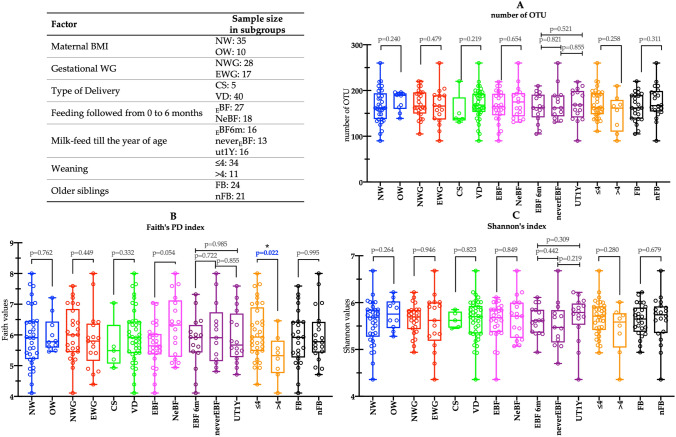
Fig. 1
Fig. 1
Alpha diversity. The number of operational taxonomic units (OTU), the Faith’s phylogenetic diversity index, and the Shannon’s diversity index (respectively A, B, and C panel) were used to describe the alpha diversity in fecal samples of infants at 1 year of age grouped according to different pre-, peri-, and postnatal variables (metadata). In detail, used metadata were: (i) maternal pre-pregnancy BMI (blue boxplots) within recommended values (NW: BMI < 25 kg/m2) or higher (OW: BMI ≥ 25 kg/m2); (ii) gestational WG (red boxplots), if optimal (NWG) or excessive (EWG) according to IOM reference values; (iii) type of delivery (green boxplots), if cesarean section (CS) or vaginally delivered infants (VD); (iv) type of feeding (pink boxplots), according to an exclusively breastfed for the first 6 months of age (EBF) or not (including both mixed and exclusively formula-fed, NeBF); (v) milk-feed up to the year of age (purple boxplots), based on infant that took at least one breastfeed up to the year of age (UT1Y), infants exclusively breastfed till 6 months of age (EBF 6 m), and infants that never were exclusively breastfed (neverEBF); (vi) time of weaning (orange boxplots), if solid foods have been given before (≤ 4) the 4th month of age or after (> 4); (vii) absence/presence of older siblings in the household (FB and nFB, respectively; black boxplots). Reporting (*), it means a significant difference (as exact p value < 0.05) according to the two-tailed Mann–Whitney’s test corrected for multiple comparisons
Fig. 2
Fig. 2
Relative abundance (16S rRNA metabarcoding) of Ruminococcaceae and Faecalibacterium in fecal samples of infants one-year-old (T3) grouped according to the time of weaning in early-weaned (≤ 4) or weaned after the 4th month of age (> 4)
Fig. 3
Fig. 3
Principal component analysis (PCA) of one-year-old infants (T3) sub-grouped according to the duration of breast-feeding, exclusively breast-fed up to six months of age (EBF6m), never exclusively breast-fed (never-EBF), and infants fed with breast milk at least once/day up to 1 year of age (ut1Y), based on the abundance of bacterial families showing p values < 0.05 (i.e., Bacteroidaceae, Lactobacillaceae, and Enterobacteriaceae). The size of blue, yellow, and gray ellipses (including EBF6m, never-EBF, and ut1Y samples, respectively) have been weighted based on the highest probability to find a related sample into the PCA plot
Fig. 4
Fig. 4
Phylogenetic Investigation of Communities by Reconstruction of Unobserved States (PICRUSt) based on 16S rRNA-seq of fecal samples of one-year-old infants (T3). Comparisons were made according to different sub-grouping, i.e., the type of milk-feeding followed during the first six months after birth (i.e., exclusively breastfed, EBF, and non-exclusively breastfed, neverEBF), milk-feeding evaluated till 1 year of age (i.e., never exclusively breastfed, neverEBF, exclusively breastfed till 6 months of age, EBF-6 m, ones taking breast milk at least once/day till 1 year of age, ut1Y), and time of weaning (i.e., early-weaned, ≤ 4, or weaned after the 4th month of age, > 4)

References

    1. Yatsunenko T, Rey FE, Manary MJ, et al. Human gut microbiome viewed across age and geography. Nature. 2012;486:222–227. doi: 10.1038/nature11053. - DOI - PMC - PubMed
    1. Turroni F, Milani C, Duranti S, et al. The infant gut microbiome as a microbial organ influencing host well-being. Ital J Pediatr. 2020;46:16. doi: 10.1186/s13052-020-0781-0. - DOI - PMC - PubMed
    1. Stiemsma LT, Michels KB. The role of the microbiome in the developmental origins of health and disease. Pediatrics. 2018;141:e20172437. doi: 10.1542/peds.2017-2437. - DOI - PMC - PubMed
    1. Satokari R, Grönroos T, Laitinen K, et al. Bifidobacterium and Lactobacillus DNA in the human placenta. Lett Appl Microbiol. 2009;48:8–12. doi: 10.1111/j.1472-765X.2008.02475.x. - DOI - PubMed
    1. Bäckhed F, Roswall J, Peng Y, et al. Dynamics and stabilization of the human gut microbiome during the first year of life. Cell Host Microbe. 2015;17:690–703. doi: 10.1016/j.chom.2015.04.004. - DOI - PubMed

Publication types

Associated data

LinkOut - more resources