


Lewis acid protection turns cyanide containing [FeFe]-hydrogenase mimics into proton reduction catalysts
- PMID: 35212328
- PMCID: PMC8939051
- DOI: 10.1039/d1dt03896f
Lewis acid protection turns cyanide containing [FeFe]-hydrogenase mimics into proton reduction catalysts
Abstract
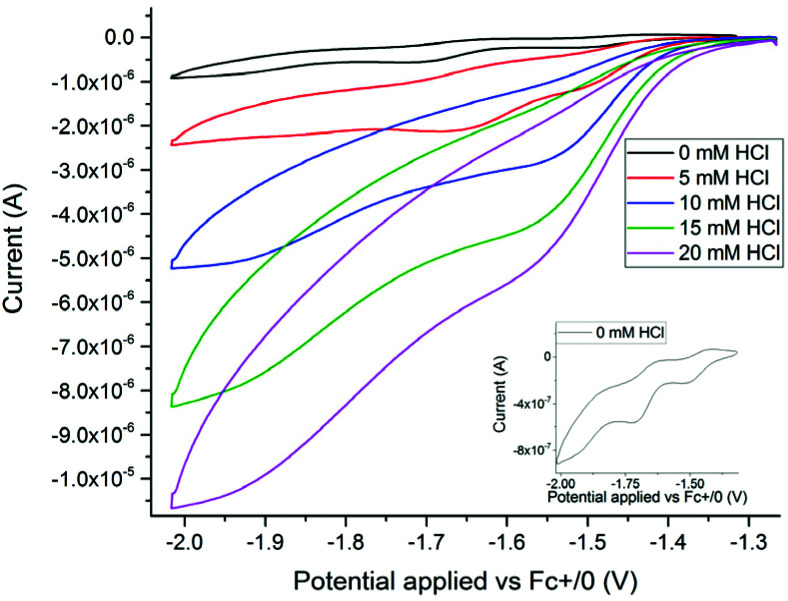
Sustainable sources of hydrogen are a vital component of the envisioned energy transition. Understanding and mimicking the [FeFe]-hydrogenase provides a route to achieving this goal. In this study we re-visit a molecular mimic of the hydrogenase, the propyl dithiolate bridged complex [Fe2(μ-pdt)(CO)4(CN)2]2-, in which the cyanide ligands are tuned via Lewis acid interactions. This system provides a rare example of a cyanide containing [FeFe]-hydrogenase mimic capable of catalytic proton reduction, as demonstrated by cyclic voltammetry. EPR, FTIR, UV-vis and X-ray absorption spectroscopy are employed to characterize the species produced by protonation, and reduction or oxidation of the complex. The results reveal that biologically relevant iron-oxidation states can be generated, potentially including short-lived mixed valent Fe(I)Fe(II) species. We propose that catalysis is initiated by protonation of the diiron complex and the resulting di-ferrous bridging hydride species can subsequently follow two different pathways to promote H2 gas formation depending on the applied reduction potential.
Conflict of interest statement
There are no conflicts to declare.
Figures


References
-
- Land H. Senger M. Berggren G. Stripp S. T. ACS Catal. 2020;10:7069–7086. doi: 10.1021/acscatal.0c01614. - DOI
LinkOut - more resources
Full Text Sources
Research Materials
