Application of Artificial Intelligence and Deep Learning for Choroid Segmentation in Myopia
- PMID: 35212716
- PMCID: PMC8883159
- DOI: 10.1167/tvst.11.2.38
Application of Artificial Intelligence and Deep Learning for Choroid Segmentation in Myopia
Abstract
Purpose: To investigate the correlation between choroidal thickness and myopia progression using a deep learning method.
Methods: Two data sets, data set A and data set B, comprising of 123 optical coherence tomography (OCT) volumes, were collected to establish the model and verify its clinical utility. The proposed mask region-based convolutional neural network (R-CNN) model, trained with the pretrained weights from the Common Objects in Context database as well as the manually labeled OCT images from data set A, was used to automatically segment the choroid. To verify its clinical utility, the mask R-CNN model was tested with data set B, and the choroidal thickness estimated by the model was also used to explore its relationship with myopia.
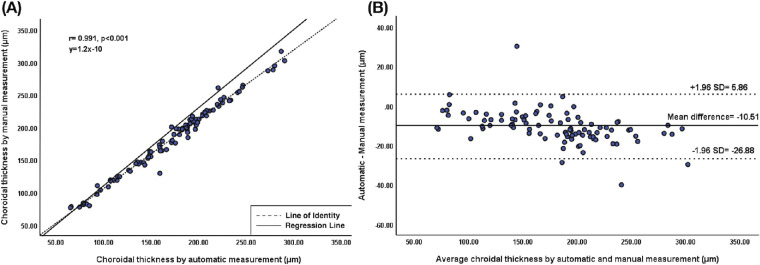
Results: Compared with the result of manual segmentation in data set B, the error of the automatic choroidal inner and outer boundary segmentation was 6.72 ± 2.12 and 13.75 ± 7.57 µm, respectively. The mean dice coefficient between the region segmented by automatic and manual methods was 93.87% ± 2.89%. The mean difference in choroidal thickness over the Early Treatment Diabetic Retinopathy Study zone between the two methods was 10.52 µm. Additionally, the choroidal thickness estimated using the proposed model was thinner in high-myopic eyes, and axial length was the most significant predictor.
Conclusions: The mask R-CNN model has excellent performance in choroidal segmentation and quantification. In addition, the choroid of high myopia is significantly thinner than that of nonhigh myopia.
Translational relevance: This work lays the foundations for mask R-CNN models that could aid in the evaluation of more intricate changes occurring in chorioretinal diseases.
Conflict of interest statement
Disclosure:
Figures


References
-
- Tarczy-Hornoch K, Ying-Lai M, Varma R; Los Angeles Latino Eye Study Group. Myopic refractive error in adult Latinos: the Los Angeles Latino Eye Study. Invest Ophthalmol Vis Sci . 2006; 47(5): 1845–1852. - PubMed
-
- Chen SJ, Cheng CY, Li AF, et al. .. Prevalence and associated risk factors of myopic maculopathy in elderly Chinese: the Shihpai eye study. Invest Ophthalmol Vis Sci . 2012; 53(8): 4868–4873. - PubMed
-
- Sawada A, Tomidokoro A, Araie M, Iwase A, Yamamoto T.. Refractive errors in an elderly Japanese population: the Tajimi study. Ophthalmology . 2008; 115 2: 363–370.e363. - PubMed
-
- Ruiz-Medrano J, Montero JA, Flores-Moreno I, Arias L, García-Layana A, Ruiz-Moreno JM.. Myopic maculopathy: current status and proposal for a new classification and grading system (ATN). Prog Retin Eye Res . 2019; 69: 80–115. - PubMed
-
- Fujiwara T, Imamura Y, Margolis R, Slakter JS, Spaide RF.. Enhanced depth imaging optical coherence tomography of the choroid in highly myopic eyes. Am J Ophthalmol . 2009; 148(3): 445–450. - PubMed
Publication types
MeSH terms
LinkOut - more resources
Full Text Sources