Review
. 2022 Jan 21;14(2):256.
doi: 10.3390/pharmaceutics14020256.

Angioprevention of Urologic Cancers by Plant-Derived Foods

Affiliations
Review

Angioprevention of Urologic Cancers by Plant-Derived Foods

Melissa García-Caballero et al. Pharmaceutics. .

Abstract

The number of cancer cases worldwide keeps growing unstoppably, despite the undeniable advances achieved by basic research and clinical practice. Urologic tumors, including some as prevalent as prostate, bladder or kidney tumors, are no exceptions to this rule. Moreover, the fact that many of these tumors are detected in early stages lengthens the duration of their treatment, with a significant increase in health care costs. In this scenario, prevention offers the most cost-effective long-term strategy for the global control of these diseases. Although specialized diets are not the only way to decrease the chances to develop cancer, epidemiological evidence support the role of certain plant-derived foods in the prevention of urologic cancer. In many cases, these plants are rich in antiangiogenic phytochemicals, which could be responsible for their protective or angiopreventive properties. Angiogenesis inhibition may contribute to slow down the progression of the tumor at very different stages and, for this reason, angiopreventive strategies could be implemented at different levels of chemoprevention, depending on the targeted population. In this review, epidemiological evidence supporting the role of certain plant-derived foods in urologic cancer prevention are presented, with particular emphasis on their content in bioactive phytochemicals that could be used in the angioprevention of cancer.

Keywords: angiogenesis; angioprevention; bladder cancer; chemoprevention; kidney cancer; phytochemicals; prostate cancer; urologic cancer.


Conflict of interest statement

The authors declare no conflict of interest.

Figures
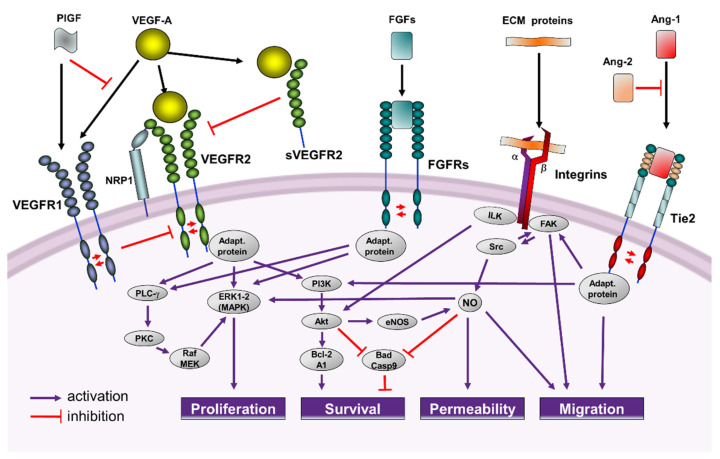
Figure 1
Figure 1
Molecular mechanisms of angiogenesis in activated endothelial cells. Ligand binding induces dimerization and autophosphorylation of tyrosine kinase receptors (VEGFR2, FGFRs, Tie-2). Receptor activation brings on the recruitment of several adaptor proteins that trigger signaling pathways leading to proliferation, migration, improved survival and loss of intercellular adhesions of endothelial cells.
Figure 2
Figure 2
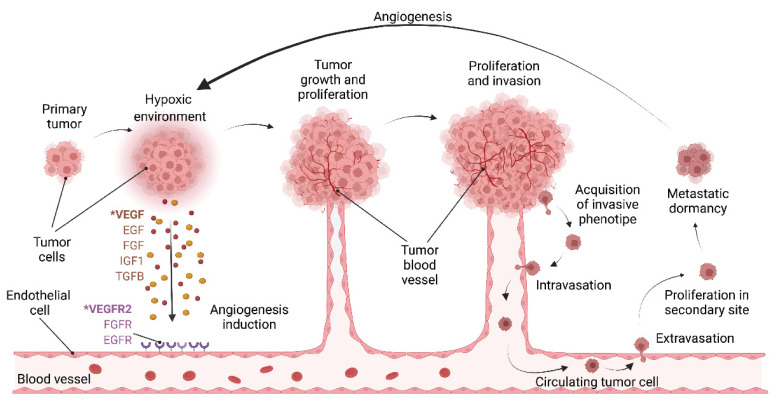
Tumor angiogenesis. Hypoxia within the tumor induces the release of different pro-angiogenic factors, such as VEGFs, EGF, FGF, IGF1 or TGFB1. VEGF-A is the major angiogenic activator and it induces angiogenesis upon binding to VEGFR2, mainly expressed by tumor endothelial cells. The new blood vessels allow exchange of oxygen, nutrients and waste products, leading to tumor growth and proliferation. Moreover, once cancer cells acquire a more invasive phenotype, they can intravasate into blood vessels and reach distant locations leading to metastasis. Disseminated tumor cells that have spread to a secondary site can enter a state of metastatic dormancy or induce angiogenesis and start proliferating.
Figure 3
Figure 3
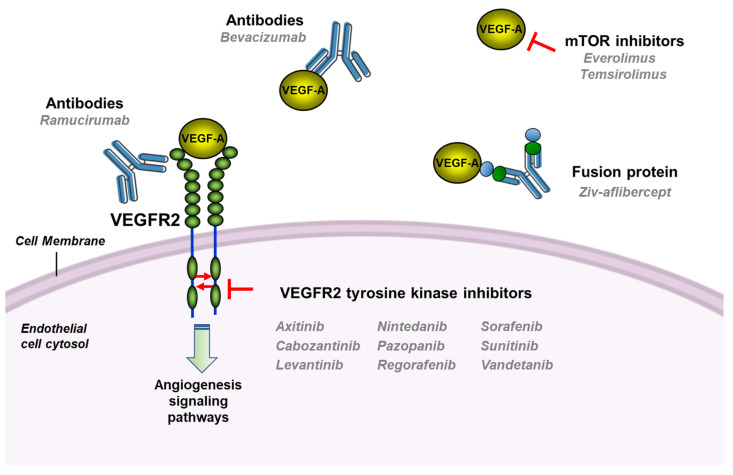
Main molecular targets for the antiangiogenic drugs approved in oncology.
Figure 4
Figure 4
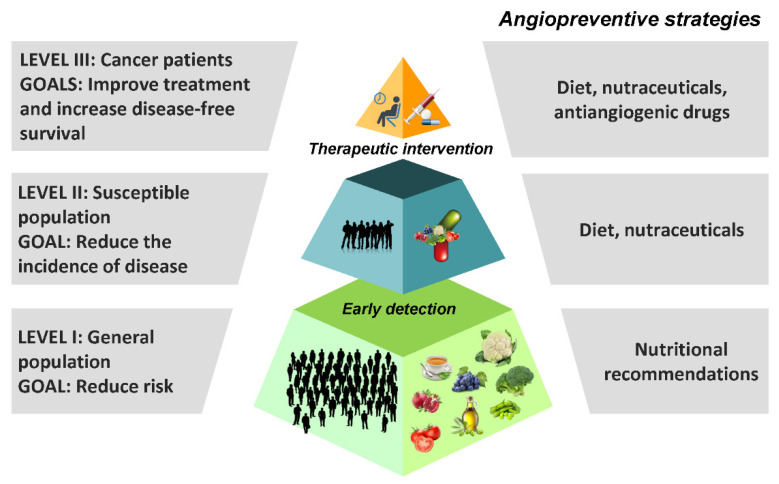
Different angiopreventive strategies can be implemented, depending on the targeted population.
Figure 5
Figure 5
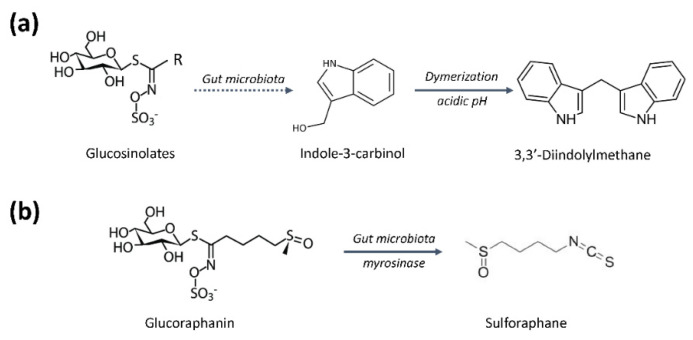
Role of gut microbiota in the production of active phytochemicals from cruciferous vegetables. (a) Indole-3-carbinol and 3,3′-diindolylmethane are generated from inert glucosinolates after digestion. (b) Glucoraphanin, a glucosinolate found almost exclusively in broccoli is converted into the chemopreventive compound sulforaphane through enzymatic catalysis by plant myrosinase or β-thioglucosidases in the gut microflora.
Figure 6
Figure 6
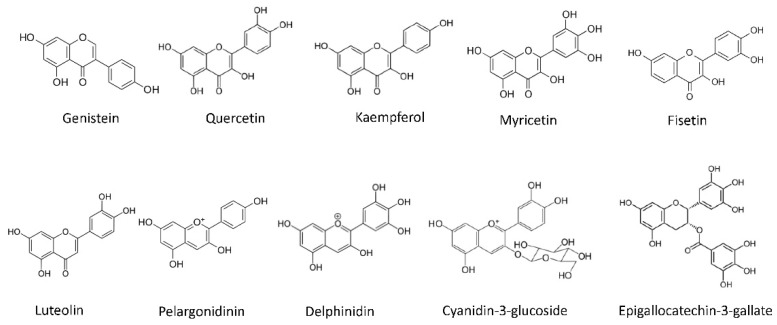
Chemical structures of some flavonoids found in vegetable and fruits, including isoflavones (genistein), flavonols (quercetin, kaempferol, myricetin and fisetin), flavones (luteolin), anthocyanidins (pelargonidin, delphinidin and cyanidin-3-glucoside) and flavan-3-ols (epigallocatechin-3 gallate).
Figure 7
Figure 7
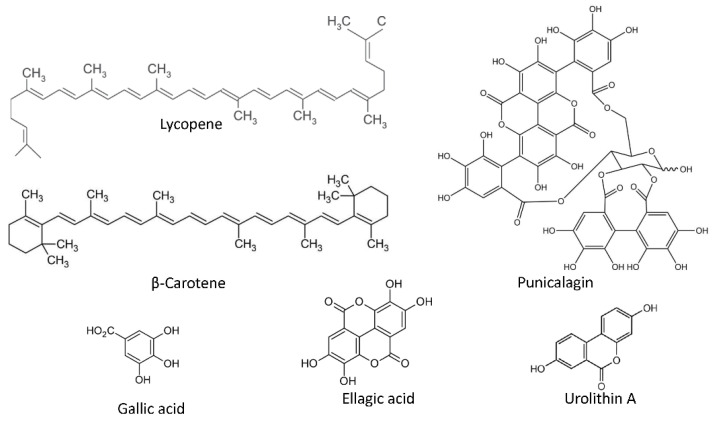
Chemical structures of some antiangiogenic phytochemicals found in fruits. They include carotenoids (lycopene and β-carotene), rich in tomato, punicalagin, the major fruit ellagitannin, abundant in pomegranate and other compounds derived from the hydrolysis of gallitannins and ellagitannins (gallic acid, ellagic acid and urolithin A).
Figure 8
Figure 8
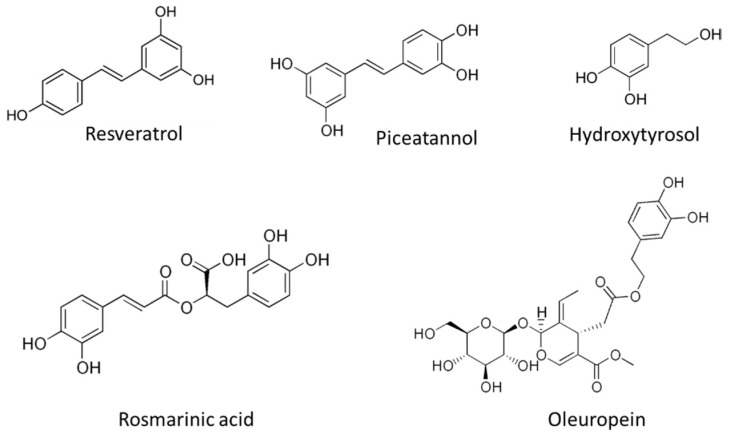
Chemical structures of several polyphenolic compounds found in vegetables, fruits and beverages.
Figure 9
Figure 9
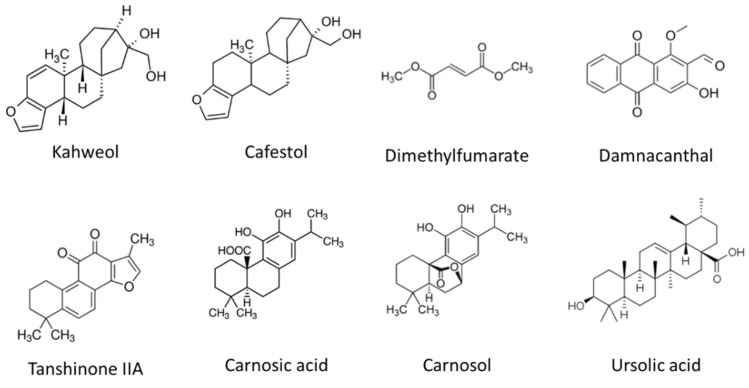
Chemical structures of some phytochemicals found in coffee (kahweol and cafestol), noni (damnacanthal), berries (ursolic acid), Danshen (tanshinone IIA), fumitori (dimethylfumarate) and rosemary (carnosic acid and carnosol).

References

    1. Sung H., Ferlay J., Siegel R.L., Laversanne M., Soerjomataram I., Jemal A., Bray F. Global Cancer Statistics 2020: GLOBOCAN Estimates of Incidence and Mortality Worldwide for 36 Cancers in 185 Countries. CA Cancer J. Clin. 2021;71:209–249. doi: 10.3322/caac.21660. - DOI - PubMed
    1. Heidegger I., Tsaur I., Borgmann H., Surcel C., Kretschmer A., Mathieu R., De Visschere P., Valerio M., Van den Bergh R.C.N., Ost P., et al. Hereditary Prostate Cancer-Primetime for Genetic Testing? Cancer Treat. Rev. 2019;81:101927. doi: 10.1016/j.ctrv.2019.101927. - DOI - PubMed
    1. Leslie S.W., Soon-Sutton T.L., Sajjad H., Siref L.E. Prostate Cancer. StatPearls; Treasure Island, FL, USA: 2022. [(accessed on 22 November 2021)]. Updated 17 September 2021. Available online: https://www.ncbi.nlm.nih.gov/books/NBK470550/

    1. Sloan F.A., Yashkin A.P., Akushevich I., Inman B.A. The Cost to Medicare of Bladder Cancer Care. Eur. Urol. Oncol. 2020;3:515–522. doi: 10.1016/j.euo.2019.01.015. - DOI - PubMed
    1. Hsieh J.J., Purdue M.P., Signoretti S., Swanton C., Albiges L., Schmidinger M., Heng D.Y., Larkin J., Ficarra V. Renal Cell Carcinoma. Nat. Rev. Dis. Prim. 2017;3:17009. doi: 10.1038/nrdp.2017.9. - DOI - PMC - PubMed