


Population Pharmacokinetics of Amikacin in Patients on Veno-Arterial Extracorporeal Membrane Oxygenation
- PMID: 35214022
- PMCID: PMC8879580
- DOI: 10.3390/pharmaceutics14020289
Population Pharmacokinetics of Amikacin in Patients on Veno-Arterial Extracorporeal Membrane Oxygenation
Abstract
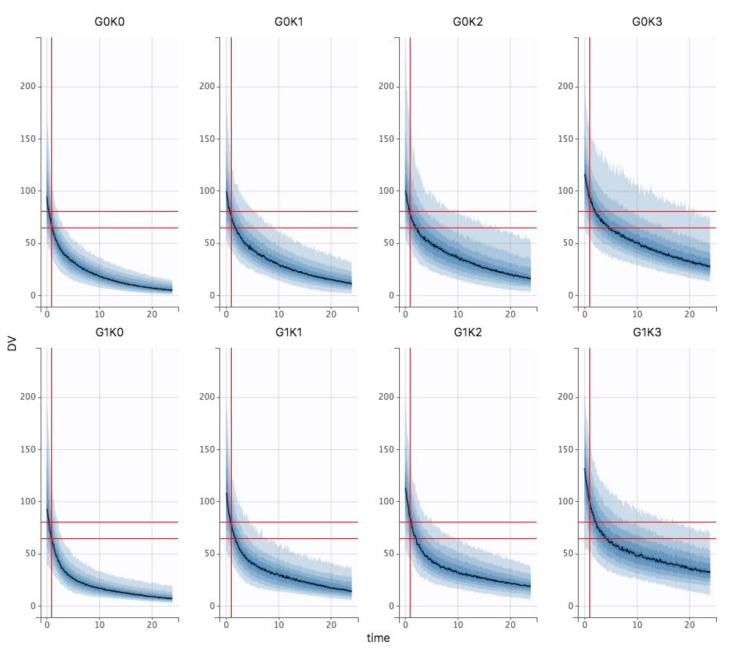
Veno-arterial extracorporeal membrane oxygenation (V-A ECMO) support leads to complex pharmacokinetic alterations, whereas adequate drug dosing is paramount for efficacy and absence of toxicity in critically ill patients. Amikacin is a major antibiotic used in nosocomial sepsis, especially for these patients. We aimed to describe amikacin pharmacokinetics on V-A ECMO support and to determine relevant variables to improve its dosing. All critically ill patients requiring empirical antimicrobial therapy, including amikacin for nosocomial sepsis supported or not by V-A ECMO, were included in a prospective population pharmacokinetic study. This population pharmacokinetic analysis was built with a dedicated software, and Monte Carlo simulations were performed to identify doses achieving therapeutic plasma concentrations. Thirty-nine patients were included (control n = 15, V-A ECMO n = 24); 215 plasma assays were performed and used for the modeling process. Patients received 29 (24-33) and 32 (30-35) mg/kg of amikacin in control and ECMO groups, respectively. Data were best described by a two-compartment model with first-order elimination. Inter-individual variabilities were observed on clearance, central compartment volume (V1), and peripherical compartment volume (V2). Three significant covariates explained these variabilities: Kidney Disease Improving Global Outcomes (KDIGO) stage on amikacin clearance, total body weight on V1, and ECMO support on V2. Our simulations showed that the adequate dosage of amikacin was 40 mg/kg in KDIGO stage 0 patients, while 25 mg/kg in KDIGO stage 3 patients was relevant. V-A ECMO support had only a secondary impact on amikacin pharmacokinetics, as compared to acute kidney injury.
Keywords: Bayesian modelization; amikacin; extracorporeal membrane oxygenation; pharmacokinetic/pharmacodynamic modeling; population pharmacokinetics; sepsis; therapeutic drug monitoring.
Conflict of interest statement
N.M. serves as a consultant for Amomed. The other authors have not disclosed any potential conflict of interest.
Figures



References
-
- de Roux Q., Renaudier M., Bougouin W., Boccara J., Fihman V., Lepeule R., Cherait C., Fiore A., Hemery F., Decousser J.-W., et al. Diagnostic Yield of Routine Daily Blood Culture in Patients on Veno-Arterial Extracorporeal Membrane Oxygenation. Crit. Care Lond. Engl. 2021;25:241. doi: 10.1186/s13054-021-03658-7. - DOI - PMC - PubMed
-
- Schmidt M., Bréchot N., Hariri S., Guiguet M., Luyt C.E., Makri R., Leprince P., Trouillet J.-L., Pavie A., Chastre J., et al. Nosocomial Infections in Adult Cardiogenic Shock Patients Supported by Venoarterial Extracorporeal Membrane Oxygenation. Clin. Infect. Dis. Off. Publ. Infect. Dis. Soc. Am. 2012;55:1633–1641. doi: 10.1093/cid/cis783. - DOI - PMC - PubMed
-
- Biffi S., Di Bella S., Scaravilli V., Peri A.M., Grasselli G., Alagna L., Pesenti A., Gori A. Infections during Extracorporeal Membrane Oxygenation: Epidemiology, Risk Factors, Pathogenesis and Prevention. Int. J. Antimicrob. Agents. 2017;50:9–16. doi: 10.1016/j.ijantimicag.2017.02.025. - DOI - PubMed
LinkOut - more resources
Full Text Sources
