


Prediction of Preterm Delivery from Unbalanced EHG Database
- PMID: 35214412
- PMCID: PMC8878555
- DOI: 10.3390/s22041507
Prediction of Preterm Delivery from Unbalanced EHG Database
Abstract
Objective: The early prediction of preterm labor can significantly minimize premature delivery complications for both the mother and infant. The aim of this research is to propose an automatic algorithm for the prediction of preterm labor using a single electrohysterogram (EHG) signal.
Method: The proposed method firstly employs empirical mode decomposition (EMD) to split the EHG signal into two intrinsic mode functions (IMFs), then extracts sample entropy (SampEn), the root mean square (RMS), and the mean Teager-Kaiser energy (MTKE) from each IMF to form the feature vector. Finally, the extracted features are fed to a k-nearest neighbors (kNN), support vector machine (SVM), and decision tree (DT) classifiers to predict whether the recorded EHG signal refers to the preterm case.
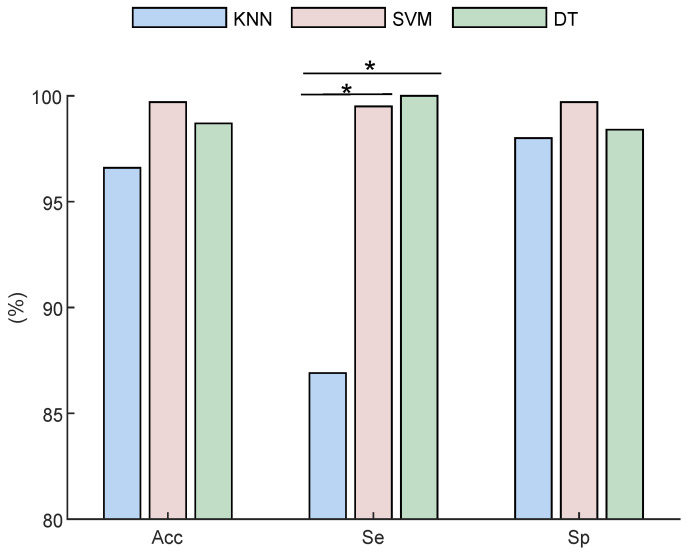
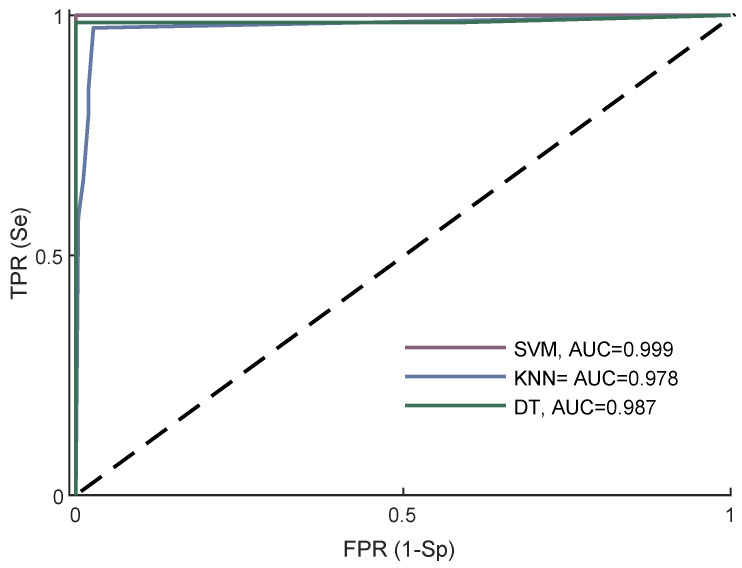
Main results: The studied database consists of 262 term and 38 preterm delivery pregnancies, each with three EHG channels, recorded for 30 min. The SVM with a polynomial kernel achieved the best result, with an average sensitivity of 99.5%, a specificity of 99.7%, and an accuracy of 99.7%. This was followed by DT, with a mean sensitivity of 100%, a specificity of 98.4%, and an accuracy of 98.7%.
Significance: The main superiority of the proposed method over the state-of-the-art algorithms that studied the same database is the use of only a single EHG channel without using either synthetic data generation or feature ranking algorithms.
Keywords: electrohysterogram; empirical mode decomposition; prediction; preterm labor; support vector machine.
Conflict of interest statement
The authors declare no conflict of interest.
Figures

Similar articles
-
Prediction of Preterm Labor from the Electrohysterogram Signals Based on Different Gestational Weeks.Sensors (Basel). 2023 Jun 27;23(13):5965. doi: 10.3390/s23135965. Sensors (Basel). 2023. PMID: 37447815 Free PMC article.
-
A New Efficient Algorithm for Prediction of Preterm Labor.Annu Int Conf IEEE Eng Med Biol Soc. 2019 Jul;2019:4669-4672. doi: 10.1109/EMBC.2019.8857837. Annu Int Conf IEEE Eng Med Biol Soc. 2019. PMID: 31946904
-
Automated detection of premature delivery using empirical mode and wavelet packet decomposition techniques with uterine electromyogram signals.Comput Biol Med. 2017 Jun 1;85:33-42. doi: 10.1016/j.compbiomed.2017.04.013. Epub 2017 Apr 18. Comput Biol Med. 2017. PMID: 28433870
-
Accuracy of frequency-related parameters of the electrohysterogram for predicting preterm delivery: a review of the literature.Obstet Gynecol Surv. 2009 Aug;64(8):529-41. doi: 10.1097/OGX.0b013e3181a8c6b1. Obstet Gynecol Surv. 2009. PMID: 19624864 Review.
-
Electrohysterography in the diagnosis of preterm birth: a review.Physiol Meas. 2018 Feb 26;39(2):02TR01. doi: 10.1088/1361-6579/aaad56. Physiol Meas. 2018. PMID: 29406317 Review.
Cited by
-
Predicting risk of preterm birth in singleton pregnancies using machine learning algorithms.Front Big Data. 2024 Feb 29;7:1291196. doi: 10.3389/fdata.2024.1291196. eCollection 2024. Front Big Data. 2024. PMID: 38495848 Free PMC article.
-
Prediction of Preterm Labor from the Electrohysterogram Signals Based on Different Gestational Weeks.Sensors (Basel). 2023 Jun 27;23(13):5965. doi: 10.3390/s23135965. Sensors (Basel). 2023. PMID: 37447815 Free PMC article.
-
Preterm birth prediction from electrohysterogram using multivariate empirical mode decomposition.Med Biol Eng Comput. 2025 Jun;63(6):1867-1880. doi: 10.1007/s11517-025-03293-2. Epub 2025 Feb 1. Med Biol Eng Comput. 2025. PMID: 39893327
References
-
- Iams J.D., Goldenberg R.L., Mercer B.M., Moawad A.H., Meis P.J., Das A.F., Caritis S.N., Miodovnik M., Menard M.K., Thurnau G.R., et al. The preterm prediction study: Can low-risk women destined for spontaneous preterm birth be identified? Am. J. Obstet. Gynecol. 2001;184:652–655. doi: 10.1067/mob.2001.111248. - DOI - PubMed
-
- [(accessed on 15 September 2019)]. Available online: www.who.int.
-
- Nieto-del-Amor F., Beskhani R., Ye-Lin Y., Garcia-Casado J., Diaz-Martinez A., Monfort-Ortiz R., Diago-Almela V.J., Hao D., Prats-Boluda G. Assessment of Dispersion and Bubble Entropy Measures for Enhancing Preterm Birth Prediction Based on Electrohysterographic Signals. Sensors. 2021;21:6071. doi: 10.3390/s21186071. - DOI - PMC - PubMed
MeSH terms
Grants and funding
LinkOut - more resources
Full Text Sources
